
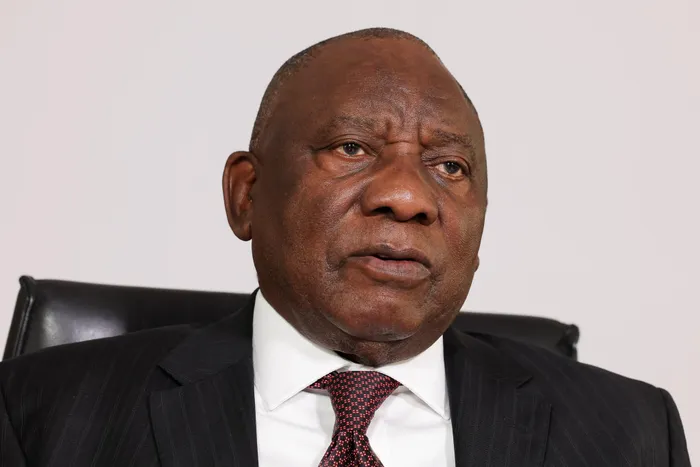
President Cyril Ramaphosa is under preasure to trim his executive
Image: Jairus Mmutle / GCIS
President Cyril Ramaphosa finds himself in a delicate balancing act, publicly defending his decision to appoint 43 deputy ministers, while privately facing mounting pressure from within the ANC and various structures of the Government of National Unity (GNU) to reduce the size of his executive.
During a recent question-and-answer session in the National Assembly, Ramaphosa defended the retention of deputy ministers, arguing that they play a "critical role" in assisting ministers and contributing to governance.
"Deputy ministers continue to play a critical role in our government. They are members of the executive, participate in Cabinet committee discussions. I’d like to believe that we have a very wonderful system that functions so well," Ramaphosa said.
He described these positions as a "training ground for future ministerial positions," highlighting the value he sees in their contributions.
However, this public stance belies a growing discontent behind closed doors.
Sources within the ANC National Executive Committee (NEC), who spoke on condition of anonymity, indicate that the issue of the "bloated" executive has become a significant point of contention.
"There is a strong feeling that the current size of the executive is unsustainable, both financially and in terms of efficiency," an insider revealed.
"While the President has his reasons for the appointments, particularly in the context of forming the GNU, the party leadership is clear that cuts need to be made and he is now trying to forge a plan to do so."
The financial implications of the current executive are a major driver of this pressure. With 43 deputy ministers each earning an annual salary of R2.2 million, their collective salaries alone amount to over R94 million per year.
This figure does not include the additional perks, such as two official residences in Cape Town and Pretoria, two official vehicles, and the allowance for support staff like a chief of staff, media liaison officer, and community outreach officers.
"The cost to the fiscus is simply too high, especially when we are facing such economic challenges," another ANC insider commented. "It’s hard to justify to the public."
ActionSA, a vocal critic of the executive's size, has consistently pushed for the abolishment of deputy ministerial positions.
The party has even submitted a Constitutional Amendment Bill directly to Ramaphosa, seeking to overhaul the executive's structure.
ActionSA parliamentary leader Athol Trollip has labelled the role of deputy ministers as "redundant," arguing that they "often sit in committees without contributing meaningfully, hold no executive authority and mostly lack the experience or expertise relevant to the portfolios they are assigned".
Ramaphosa, while acknowledging his preference for a smaller executive, has attributed the current size to the complexities of forming a GNU after the May 2024 elections.
"I would want a much smaller executive. I would also like fewer deputy ministers. But right now, we do have deputy ministers who are really putting their shoulder to the wheel, who are going even beyond what I would call the call of duty," he said.
He said that the size was a direct "result of the outcome of the elections" and the necessity to accommodate various parties in the GNU.
Political commentator Dr John Molepo said the issue of cabinet size was likely to remain a contentious point.
“The coming months will reveal whether the president can navigate these competing demands and demonstrate a tangible commitment to a more streamlined and cost-effective government, while maintaining the stability and inclusivity of the nascent GNU” he said.