

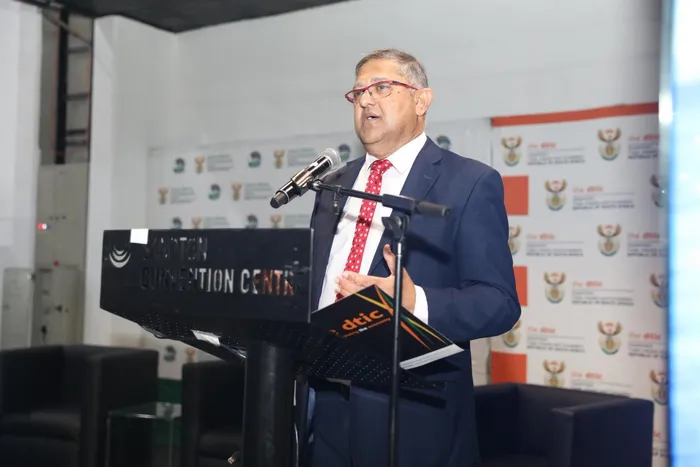
The Deputy Minister of Forestry, Fisheries and the Environment, Mr Narend Singh at the opening of day 2nd African Biotrade Festival
Image: Michael Mokoena/ DFFE
The Deputy Minister of Forestry, Fisheries and the Environment, Narend Singh on Thursday opened the second African Biotrade Festival (ABF) at the Sandton Convention Centre in Johannesburg, Gauteng.
The festival aimed to create a platform to discuss and address biotrade challenges and opportunities, with an emphasis on market access, building business support networks, and creating linkages within the wider biotrade ecosystem, it also served to provide an opportunity to launch BioPANZA.
Singh said the event is a convergence of heritage and hope, with the aim of celebrating Africa’s natural abundance and the ingenuity of its people. "It is a celebration not only of our continent’s extraordinary biodiversity, but of our collective commitment to harnessing it responsibly, equitably, and sustainably."
"BioPANZA is a commitment to people. We aim to empower small-scale producers, traditional knowledge holders, women-led enterprises, and youth innovators."
Singh encouraged South Africans to care for and utilise indigenous plants, suggesting that they have special attributes which were beneficial to the previous generations.
"Let us begin by acknowledging the quiet power of our indigenous plants. The baobab, often called the “Tree of Life,” which offers fruit rich in vitamin C, leaves that nourish, and bark that heals. The marula tree, sacred in many traditions, that yields oil that has become a global beauty staple. Honeybush and rooibos, once brewed in village kitchens, now grace shelves in Paris, Tokyo, and New York.
These plants are not just commodities. They are cultural symbols. They are ecological anchors. They are the legacy of generations who understood the land, not as something to be exploited, but as something to be respected."
Singh paid homage to various role players engaging closes with the biodiversity sector saying they have helped shape and guide society to what it is now.
"Today, we pay tribute to the traditional knowledge holders—our elders, our healers, our farmers—whose wisdom has guided sustainable use of biodiversity for centuries. Their knowledge is not anecdotal; it is empirical. It is tested, refined, and passed down through oral histories, rituals, and lived experience."
The department announced a partnership with the Department of Trade, Industry and Competition, and the Department of Science, Technology and Innovation to streamline regulations, support SMMEs, and foster public-private partnerships that drive growth without compromising sustainability.
Singh also called for the appreciation, safe keeping of the planet and the development of innovative ideas to advance climate-resilient cultivation methods, improving extraction technologies, or creating blockchain-enabled traceability systems and also made a clarion call to universities, research institutions and tech hubs to stop using communities as subjects but to collaborate with them as equal partners.
The Star