

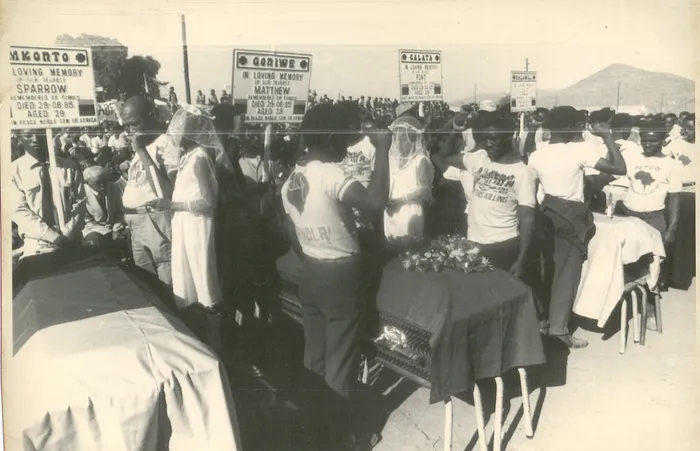
The funerals of the Cradock Four, Mathew Goniwe, Fort Calata, Sparrow Mkonto and Sicelo Mhlauli. More than 16,000 people in 160 buses, and thousands more in private cars and bakkies, descended on Cradock for the funerals of the community leaders on July 20, 1985.
Image: Independent Media Archives
The murders of the Cradock Four were deliberate and premeditated, carried out on the direct orders of apartheid’s top security bosses, who killed anyone they did not like.
This was the view of Deputy Defence Minister and former chair of the Transkei Defence Force, Bantu Holomisa, who testified at the reopened Cradock Four inquest in Gqeberha on Tuesday.
The Cradock Four — Matthew Goniwe, Fort Calata, Sicelo Mhlauli and Sparrow Mkonto — were anti-apartheid activists from the Eastern Cape town of Cradock, now known as Nxuba.
They were abducted by security police in June 1985 after leaving a political meeting in Gqeberha.
Days later, their bodies were found.
It emerged in the Gqeberha High Court on Tuesday that while serving as a senior officer in the Transkei Defence Force at the time, Holomisa came across a secret military communication known as “the signal”.
The document, circulated among apartheid security officials, instructed that three Eastern Cape activists — Goniwe, Calata and Mbulelo Goniwe — be “permanently removed from society”.
He decided to leak the document to the media in 1992, believing that the public deserved to know how these murders had been approved at the highest level.
According to Holomisa, the phrase “permanent removal” was coded language for assassination.
“The evidence led at the Truth and Reconciliation Commission (TRC) proved beyond reasonable doubt that this violence was sponsored by the apartheid state,” he testified.
Holomisa also criticised the late former president FW de Klerk for doing nothing once the evidence came to light.
“If you were not aware that your security forces were doing this dirty work, you should have prosecuted them.
"Why issue statements denying involvement when there was proof?” he said.
His testimony followed that of Mbulelo, nephew of Goniwe, who told the court on Monday that the family lived under constant police surveillance in the years leading up to the killings.
He described how security police raided their Cradock home, allegedly planted listening devices in houses and community halls, and sent informants to monitor meetings.
Mbulelo explained that his uncle led the Cradock Residents’ Association (Cradora), a civic movement formed in 1983 to fight rent hikes and poor services in the township.
With encouragement from exiled ANC president Oliver Tambo, the group took on a broader political role.
Goniwe served as president, Calata as treasurer and Mbulelo as organiser.
As Cradora grew in influence, so did state harassment.
Mbulelo recalled a chilling incident when a police officer stopped Goniwe on the N10 near Cradock, dragged him from his car and pressed a gun to his head before suddenly releasing him.
He said the disappearance of the Pebco Three — Sipho Hashe, Champion Galela and Qaqawuli Godolozi — sent a clear warning.
The three leaders of the Port Elizabeth Black Civic Organisation, who had close ties with Cradora, were abducted by security police in 1985 and later murdered.
Not long after that, the Cradock Four were abducted and killed.
Their deaths sparked national outrage, and on the day of their funeral, then-president PW Botha declared a national state of emergency.
At the first inquest in 1989, the court ruled that the men had been killed by “unknown persons”.
But in 1992, the New Nation newspaper published the secret signal leaked by Holomisa, confirming that the order to eliminate the men had come from within the state.
In response, De Klerk ordered a second inquest, which found that security forces were responsible and that there was a prima facie case against them.
Despite this, no one was charged.
In 1999, eight former police officers applied for amnesty before the TRC for their role in the abduction and murder of the four activists.
They included Hermanus du Plessis, who drafted the death order; Eric Taylor, who confessed to the killings; Harold Snyman, Nicolaas Janse van Rensburg, Gerhardus Lotz, Sakkie van Zyl, Jaap van Jaarsveld and Eugene de Kock.
Only De Kock and Van Jaarsveld were granted amnesty.
The TRC found there was sufficient evidence for prosecution, but none followed.
All the accused have since died.
The inquest continues.
IOL News