

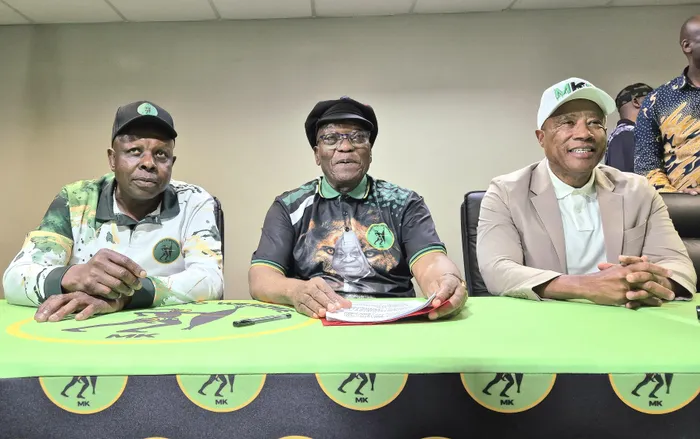
From left: MKP first deputy president Dr John Hlophe, President Jacob Zuma and newly appointed party second deputy president Tony Yengeni, who was unveiled as a new party member at a media briefing on Thursday.
Image: Sibonelo Ngcobo/Independent Media
According to former President Jacob Zuma, the Government of National Unity (GNU) in South Africa is "illegitimate" and incapable of bringing about significant change.
Zuma claimed during a media briefing in Durban on Thursday that the GNU was "a fragile, elitist pact of political rejects" that was established out of "desperation to maintain the status quo" rather than out of democratic will.
He said the coalition was unable to govern with legitimacy and was “an arrangement born not of democratic will, but of desperation to maintain the status quo and to prevent true transformation.”
Zuma described the current global environment as one of uncertainty, with economic turbulence and social collapse exposing the failures of neoliberal capitalism. He said Africa was at the centre of a global struggle over resources and political power, asking, “Who benefits from Africa’s wealth?”
Highlighting domestic challenges, Zuma praised Lieutenant General Nhlanhla Mkhwanazi and the Political Killings Task Team for revealing how “the state apparatus is manipulated to protect the interests of the few whilst persecuting the many.”
“His courage has exposed how the state apparatus is manipulated to protect the interests of the few whilst persecuting the many,” Zuma said.
He said the MK Party would demand “full accountability from those implicated” and would use “every parliamentary and legal instrument at our disposal to ensure that the truth triumphs over corruption and cover-ups.”
Zuma expressed particular concern about the use of police resources to protect private corporate interests, citing the situation at Richards Bay Minerals.
He compared it to the 2012 Marikana massacre, noting that President Cyril Ramaphosa had called for “concomitant action against the Marikana miners, which led to the massacre of 34 innocent workers.”
“Once again, the lives of Black South Africans are treated as expendable in defence of private capital,” Zuma said.
He reiterated support for the Parliamentary Ad-hoc Committee investigating these allegations but said the MK Party had “no hope that the GNU will vote positively for the implementation of the report which aims to hold Mr Ramaphosa and his cabinet accountable.”
Zuma also called on the Constitutional Court to unseal the CR17 bank statements and urged the Ad-Hoc Committee to compel the Independent Police Investigative Directorate (IPID) to declassify the Phala-Phala report.
He criticised the continued reliance on the Roman-Dutch legal system, which he said contradicts indigenous African values.
Zuma renewed calls for lifestyle audits of judiciary members, arguing that General Mkhwanazi’s allegations “confirm what we MK Party has long been exposing, that judicial officers are not immune to corruption or political manipulation.”
Zuma described the GNU as “nothing but a coalition of the compromised, a conglomerate of opportunists who have been rejected by the people yet cling to power through elite pacts and backroom deals.”
On international affairs, Zuma said his recent visit to Ghana focused on “geo-economics and the future of African sovereignty,” with discussions centred on de-dollarisation, the BRICS currency initiative, and Africa’s common currency.
He rejected “the continued domination of Africa’s financial systems by Western currencies and institutions.”
He also noted his recent return from Russia and said he would soon brief party structures and the nation on developments. Zuma announced that next week he would lead an MK Party delegation to Burkina Faso.
Given his international workload, Zuma said he had appointed a second deputy President (Tony Yengeni) to oversee internal and broader political organisational issues, while Dr John Hlophe would continue as deputy president, focusing on parliamentary work.
Zuma remembered the children who died in October 2024 in Naledi, Soweto, after consuming poisoned snacks from spaza shops.
Naming the victims, Karabo Rampou, Njabulo Msimanga, Zinhle Ida Maama, Monica Sebetwana, and Isago Mabote, he said the MK Party would file a class action lawsuit against the GNU to hold them accountable and seek justice for the families affected.
“In their honour and in pursuit of justice, as MK Party we will file a class action against the so-called GNU to hold them accountable and get justice for the families that lost their children,” he said.
Zuma called on South Africans to continue the mission of total emancipation. He said the MK Party represented “that historic continuity, that revolutionary flame that refuses to be extinguished.”
“Though our enemies conspire, infiltrate and attempt to derail our progress, we, like the phoenix, shall rise from the ashes of betrayal and stagnation. We shall rise to reclaim our land. We shall rise to restore dignity to our people. We shall rise to govern this country in the interest of the majority, not the privileged few,'' he said.
IOL Politics