

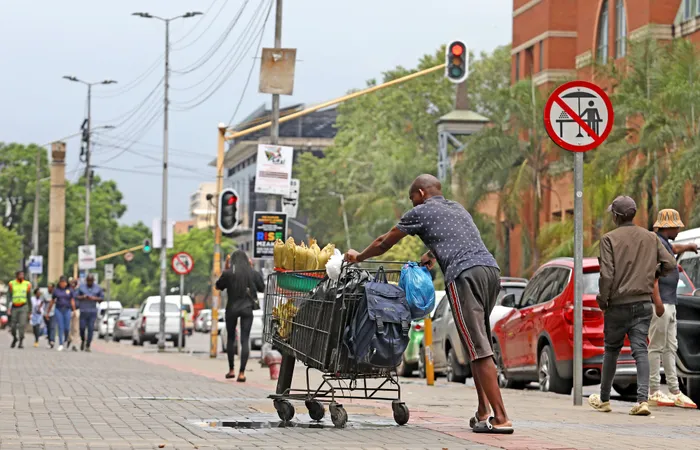
Stats SA reports that the South African unemployment dropped from 33,9% in the second quarter to 31,9% in the third quarter of 2025
Image: Oupa Mokoena / Independent Newspapers
The latest quarterly labour force survey report released by Statistics South Africa on Tuesday indicates a positive trend in employment, with 248,000 additional jobs created in the third quarter of 2025.
This growth led to a decrease in the unemployment rate from 33.2% in the second quarter to 31.9% in the third quarter, a transition that brings a glimmer of hope to a nation grappling with one of the highest unemployment rates globally.
Professor Waldo Krugell, a Professor of Economics at North West University, remarked on the significance of these numbers, stating, "The increase in the number of people in the third quarter is a positive development, alongside that is the decrease in the unemployment rate. It is difficult to say how much of this is driven by a growing economy, we do not have a third quarter Gross Domestic Product number yet, that will give us an indication on whether this was related to an upswing in the economy that also led to creating employment.
We need to create many more jobs and the key to this is private sector investment, get business confidence up. We need faster progress with the reforms that are underway."
Lisette Ijsel de Shepper, an economist at the Bureau for Economic Research, also weighed in, noting that while the increase of 248,000 jobs in the third quarter exceeds the meagre gain of 19,000 in the previous quarter, challenges remain.
Economist Dawie Roodt provided a further perspective on the statistics, noting that despite the positive figures, the labour market is far from robust. He indicated, "The reality is that unemployment came down a little bit which is good news, it also corresponds with recent data suggesting that the South African economic growth is a little bit better than we thought previously, but we need to put much better measures in place to achieve a much better economic growth in order to make a significant dent to unemployment. This is good as far as unemployment is concerned, but we are definitely not out of the woods yet.
Lisette Ijsel de Shepper, an economist at the Bureau for Economic Research, also weighed in, noting that while the increase of 248,000 jobs in the third quarter exceeds the meagre gain of 19,000 in the previous quarter, challenges remain.
"The 248 000 quarterly increase was a welcome improvement from the 19 000 jobs gain we saw in the second quarter, but following the sharp decline in the first quarter, of 294 000, we are still 24 000 jobs down since the beginning of the year. With an increase in the number of the employed, and a steep drop in the number of unemployed, the unemployment rate declined to 31.9% from 33.2% - signalling roughly 8 million that would want to work and are looking for work but cannot find employment."
"To create employment on a sustained basis going forward, we need to see sustained economic growth and improved business confidence. Business confidence remains too weak to sustain higher levels of formal sector job and investment growth. While the informal sector can play an important role in providing job opportunities too, it still needs a steady increase in activity to thrive." remarked de Shepper
De Shepper said there needs to be sustainable structural reforms in order to support economic growth. "Sustained progress on the stuctural reform front - support for operation vulindlela, which is attempting to lift the constraints needed to get growth going."
Meanwhile, Labour expert Michael Bagraim voiced concern over the steadily rising number of discouraged job seekers, suggesting that while any job growth is a positive step, the increase in job seekers outstripping job creation is alarming.
"It is a slight improvement. However, the number of job seekers entering into the future economy is greater than jobs being created. This means that we have more and more people in the unemployment queue. Unfortunately, the country cannot cope with the number of jobseekers, and the system is getting weaker."
Bagraim stressed the need to help small businesses remain stable and contribute significantly to the economy. :"We need to ensure that we enhance the environment for small businesses to create jobs. In essence, it's the small businesses that are creating the jobs of the present. We need to give them encouragement and regulate the system so that they don’t have to compete with big business. Around the world small businesses are the engine room for job creation."
The Star