

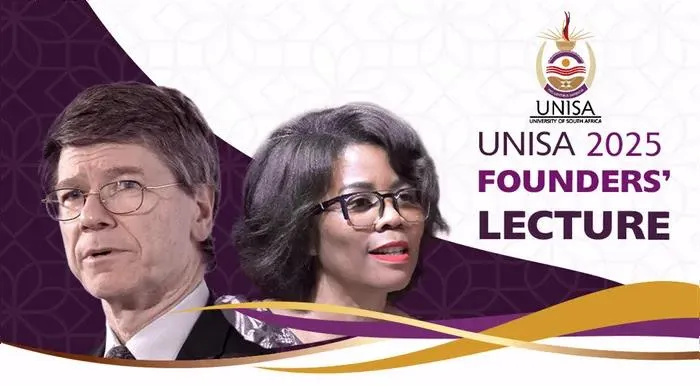
The University of South Africa hosted globally acclaimed economist Professor Jeffrey D. Sachs for its 2025 Founders’ Lecture on 20 November.
Image: Supplied
Renowned economist and public policy expert Professor Jeffrey D Sachs delivered a fiery and uncompromising keynote address at the University of South Africa Founders Lecture 2025, held under the theme “solidarity, social justice and reclaiming futures, the roles of universities in contested geopolitics.” Sachs, a leading figure in sustainable development and global policy, used his platform to issue stark warnings about global political tensions, failing Western dominance and what he described as dangerous geopolitical choices by the United States and Israel.
Sachs is University Professor and Director of the Center for Sustainable Development at Columbia University. He previously directed the Earth Institute for fourteen years and served as Special Advisor to three United Nations Secretaries General. A former Harvard professor for more than two decades and the recipient of forty two honorary doctorates, Sachs is widely regarded as one of the most influential economists of the modern era.
Addressing an audience of academics, diplomats and policy leaders, Sachs launched a direct critique of United States President Donald Trump and Israeli Prime Minister Benjamin Netanyahu, accusing both leaders of contributing to global instability.
“The United States power is fading,” Sachs said. “It takes three minutes to move from the United States President office to the IMF building. This means the United States President can tell the IMF what to do. He can simply say Veto that country now.”
He added that Western institutions were struggling to adapt to a shifting world. “The world is not ending. But Europe and the United States are having a fit. That is why Trump is home today. You cannot build a world today outside of China. That is why BRICS is such a threat to them.”
Sachs also praised South Africa for its leadership on global justice, particularly the country’s decision to take Israel to the International Court of Justice. “It was a great gesture for South Africa to take the Palestine matter to the ICJ. The United Nations just takes too long. Let me commend you South Africa for the fight for the Palestinian people.”
A call for universities to defend justice
Reflecting on the theme of the lecture, Sachs argued that universities now play a central role in defending truth, justice and the future of democratic societies. He said institutions of higher learning must act as intellectual anchors in an age of contested geopolitics and misinformation.
“Universities must insist on social justice, on human rights and on the protection of peace. They must provide the knowledge needed to guide societies away from war, division and fear,” he said.
Long standing critique of Netanyahu
Sachs has been outspoken on the Middle East in recent years, and he did not shy away from repeating his sharp criticism of Netanyahu. Drawing from arguments he has made in earlier public writings, he said the Israeli leader has driven the region toward repeated cycles of violence.
In other internationally publicised speeches Sach said: “For nearly thirty years Israel Prime Minister Benjamin Netanyahu has driven the Middle East into war and destruction,” Sachs said. “The man is a powder keg of violence. Throughout all the wars that he has championed, Netanyahu, who is wanted by the International Criminal Court, has always dreamed of the big one, to defeat and overthrow the Iranian government. His long sought war, just launched, might just get us all killed in a nuclear Armageddon unless Netanyahu is stopped.”
Sachs argued that Netanyahu’s political philosophy is rooted in the teachings of early twentieth century Zionist hardliners. “Netanyahu fixation on war goes back to his extremist mentors Ze ev Jabotinsky, Yitzhak Shamir and Menachem Begin. The older generation believed that Zionists should use whatever violence is needed to achieve their aims of eliminating any Palestinian claim to a homeland.”
He cited the founding charter of the Likud party, which declared that the entire territory between the Mediterranean Sea and the Jordan River should be under exclusive Israeli control. “The chant from the River to the Sea, which is described as anti Jewish, turns out to be the anti Palestinian rallying call of Likud,” Sachs said.
A decades long strategy of regional domination
Sachs described the 1996 “Clean Break” strategy, developed by Netanyahu and a group of American advisers, as a turning point in Middle East politics. The plan argued that Israel should not withdraw from Palestinian territories but should reshape the region through force, relying on the United States to help topple governments hostile to Israeli dominance.
He said the influence of this strategy could be seen in United States military interventions across the region following the 2001 attacks. Sachs cited statements by former NATO Supreme Commander General Wesley Clark, who said the United States intended to “attack and destroy the governments in seven countries in five years.”
Sachs said Netanyahu championed these wars publicly and privately. He recalled Netanyahu testimony to the United States Congress in 2002, when the Israeli leader pressed for the invasion of Iraq, claiming falsely that Iraq was developing nuclear weapons.
According to Sachs, the current escalation between Israel and Iran is the final stage of this decades long project. “We are witnessing the culmination of decades of extremist Zionist manipulation of United States foreign policy,” he said.
A global thinker in a time of crisis
Professor Sachs continues to hold several global leadership roles, including President of the United Nations Sustainable Development Solutions Network and Co Chair of the Council of Engineers for the Energy Transition. His works, including The Ages of Globalization and Ethics in Action for Sustainable Development, remain influential in debates on global governance.
His message at Unisa was clear: humanity is at a crossroads, and institutions of learning must help guide the world away from violence and toward justice, peace and sustainable development.