

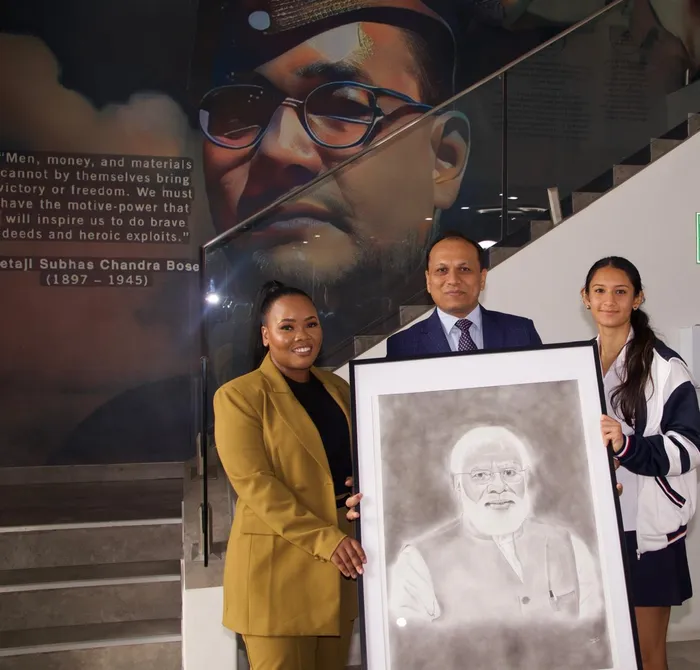
During his visit to Johannesburg for the G20 Leaders' Summit, Indian Prime Minister Narendra Modi was moved to receive a hand-drawn portrait of himself by South African architect Thandeka Shezi.
Image: Supplied
Indian Prime Minister Narendra Modi was moved when a hand‑drawn portrait of him, created by South African architect Thandeka Shezi, was presented during his visit to Johannesburg for the G20 Leaders’ Summit.
The portrait was gifted by Suhani Ahuja, ambassador of the Alfeco Foundation, to India’s Consul General Mahesh Kumar as a gesture of deep friendship and shared values between India and South Africa.Shezi said the portrait was drawn with “profound respect,” inspired by her background in architecture.
“Architecture teaches us to design for people … this portrait was drawn with the hope that it becomes a symbol of unity and the spirit of Ubuntu that South Africa holds dear.” Ahuja added that the gift recognizes not only Modi’s leadership but also the cultural ties and collaborative future being built between the two nations.
Modi expressed his gratitude for the warm welcome and used his platform at the G20 Summit to articulate a bold development vision rooted in empathy and cooperation.
In his opening address at the session on “Inclusive and sustainable economic growth,” he called for “new parameters of development”, ones that balance progress with ecological stewardship, an approach he framed through the Indian philosophy of Integral Humanism.
He unveiled six major proposals for the G20 to consider a Global Traditional Knowledge Repository, a G20–Africa Skills Multiplier Initiative, a G20 Global Healthcare Response Team, a G20 Initiative to Counter the Drug‑Terror Nexus, a G20 Open Satellite Data Partnership, and a Critical Minerals Circularity Initiative.
In his second session on building a “Resilient World,” Modi emphasized the urgency of rethinking disaster resilience. He urged a shift from a “response‑centric” to a “development‑centric” model, arguing that future resilience must integrate nutrition, public health, sustainable agriculture, and disaster preparedness.
To support this, he proposed that satellite data from G20 countries’ space agencies be made available to developing nations through a new partnership, particularly benefiting agriculture, fisheries, and disaster management in the Global South.
Modi also stressed the need for sustainable energy transitions and supply chain security, proposing the Critical Minerals Circularity Initiative, which would promote recycling, urban mining, and second-life battery innovation. He thanked South African President Cyril Ramaphosa for hosting the summit and lauded the South African G20 presidency for advancing issues like migration, food security, and women’s empowerment.