
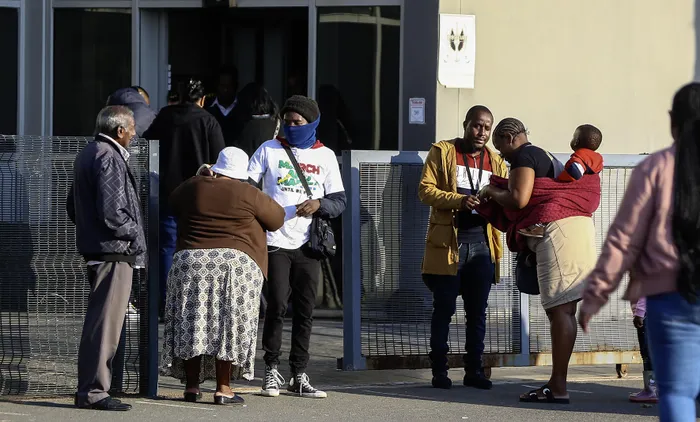
Recently, Operation Dududula was turning away a large number of undocumented foreign nationals from accessing healthcare at health facilities across the nation. Several organizations, including SECTION27, are now taking the illegal activity to court.
Image: Leon Lestrade / Independent Newspapers.
The South Gauteng High Court has received an application from civil society organizations that support fair access to healthcare in public facilities, requesting prompt action to remove the barrier preventing vulnerable patients from receiving necessary medical care.
The application was filed by Médecins Sans Frontières (MSF), Treatment Action Campaign (TAC), and Kopanang Africa Against Xenophobia (KAAX), represented by SECTION27, against a number of state respondents, including the South African Police Service (SAPS), the Gauteng Department of Health (GDoH), and the City of Johannesburg Metropolitan Municipality.
The application, which will be heard on Tuesday, November 25, 2025, asks for an order requiring the state to ensure safe and unhindered access and to remove any unauthorized individuals who impede or interfere with the delivery of healthcare services.
Many clinics in Gauteng have become "hotspots" of xenophobic vigilante activity, where individuals have been barring patients—including South Africans and foreign nationals—from entering if they cannot produce South African identity documents. This has led to many patients being turned away and denied medical care.
''This hindrance affects everyone seeking medical assistance, including pregnant and lactating women, infants, and children - groups that are particularly dependent on continuous medical care,'' says SECTION27.
''In essence, the continued denial of access to healthcare not only threatens the targeted groups without South African identity documents but also the broader public health system, as untreated illnesses and disrupted medical treatments can have serious consequences for entire communities.
''The state has an obligation to uphold the Constitution and to ensure that everyone living in South Africa can exercise their right to access healthcare services, including reproductive healthcare. The Constitution guarantees that no one may be refused emergency medical treatment and that every child has the right to basic healthcare services. Despite numerous requests for assistance and coordination, the authorities have not taken effective measures to ensure access to these facilities.''
SECTION27 says the government's failure to intervene has created exclusion at public health facilities, infringing on the constitutional right to access healthcare.
The organisations are seeking relief to order the state respondents to take the following actions:
First, to take all reasonable measures to ensure safe and unhindered physical access to the healthcare facilities for all persons seeking health services;
Second, to secure the removal of any unauthorised persons hindering access from the healthcare' premises or immediate surroundings;
Third, to station adequate numbers of trained security personnel at all access points;
Fourth, to place public notices at all access points prohibiting unauthorised interference and stating that violators will be removed and reported to the police; and finally, to report all incidents of obstruction to the SAPS, with the expectation that the SAPS will provide all necessary assistance to ensure access to these facilities.
''We reiterate that the ongoing vigilante actions at these clinics violate a range of constitutional rights, and that these rights are not qualified by affiliation to particular groups, nationality, or documentation status.
''It is therefore imperative for state actors not to pass the buck but to act decisively to protect the right to access healthcare, which can make the difference between life and death.,'' added SECTION27.