
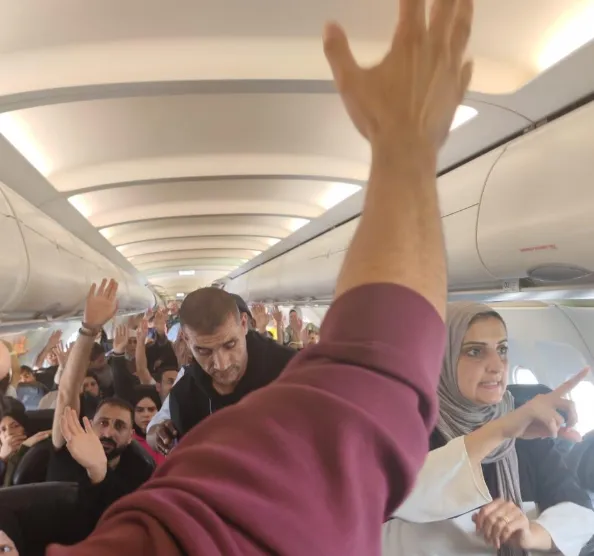
Home Affairs Minister Dr Leon Schreiber announces the withdrawal of South Africa’s 90-day visa waiver for Palestinian passport holders following intelligence findings of systematic exploitation.
Image: Supplied
South Africa has withdrawn its ninety day visa exemption for Palestinian passport holders following the arrival of two charter flights that brought one hundred fifty three Palestinians into the country without what authorities described as proper travel documentation. The decision marks a significant shift in Pretoria’s policy toward Palestinian travelers, raising questions about future humanitarian admissions and South Africa’s broader stance on the Gaza conflict.
The Department of Home Affairs announced that the passengers on the recent flights did not possess valid documents, exit stamps, or confirmed travel plans. According to officials, many of those who arrived had incomplete paperwork or were unable to provide clear information about their intended stay. The department said it was compelled to respond to what it viewed as a concerning pattern that could pose risks to national security and immigration control.
The arrivals were transported on two privately arranged chartered flights that landed in Johannesburg earlier this month. Officials said the flights were organized outside of the usual immigration and security procedures, prompting urgent internal reviews and repeated consultations between Home Affairs, intelligence agencies, and the aviation authorities.
While South Africa has long taken a supportive position toward the Palestinian cause, the new visa requirement reflects a growing anxiety among government officials about the possibility of unregulated or coerced population movements linked to the war in Gaza.
Some analysts warn that the charter flights could be part of a larger effort to relocate Palestinians in ways that may circumvent international oversight. Aimée Noël Mbiyozo, a senior research consultant on migration at the Institute for Security Studies, told AFP that the decision to withdraw the exemption was disappointing but understandable given the circumstances.
“South Africa definitely did not start the problem, but revoking the ninety day exemption shows it is taking a security first position,” she said. Mbiyozo noted that Pretoria had been placed in a difficult position by the unexpected arrivals, which appeared to lack the basic transparency required under international migration rules.
She warned that the broader context of the arrivals must not be ignored. “From a humanitarian law perspective, there is concern that if Israel is forcibly sending people to destinations unknown to them, it could amount to ethnic cleansing,” she said. Mbiyozo stressed that without clear evidence of voluntary movement, the situation demands close scrutiny by the international community.
South Africa has been one of the most outspoken critics of Israel’s military actions in Gaza and has been a strong advocate for Palestinian rights at the International Court of Justice. Pretoria has argued consistently that the Palestinian population is facing collective punishment, and it has urged other countries to hold Israel accountable under international law.
Against that backdrop, the arrival of the charter flights placed the government in what some officials privately describe as an impossible position. Allowing undocumented arrivals to enter freely could encourage more irregular movements and put South Africa at odds with international aviation protocols. Blocking entry, however, would be politically and morally difficult for a government that has long aligned itself with the Palestinian struggle.
Mbiyozo said these conflicting pressures created a situation with no easy solutions. “South Africa was thrust into a position where it had to balance these issues,” she said. She argued that the government needed to ensure that the country did not become an unintended destination for forced displacement. “We are not going to see Gaza ethnically cleansed one charter flight at a time to South Africa,” she said, adding that many observers around the world would be watching how the government navigates the challenge.
She described the situation as a test of both national and international law, and a measure of how countries respond collectively when humanitarian concerns intersect with security and migration controls. “It is a test of law and collective response,”
South African officials say they are continuing to monitor the situation closely and remain committed to working with international partners to ensure that vulnerable people receive protection without compromising national security. It is still not known who in fact chartered the jet. Insiders reveal that government believes the Israelis could've sent a "trojan horse" to South Africa. The details on the funding of the trip are still sketchy.
This is a developing story.