

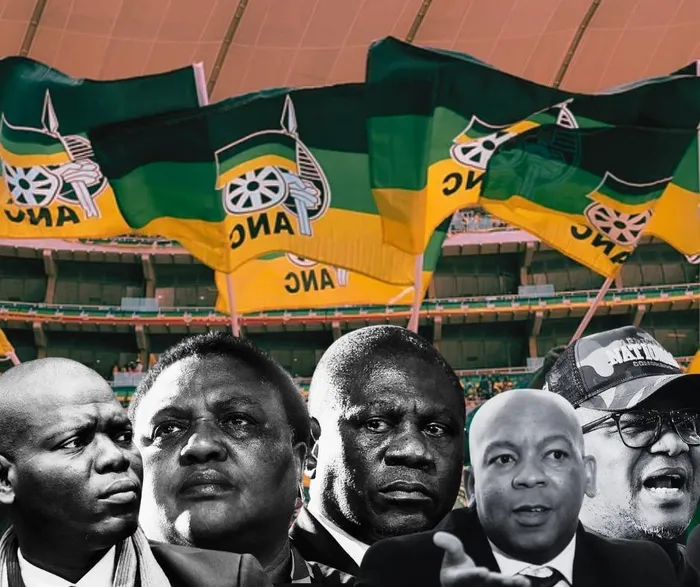
While the race to lead the ANC has traditionally been seen as a showdown between Deputy President Paul Mashatile and the party’s Secretary-General Fikile Mbalula, the SRF poll has introduced an unexpected player into the race.
Image: IOL Graphics
The race to succeed President Cyril Ramaphosa as leader of the African National Congress (ANC) is heating up, with fresh polling and high-profile political maneuvers indicating an increasingly volatile field of contenders.
This week’s ANC National General Council (NGC) meeting in Boksburg has become the backdrop for the growing succession debate, even as party officials downplay the idea of an imminent leadership battle.
The NGC, held at the Birchwood Conference Centre, marked the beginning of the final phase of Ramaphosa’s presidency, with the ANC’s next elective conference scheduled for 2027.
However, talk of who will lead the ANC after Ramaphosa is already dominating internal discussions, fuelled by the findings of a recent Social Research Foundation (SRF) poll that paints a highly competitive picture.
While the race to lead the ANC has traditionally been seen as a showdown between Deputy President Paul Mashatile and the party’s Secretary-General Fikile Mbalula, the SRF poll has introduced an unexpected player into the race.
Business tycoon Patrice Motsepe, president of the Confederation of African Football (CAF) and a prominent billionaire, is leading the pack, despite his public insistence that he will not run.
Motsepe’s inclusion in the poll has raised eyebrows, with some suggesting that his backers could convince him to run in 2027. The SRF survey found Motsepe holding a five percentage point lead over Mashatile among general voters, though the preference among ANC supporters showed a slightly different trend. Within the party base, the race remains fluid, with other prominent names gaining traction as well.
The race for the ANC presidency has been further complicated by the emergence of several new, high-profile candidates. The ANC Women’s League is actively pushing for the party’s first female president, and this has brought forward Nomvula Mokonyane, the ANC’s Deputy Secretary-General, and Thoko Didiza, the National Assembly Speaker, as potential contenders.
Mokonyane’s political future, however, is clouded by her alleged involvement in the Bosasa corruption scandal, which was extensively detailed in the findings of the State Capture Commission. Despite this, insiders believe Mokonyane could still throw her hat in the ring, particularly with the backing of some ANC factions.
Didiza, meanwhile, is seen by many as a reform candidate with strong ties to President Ramaphosa. Her candidacy is gaining traction among those who seek a more modern, forward-thinking leadership for the ANC. Some senior ANC members reportedly see Didiza as a potential unifying figure who could guide the party through a period of renewal.
Another name that has surfaced is Kgosientsho Ramokgopa, the Electricity Minister in the Presidency. Ramokgopa has reportedly expressed interest in either the presidency or the deputy presidency, although he has not formally announced his candidacy.
As the ANC continues to grapple with its worst electoral performance in decades, having secured only about 40% of the vote in the 2024 national elections, the party is looking to reposition itself for future success. The focus on organisational renewal has provided a platform for some ambitious figures, particularly Fikile Mbalula, to position themselves as the solution to the party’s current woes.
Mbalula, once a high-profile sports minister, has increasingly become a central figure in the ANC’s efforts to rebuild. He has focused much of his public messaging on the need for internal discipline and a revival of party unity, often framing his efforts as a necessary part of renewal. However, many insiders believe Mbalula is using his role as secretary-general to strengthen his political base ahead of 2027.
At the NGC, Mbalula launched a sharp critique of the party’s leadership in KwaZulu-Natal (KZN), which has seen a dramatic decline in support. He described the ANC’s intervention in the province as a failure, famously saying, “We thought we were bringing a Ferrari, but what we have now is a [Toyota] Tazz.” The remarks were widely interpreted as a veiled attack on Jeff Radebe, the veteran ANC tasked with rebuilding the party in KZN. Radebe is also a presidential hopeful.
Political analysts argue that Mbalula’s comments are part of a broader strategy to eliminate rivals within the ANC, particularly those associated with KZN, and to solidify his own position. Senzo Mchunu, a senior ANC figure linked to KZN, is also under intense scrutiny, with allegations of corruption and interference in police matters threatening his standing. Mbalula recently approved Mchunu’s request for special leave, a decision seen as aligning with his broader political interests.
There are growing concerns within the ANC about Mbalula’s potential use of the party machinery to further his own ambitions. Critics accuse him of building a network of loyalists within the ANC’s structures, what some have described as a “political machine.” His frequent calls for unity and discipline within the party are viewed by some as attempts to sideline rivals and consolidate his influence ahead of the 2027 conference.
Despite the buzz surrounding his potential candidacy, Mbalula has repeatedly denied he is positioning himself for the presidency, insisting that his focus remains on the ANC’s renewal and reclaiming voter support ahead of the next election.
“I am not campaigning,” Mbalula stated recently, insisting that any talk of succession is premature. “We need to focus on rebuilding the ANC and the country.”