
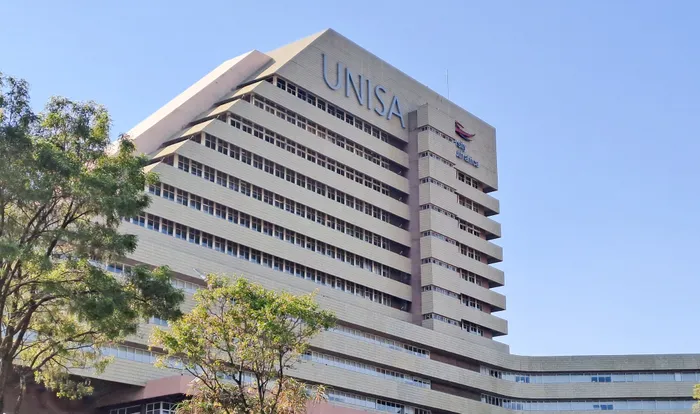
University of South Africa building
Image: Jacques Naude / Independent Newspapers
The University of South Africa has rejected what it describes as a coordinated and baseless media offensive following its recent announcement that it had thus far made more than R170 million available for student funding, a milestone that makes Unisa the institution funding the largest number of students in the country.
This is in response to reports linking Parliament’s Portfolio Committee on Higher Education Chairperson, Tebogo Letsie, to an R82 million Unisa security tender, the university said it had observed a troubling pattern of media fightback for reasons that remain unclear. Unisa said the timing of the allegations raises serious questions, coming shortly after the institution publicly declared its unprecedented student funding commitment.
“There is so much to talk about at Unisa,” the university. “We are funding more students than any other university in South Africa, expanding access to higher education, stabilising governance systems and improving academic delivery yet we find ourselves forced to respond to falsehoods instead of focusing on our achievements,” Unisa spokesperson Professor Boitumelo Senokoane said.
Letsie has firmly denied any involvement in the security tender, describing the City Press article published on 6 December as misleading and unsupported by evidence. He said neither he nor the university was given a fair opportunity to respond before publication.
Unisa echoed this concern, stating that irresponsible reporting not only damages individual reputations but also undermines public confidence in institutions that serve millions of students, many of whom depend on the university for social and economic mobility.
The university stressed that its procurement processes are governed by strict legal and regulatory frameworks, with multiple layers of oversight. It rejected any suggestion of improper influence, calling on those making allegations to substantiate them with facts rather than innuendo.
“If there is evidence of wrongdoing, it must be brought forward speedily and through the proper channels,” the university said. “Trial by media without proof is unacceptable.”
Unisa said it would not be distracted from its core mandate by unsubstantiated claims. Over recent years, the institution has recorded significant achievements, including increased student support, expanded digital learning platforms and improved completion rates across several faculties.
Letsie, who chairs the parliamentary committee responsible for higher education oversight, warned that careless reporting weakens democratic accountability by conflating oversight with corruption. He confirmed that he is seeking legal advice over the publication, saying public trust cannot be sacrificed for sensational headlines.
The statement, issued by Parliament Media Officer Jabulani Majozi, reaffirmed Unisa’s commitment to transparency and accountability while defending its right to correct misinformation.
At the time of publication, City Press had not provided evidence to substantiate the claims or issued a response to the university’s concerns.
Unisa concluded by urging journalists to uphold professional standards and engage institutions fairly, noting that criticism must be rooted in fact, especially when it risks overshadowing tangible progress in transforming higher education.