
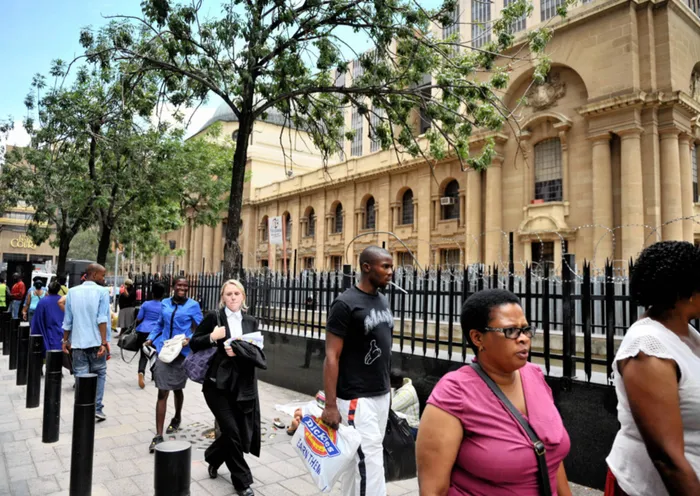
Given the reported crime problems in the South Gauteng High Court precinct in Johannesburg, lawyers feel unsafe strolling outside the court.
Image: Picture: Dumisani Dube Independent Newspapers
For years, the high court precinct in Johannesburg has undergone substantial deterioration, which is indicative of the wider deterioration of the city's inner-city infrastructure.
However, it is currently the subject of a significant public-private revitalisation project.
This decline is symptomatic of a wider issue affecting the Johannesburg CBD, characterised by severely crumbling infrastructure. This includes pothole-ridden roads, non-functional streetlights, and damaged stormwater systems.
Insufficient basic services within the court buildings themselves, leading to frequent disruptions from power cuts, water shortages, broken lifts, and faulty air conditioning.
Lawyers complain about the Johannesburg High Court precinct's severe issues, including filth, poor security, fire hazards, and decay, making it unsafe and difficult to access.
These issues not only detract from the dignity and functionality expected of a judicial precinct but also undermine the administration of justice and public access, leading to case backlogs and prolonged trauma for victims.
The Johannesburg Development Agency (JDA), on behalf of the City of Johannesburg, has begun implementing the High Court Precinct Public Environment Upgrade Project — a major initiative to transform the public environment around the Johannesburg High Court into a safer, more accessible, and vibrant urban precinct.
The project focuses on the area surrounding the Gauteng Local Division of the High Court in the Johannesburg CBD. The precinct is bounded by Lillian Ngoyi Street (north), Delvers Street (east), Helen Joseph Street (south), and Eloff Street (west). The area is currently characterised by mixed commercial, residential, retail, and informal trading activity and contains key public amenities such as toilets and street furniture.
Speaking on the importance of the project, Eric Raboshakga, the Executive Director for Development Planning, said, “The High Court Precinct Public Environment Upgrade is a key component of Johannesburg’s broader inner-city regeneration agenda.”
“By improving safety, accessibility, and urban management, this project reinforces the City’s commitment to creating inclusive, vibrant, and investor-friendly spaces,” he said.
Themba Mathibe, the Chief Executive Officer of the Johannesburg Development Agency, said, “The JDA’s work within the High Court Precinct aligns with the City of Johannesburg’s strategic objectives to revitalise the CBD, enhance public environments, and stimulate local economic activity through well-designed, safe, and accessible urban spaces.”