

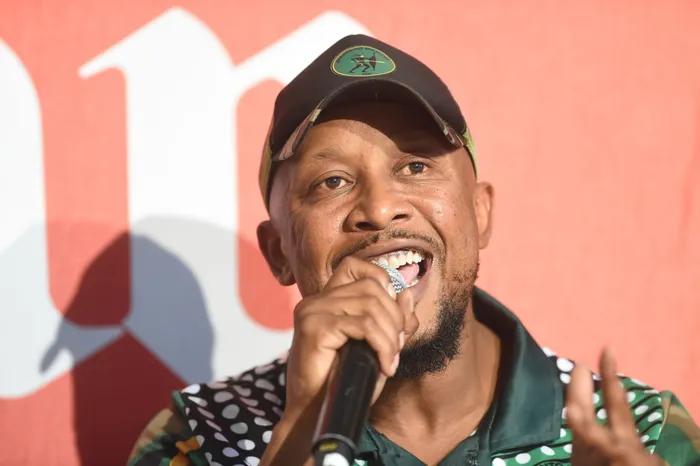
MK Party national spokesperson Nhlamulo Ndhlela said the proposal exposed a fundamental disconnect between political leaders and the lived realities of ordinary South Africans.
Image: Itumeleng English / Independent Newspapers
The uMkhonto weSizwe Party (MK Party) has strongly rejected a proposed 4.1% salary increase for public office bearers for the 2025 and 2026 financial year, describing it as unjustifiable and “morally indefensible.”
The proposal, recommended by the Independent Commission for the Remuneration of Public Office Bearers and published in a government gazette this week, applies to the president, deputy president, cabinet ministers and deputy ministers.
If approved, the president’s annual salary would increase by about R137,000 to approximately R3.4 million.
The deputy president would receive just under R130,000 more, taking his salary to around R3.1 million a year.
Cabinet ministers would see an increase of about R110,000, raising their annual pay to roughly R2.8 million, while deputy ministers would earn more than R2.3 million per year.
MK Party national spokesperson Nhlamulo Ndhlela said the proposal exposed a fundamental disconnect between political leaders and the lived realities of ordinary South Africans.
“The MK Party has consistently maintained that the so-called Government of National Unity (GNU) is fundamentally misaligned with the interests and lived realities of the majority of South Africans,” Ndhlela said.
“It is a political arrangement that entrenches inequality, protects privilege and advances elite comfort at the expense of mass poverty, unemployment and social distress.”
He said it was within this context that the proposed salary increases were “not only unjustifiable, but morally indefensible”.
“Under this proposal, the president’s salary would increase to approximately R3.4 million per annum, the deputy president’s to about R3.1 million and cabinet ministers’ to roughly R2.8 million annually,” he said.
According to Ndhlela, the increases demonstrate a “staggering disconnect” between those in power and the socio-economic hardships faced daily by ordinary South Africans.
“South Africa remains gripped by one of the most severe unemployment crises in the world,” he said. “The official unemployment rate remains above 32%, while the expanded rate, which includes discouraged work-seekers, is close to 43%.”
He said more than eight million South Africans are unemployed, with millions more having abandoned hope of ever finding work.
Youth unemployment, he added, remains “catastrophic”, with nearly one in two people aged 15 to 34 unable to secure employment.
“In this context, any proposal to increase the remuneration of political office bearers is a direct insult to the unemployed and the working poor,” Ndhlela said.
He added that poverty continues to define the daily reality for most South Africans, with more than 18 million people living below the upper-bound poverty line.
“Families are forced to make impossible choices between food, education, healthcare and basic services, yet the GNU prioritises salary increases for those already among the highest-paid public officials on the continent,” he said.
Ndhlela also highlighted South Africa’s extreme inequality, noting that the country remains the most unequal society in the world, with a Gini coefficient exceeding 0.63.
“The proposed increases for public office bearers will only deepen this inequality and further erode public trust in democratic institutions,” he said.
The MK Party has long criticised the GNU and opposed its formation, arguing that state resources should instead be directed towards job creation, poverty eradication, improved public services and dismantling structural inequality.
“At a time when public servants face wage restraint, communities endure service delivery failures, and millions struggle to survive, the GNU’s priorities are laid bare,” Ndhlela said.
Civil society organisation Forum for South Africa (FOSA) has also condemned the proposed salary increases.
FOSA national leader Tebogo Mashilompane described the recommendation as “insensitive, immoral and disconnected from reality”.
“At a time when millions of South Africans are facing extreme economic hardship, unemployment, rising food prices, collapsing public services and record crime levels, the proposal to increase salaries for political elites is unacceptable,” Mashilompane said.
He called on President Cyril Ramaphosa to reject the recommendation and demonstrate leadership by prioritising the needs of citizens over political privilege.
ActionSA has likewise opposed the proposed increases.
The party has tabled a private member’s bill calling for the removal of deputy ministers, arguing that their roles offer little value to taxpayers.
ActionSA MP Alan Beesley said the proposed salary hike was unacceptable and inappropriate, particularly given what he described as poor performance by public office bearers.
He pointed to the widespread of hunger, saying that about 50% of families were going to bed hungry over the festive period.
“This is a huge slap in the face for South Africans,” Beesley said. “Nobody knows what deputy ministers do, including themselves.”
IOL Politics