

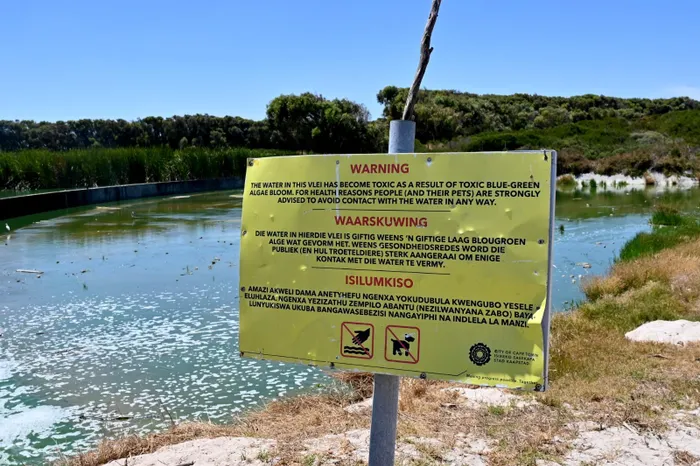
Zeekoevlei Lake in Cape Town is frequently polluted, experiencing issues from sewage spills and harmful blue-green algae blooms.
Image: Ayanda Ndamane / Independent Media
The City of Cape Town has temporarily closed recreation activities at its Zeekoevlei waterbody, the city’s popular tourist attraction this festive season, due to a sewage spillage that has contaminated the water and placed human life at risk.
The city announced, through a letter dated December 19, that it will monitor the situation during the closure and reopen the facility once water quality results return to acceptable levels.
“The purpose of this closure is to safeguard the health of members of the public from compromised water quality detected within the Zeekoevlei waterbody due to Microcystin levels in the system having reached a high-risk category.
“The closure remains in line with the city-approved System and Procedure for the decision-making to partially close or re-open recreation vleis within Protected Areas,” read the letter from the False Bay Nature Reserve’s Biodiversity Area Coordinator Andrea von Gunten.
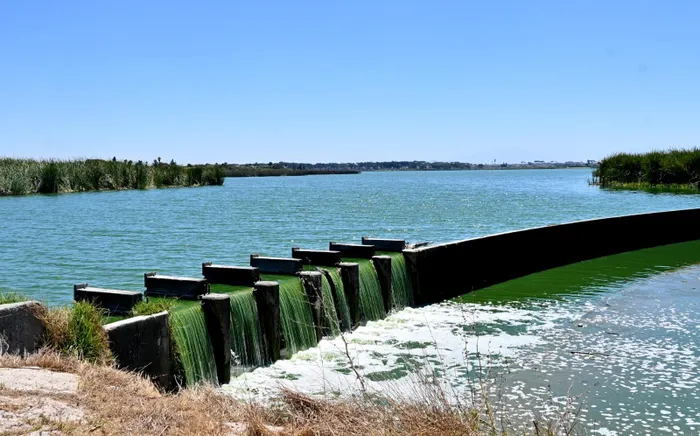
Water at Cape Town's Zeekoevlei Lake had turned green due to contamination.
Image: Ayanda Ndamane / Independent Media
Warning signs have been put up, alerting members of the public that the dam has become toxic as a result of a blue-green algae bloom.
“For health reasons, people (and their pets) are strongly advised to avoid contact with the water in any way,” read the signs.
City Deputy Mayor Eddie Andrews said the Zeekoevlei waterbody was closed due to high Microcystin levels of a blue-green algae bloom.
“The last time Zeekoevlei was closed for recreational use was on December 13, 2024, for a few days, also because of elevated levels of Microcystin due to a blue-green algae bloom of Microcystis,” said Andrews.
City’s Mayoral Committee Member for Water and Sanitation, Councillor Zahid Badroodien, attributed the pollution to several factors, including sewage runoff from informal settlements, breakdowns at sewer pump stations, or blocked sewer pipes.
“Littering, illegal dumping, and human defaecation are all forms of pollution that directly impact the water quality of the rivers,” he said.
Badroodien said the city has established the Zeekoei Catchment Management Forum to encourage community participation to improve the water quality.
“Residents must avoid dumping any foreign objects such as rags, rubble, nappies, tyres, bins, or any solid waste into toilets or sewer manholes.
“The sewer system is designed to handle wastewater and toilet paper only. Lasting change is only possible when everyone plays their part in protecting our shared infrastructure,” he said.
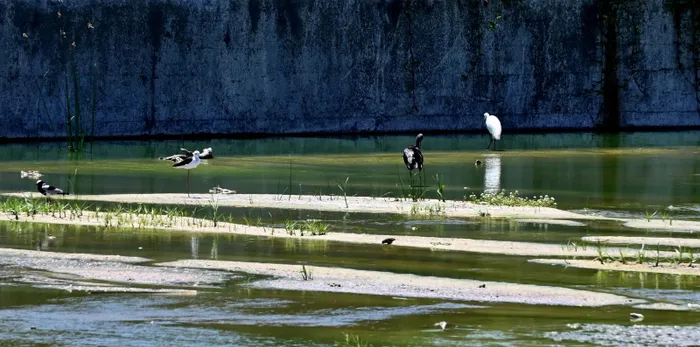
Zeekoevlei, which is the home of various species of birds, has become dangerously polluted due to sewage spillage.
Image: Ayanda Ndamane / Independent Media
Zeekoevlei, according to fynboslife.com, is Cape Town’s largest natural inland waterbody and is a popular picnicking, sailing, and fishing spot.
It is also home to pelicans, flamingos, and many other birds that “can be seen within the 344 ha site”.
A source said that the beauty of the park has been spoiled by green algae that have covered a large part of the lake.
“Even the water is too green, and I would not dare to swim in that water because the colour of the water is totally off,” he said.
Certain sections of the lake were repeatedly closed down in the past couple of years because of sewage spills.
Three years ago, the closure came after water sampling confirmed high levels of E. coli as a result of the sewage spill in the Big Lotus River.
One of the local businessmen, who asked to remain anonymous, raised an alarm about the closure of the waterbody, which he linked to the algae bloom becoming dangerous for humans.
“The algae boom is caused by years of sediment, mainly from sewerage, continuously flowing into the vlei. At the moment, the water that is coming in is so contaminated that we are not allowed to use it for recreation such as sailing,” he said.
He said the three-year-old problem started when the sewage from the highly populated settlements, including Cape Flats, overflowed into rivers that feed the lake.
“The water flows in and then flows out at the top into a river, which flows into False Bay about half a kilometre above the popular surfing beach of Muizenberg.
“The current thus takes this effectively contaminated water and spreads it all the way up the coast to Kalk Bay,” he said.
He said he once fell off the boat into the contaminated water, “and then I got the lung infection that was really terrible”.
He said there was “too much stuff that is rotting in the water” from settlements above the lake.
Friends of Zeekovlei and Rondevlei chairperson Sidney Jacobs accused the City of Cape Town of not taking action to stop the sewage running into the lake and destroying the environment and habitats.
“Various sources in the huge Zeekoevlei catchment area are well known to all the high-level city officials, as we have taken them to the actual sites so that urgent solutions could be implemented about a year ago.
“Nothing concrete in place yet, and some testing sites for possible solutions have now been identified,” said Jacobs.
He said the municipality was not doing enough to deal with the situation.
“They should be doing much more proactive work to prevent these catastrophes from happening, even though we acknowledge it is not an easy task.
“Some cases that we have pointed out to them have not been resolved more than a year later ... definitely not acceptable, and our environment is suffering tremendously.”
Jacobs said residents were furious at the closure of the vlei.
“It was the same situation last year, and a national boating event had to be moved to another venue because of high E. coli levels.
“Locals cannot use the waterbody for recreational purposes, and let's remember that is one of the main reasons they bought properties in Zeekoevlei,” said Jacobs.
The issue of Zeekoevlei waterbody contamination came while the city was dealing with allegations that the municipality was disposing of untreated raw sewage into the sea, creating a health hazard, including E.coli.
The city estimated that it would need R12 billion to achieve its long-term plan to improve its sewage discharge at the ocean outfalls.
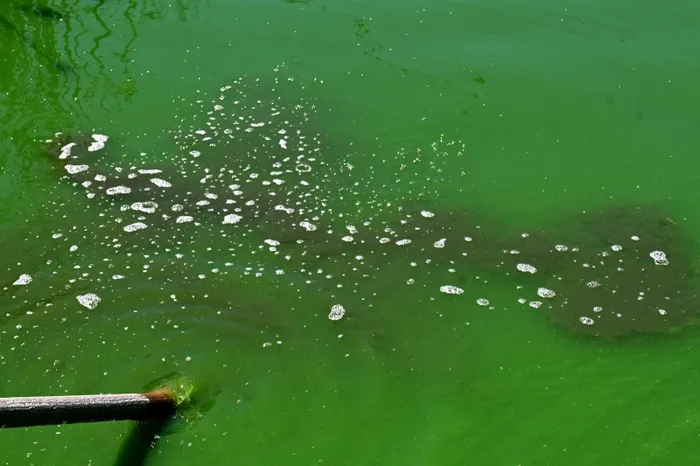
Green substance showing the extent of the water pollution.
Image: Ayanda Ndamane / Independent Media
Badroodien said the city had in November awarded a R200 million tender, which is currently in the appeal period, for improved screenings removal, improved odour and safety systems, replacement or refurbishment of washwater pumps, drainage pumps, jockey pumps, and outfall pumps, and modernised electrical and control equipment.
“These upgrades will enhance reliability, reduce odours, and improve solids removal before discharge,” said Badroodien.