
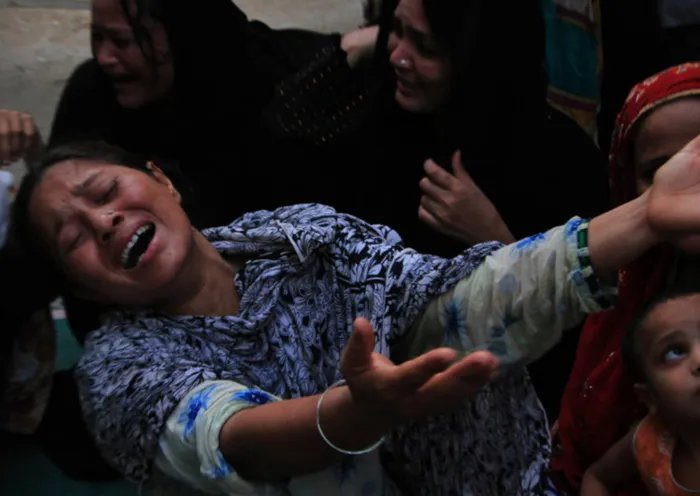
AFP/ Family members of a target killing victim mourn his death in Karachi, Pakistan.
Image: AFP
Pakistan has declared 2025 as the most violent year for the country in its modern history, with nearly four thousand people killed in attacks carried out by militant groups across the country. According to data compiled by the South Asian Terrorism Portal, more than one thousand violent incidents were reported by the end of December, including bombings, armed assaults, suicide attacks, and counterterrorism operations. The scale of the violence underscores deepening insecurity in a nation already grappling with political instability, economic strain, and fragile regional relations.
Most of the attacks occurred in the north western provinces bordering Afghanistan, where insurgent groups have long exploited rugged terrain and open borders to launch attacks with relative freedom. Civilians, security personnel, and militants themselves bore the brunt of the violence, highlighting the indiscriminate nature of the conflict. In North Waziristan, a suicide bombing at a military compound killed seven soldiers, drawing attention to the continuing threat posed by militant organisations to Pakistan’s security infrastructure and local communities.
The Tehreek e Taliban Pakistan, or TTP, has been identified as the primary actor behind the surge in attacks. Analysts note that the group has intensified assaults on military installations, checkpoints, and convoys. Its operations have shifted from targeting specific policies to openly challenging the authority of the Pakistani state and seeking to impose its strict interpretation of Islamic law. The group also rejects the Durand Line, the century old border separating Pakistan from Afghanistan, a position that aligns ideologically with elements of the Afghan Taliban.
Islamabad has repeatedly accused Afghanistan’s Taliban government of providing sanctuary to TTP leadership and allowing fighters to plan attacks from Afghan soil. Kabul denies these allegations and insists that its territory is not used for operations against Pakistan. The dispute has heightened tensions between the two neighbours, leading to intermittent cross border clashes and air operations targeting suspected militant positions. Diplomatic efforts to mediate the conflict have largely failed, leaving a persistent trust deficit between Islamabad and Kabul.
When the Taliban returned to power in Kabul in 2021, Pakistan had hoped that militant activity along the border would decrease. Instead, the TTP has grown stronger and broadened its objectives. Security analysts estimate that the group commands several thousand fighters and possesses increasingly sophisticated equipment, including night vision devices and modern rifles believed to have come from abandoned stockpiles in Afghanistan. Leadership is thought to operate largely from across the border, making it difficult for Pakistani authorities to dismantle the organisation completely.
The surge in violence has also had significant economic consequences. Trade with Afghanistan has been disrupted due to border closures and strict security measures. Official figures indicate that exports have declined dramatically, while delays in transport and rising costs have further strained Pakistan’s economy. Inflation has increased the financial burden on ordinary citizens, and businesses have struggled to cope with supply chain disruptions and rising operational expenses.
Humanitarian concerns have compounded the crisis. Pakistan hosts nearly two million Afghan refugees, many of whom fled decades of conflict in their homeland. In recent months, authorities have deported tens of thousands of undocumented migrants, citing national security considerations. Human rights organisations warn that such large scale returns risk worsening the plight of families who have already faced hardship and uncertainty. Vulnerable communities, including women and children, remain at particular risk amid the continued instability.
Domestically, the crisis has strengthened the military’s influence over national security and policy decisions. Analysts argue that while security operations may disrupt militant networks in the short term, long term stability requires political engagement, economic development, and regional cooperation. Without addressing the social and political grievances that fuel unrest, experts caution that cycles of violence are likely to continue, leaving Pakistan trapped in a persistent state of insecurity.
For South Africa and the international community, Pakistan’s turbulent year serves as a stark reminder of how insurgency, cross border tensions, and economic pressures can converge to create regional instability. The conflict demonstrates the complexity of addressing militant activity in countries with porous borders, weak infrastructure, and refugee populations exposed to both economic hardship and political uncertainty.
As Pakistan enters 2026, authorities face the dual challenge of containing militant activity while maintaining fragile relations with Afghanistan. Meanwhile, the civilian population continues to live under constant threat, and the country’s economic and political systems struggle to absorb the combined pressures of conflict, displacement, and inflation.