

As South Africa continues to battle rolling blackouts, rising electricity costs, and ageing infrastructure, the search for long-term energy solutions has taken on renewed urgency.
With economic growth, social development, and industrial productivity increasingly threatened by an unstable power supply, the question is no longer whether the country needs alternative energy solutions but how quickly they can be implemented.
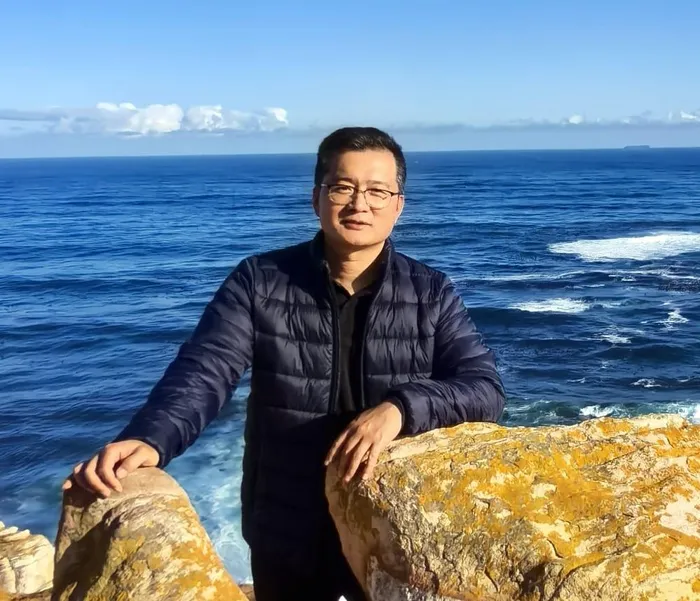
Eric Zhou Eric Zhou is an advanced energy technology specialist who advocates for modern power transmission and renewable energy solutions to help stabilise South Africa’s electricity supply. He emphasises the role of clean energy infrastructure in driving economic growth, job creation and long-term energy security.
Image: EZ
Against this backdrop, global Chinese energy giant TBEA has entered conversations about whether advanced renewable energy technology could help stabilize South Africa’s power system and position the country as a future renewable energy hub for the African continent.
Represented by advanced technology specialist Eric Zhou, TBEA specialises in power transmission, renewable energy systems, and large-scale electrical infrastructure. Zhou explains that modern energy systems face a fundamental challenge: “Energy production and consumption areas are distributed in different places, which requires large-capacity and long-distance power transmission technology.”
He notes that China’s rapid development in this field did not happen by chance. “Through the unremitting efforts of many people, China has developed world-leading power transmission and transformation technology,” he says.
Because China’s climate and landforms vary dramatically across regions, its power systems have been tested under extreme and diverse conditions. “This proves the advancement and reliability of China’s power transmission and transformation technology. We hope to share our technology with South Africa and create conditions for the South African economy to take off.”
Renewable energy, according to Zhou, has the potential to transform not only national infrastructure but also rural communities and agricultural sectors. He emphasizes that affordability and accessibility must come first.
“The first thing we need to do is to make energy costs affordable, so that every South African can have sufficient electricity,” he says. “We can’t wait , students’ learning, farm irrigation, small industries, fishery freezing chains, and food processing lines cannot wait. This task is urgent and important.”
Traditional power generation and transmission systems, however, often require long construction periods and significant capital investment. For rural areas, Zhou believes a different approach is needed. “New energy combined with energy storage has become a very good option,” he explains. “It can quickly achieve the goal of meeting power demand.”
Beyond infrastructure, TBEA sees its potential role in South Africa as extending to industrial development, job creation, and skills transfer. Zhou stresses that the company is more than a contractor.
“TBEA is not only an EPC contractor, but also a manufacturer with world-leading technology,” he says. “We hope to integrate our technology into the South African economic ocean and contribute to South Africa’s industrial development.”
Drawing on the company’s experience in other countries, Zhou highlights the importance of collaboration. “Through cooperation, we can leverage our strengths to form a win-win situation, create more jobs, promote economic growth, and add bright colours to the friendship between South Africa and China, making the ‘rainbow’ brighter and more beautiful.”
Looking ahead, Zhou envisions a partnership that goes beyond solving immediate energy challenges. “Through cooperation between the two parties, we will not only solve the current energy problems, but also create good products for this world,” he says. “We believe that in the process, the two sides will establish friendship as we work together shoulder by shoulder.”
He also reflects on the historical ties between the two nations. “China and South Africa have always had a very deep friendship history, both official and people-to-people. Cherishing friendship is the root of our traditional cultures,” Zhou says. “We firmly believe that through in-depth exchanges and cooperation, we can create a better life and benefit the people of both sides.”
As South Africa grapples with its energy crisis, the possibility of international collaboration particularly in advanced renewable technologies offers a glimpse of a more stable, sustainable, and inclusive energy future.