Godongwana increases disaster recovery funding for provinces, municipalities
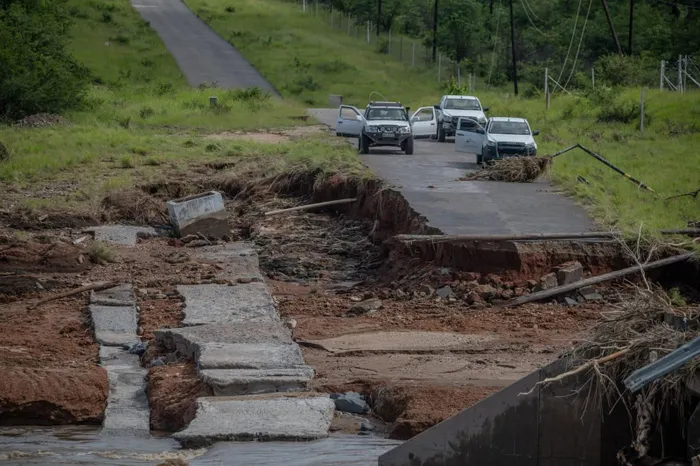
Finance Minister Enoch Godongwana has increased funding to fix infrastructure damaged by floods in six provinces and several municipalities.
Image: Gift of the Givers
Finance Minister Enoch Godongwana has increased the allocation to municipalities and provincial governments by nearly R2.5 billion to fund the recovery and rehabilitation of infrastructure damaged by disasters that were classified in March last year.
Godongwana has also noted that the funds are restricted to projects expressly approved and recorded in the National Disaster Management Centre’s (NDMC’s) post‑disaster verification assessment reports.
In addition, the allocations must be used for the repair of infrastructure damaged by disasters classified in March 2025, and the funds must be spent by the end of the 2025/26 financial year, which is March 31, 2026.
Six provinces – Eastern and Western Cape, KwaZulu-Natal, Limpopo, Mpumalanga, and the North West – will share about R1.54bn.
The funds will be used, through different grants, for comprehensive agricultural support, education infrastructure, health facility revitalisation, and provincial roads maintenance.
KwaZulu-Natal receives the largest allocation of R630.1 million, while Mpumalanga is set to receive just over R351.2m and R275m to Limpopo.
Other allocations will be to the Eastern Cape (R100.4m), North West (R100m), and the Western Cape (about R80m). Several municipalities in KwaZulu-Natal, Limpopo, Mpumalanga, and the North West will also share in the nearly R956m municipal disaster recovery grant.
Affected Limpopo municipalities will share R407.15m, while KwaZulu-Natal municipalities will receive R393.8m, R90m in Mpumalanga, and R65m in the North West, according to information provided by the National Treasury last Friday.
In March last year, the NDMC declared disruptive rains, thunderstorms, floods, and strong winds from February 16 to 28 a national disaster after assessing the magnitude and severity of severe weather, which caused significant impact in KwaZulu-Natal, Eastern Cape, Free State, Mpumalanga, Limpopo, North West, and Gauteng.
The inclement weather resulted in the loss of life, damage to property, infrastructure, and the environment, as well as the disruption of basic services.
The NDMC has called for communities to be empowered about different hazards in their localities, which, when not managed properly, will result in disaster incidents. In order to prevent and reduce disaster risk, according to the centre, all organs of state must develop and conduct public awareness programmes in line with their legislative mandates.
Additionally, municipalities must develop and enforce by-laws that regulate and promote a safe and healthy environment for their communities, and ensure that they are aware of such by-laws and the implications of not complying with the by-laws.
The NDMC cited as an example that building houses without approval of the town planning section must be discouraged, as such development may be in contravention of the building codes.
Littering must be discouraged as refuse will result in blocked drainage pipes, which will exacerbate flooding, the centre warned.