

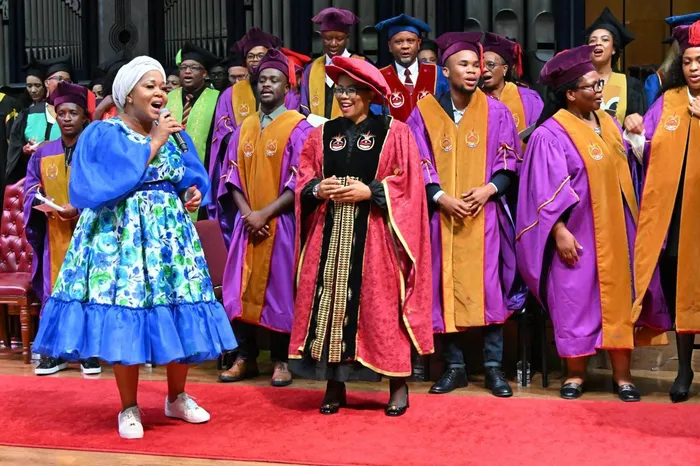
Unisa Pretoria. Award winning music sensation Winnie Mashaba sealed the university's official opening ceremony with song.
Image: Supplied
The University of South Africa (Unisa) officially opened its 2026 academic year with a strong call for focus, alignment, and bold leadership, as Principal and Vice-Chancellor Professor Puleng LenkaBula positioned higher education at the centre of national development and global accountability.
Opening her address against the backdrop of heightened geopolitical tension, LenkaBula referred to controversial developments linked to United States President Donald Trump and the reported capture of Venezuela’s president, describing them as reminders of the fragility of international relations. Such global shifts, she said, highlight the urgent need for institutions of higher learning to cultivate graduates capable of critical thought, ethical reasoning, and diplomatic engagement.
“This year must be marked by dedication, coherence, and decisive action,” she told a packed ZK Matthews Great Hall at Unisa’s Muckleneuk Campus.
With South Africa preparing for the State of the Nation Address and the 2026 National Budget Speech, alongside the Mining Indaba currently under way in Cape Town, LenkaBula emphasised that universities must remain closely aligned with the country’s economic priorities and fiscal realities. Higher education, she argued, cannot operate in isolation from the national skills agenda and broader development strategy.
Unisa, as Africa’s largest open distance learning institution, has a particular responsibility to expand access while ensuring relevance. “Our programmes must not only confer degrees,” she said. “They must unlock opportunities, dignity, and employability.”
The Vice-Chancellor highlighted the rapid transformation of the global higher education landscape, driven largely by advances in artificial intelligence. Institutions are now required not only to adopt artificial intelligence tools but also to govern them ethically and responsibly. Technology, she stressed, must enhance rather than replace human learning.
Quoting historian Yuval Noah Harari, LenkaBula said, “In a world deluged by irrelevant information, clarity is power.” Universities, she added, must become spaces where clarity, ethics, and innovation intersect.
She also pointed to the global rise of micro-credentials and lifelong learning as a necessary response to labour market demands. In a country facing persistently high youth unemployment, higher education must be agile and forward-looking. Echoing Nelson Mandela’s words that education is the most powerful weapon to change the world, LenkaBula said that weapon must remain accessible, flexible, and aligned with economic realities.
The opening ceremony also showcased a major climate research partnership that signals Unisa’s commitment to confronting urgent regional challenges. Among other research grants from various corporates, Standard Bank has committed R1 million in seed funding to support a dedicated research initiative on climate change-induced loss and damage, to be housed within Unisa’s Institute for Sustainability and Corporate Citizenship.
The funding will run for an initial year and is expected to strengthen research capacity, generate policy-relevant insights, and support practical interventions aimed at communities hardest hit by environmental shocks. The institute is led by Professor Godwell Nhamo, a prominent voice in sustainability and climate governance.
The new programme builds on years of collaboration between Unisa researchers and the National Department of Forestry, Fisheries and the Environment, as well as other stakeholders active in the climate policy space. Pearl Phoolo, Head of Corporate Social Investment at Standard Bank, said responding to environmental devastation requires more than short-term relief measures. She described the partnership as a strategic investment in African-led knowledge that can inform national adaptation strategies, improve disaster risk management, and produce inclusive solutions grounded in local realities.
Since 2023, Nhamo and his team have been working with government to develop a national framework focused specifically on climate-related loss and damage. The goal is to ensure that global climate debates are translated into concrete responses that address the lived experiences of vulnerable communities across Southern Africa.
The concept of loss and damage gained prominence in international climate negotiations in 2012 during the Doha climate conference, followed by the creation of the Warsaw International Mechanism a year later. Despite these milestones, funding and coordinated implementation have lagged behind mitigation and adaptation efforts. Recent events such as Cyclone Idai and the severe floods that struck parts of Mozambique and South Africa in January 2026 have once again underscored the scale of the challenge.
Under the new agreement signed in January 2026, the Unisa programme will undertake in-depth research into both the economic and social impacts of climate disasters, develop indicators to help measure and monitor damage, support the training of emerging scholars in the field, and work closely with communities, government departments, and international partners to shape responsive policy solutions.
“Loss and damage are no longer a future risk; they are a present and lived reality,” said Nhamo. He added that collaboration with the private sector is essential to fast-track progress and ensure that climate justice becomes part of mainstream development planning.
For Unisa, the partnership reflects the broader vision outlined by LenkaBula at the start of the academic year: a university that is coherent in strategy, responsive to global complexity, and firmly committed to research that serves society.
As the ceremony concluded, LenkaBula urged the university community to move into 2026 with clarity of purpose and collective resolve, positioning Unisa not only as a centre of academic excellence but as a catalyst for inclusive growth, ethical leadership, and sustainable development.