

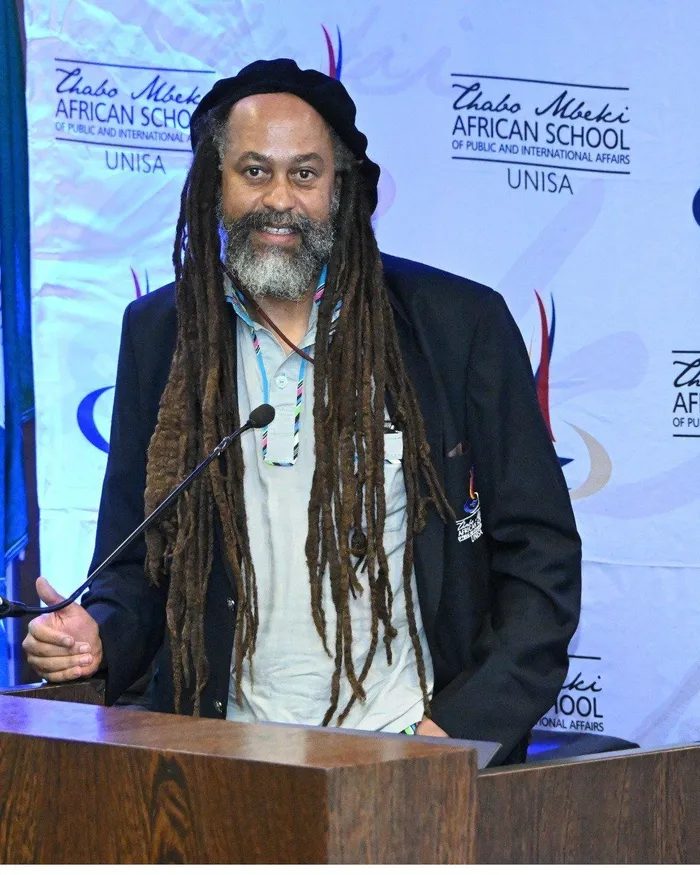
Unisa. Advocate Sipho Mantula
Image: Supplied
Respected Unisa academic, Advocate Sipho Mantula has delivered a pointed critique of President Cyril Ramaphosa’s State of the Nation Address (SONA) held in parliament on Thursday evening. Speaking to The Star on Friday Mantula argued that while the SONA speech acknowledged many of South Africa’s pressing crises, it stopped short of offering the bold, rights-based transformation required under the Government of National Unity (GNU).
Mantula, also a researcher at the Thabo Mbeki African School of Public and International Affairs, framed his response around five key takeaways, describing SONA as “a constitutional ritual that must go beyond ceremony and speak directly to the lived realities of our people.”
Delivered in terms of Section 42(5) of the Constitution, SONA remains one of the most significant moments in South Africa’s democratic calendar, bringing together the executive, legislature and judiciary under one roof. In his address this year, Ramaphosa said: “This State of the Nation Address is a call to action, to build a nation that works for all, where no one is left behind.” He added: “We are determined to build a capable, ethical and developmental state that serves the people of South Africa.”
Mantula said the tone was appropriate, but warned that implementation would be the ultimate test.
Political memory and the unfinished struggle
Ramaphosa anchored his speech in historical reflection, highlighting the 70th anniversary of the 1956 Women’s March and the 30th anniversary of the Constitution. “We honour the women who marched in 1956 and reaffirm our commitment to equality, dignity and justice,” the President said.
Mantula welcomed the recognition of these milestones but argued that commemoration must be matched by material progress.
“Seventy years after the women’s march, our mothers and daughters still face sexual violence, economic exclusion and poverty,” he said. “We cannot celebrate constitutional values while Chapter 9 institutions meant to safeguard democracy remain underfunded and constrained.”
Ramaphosa also referenced the legacy of the 1976 student uprising, stating: “The courage of the youth of 1976 reminds us that freedom was won through sacrifice and determination.”
Mantula, however, said the historic role of the 1976 generation deserved more prominence. “The youth of 1976 internationalised our struggle and reshaped the political direction of this country. Their sacrifices must remain central to our democratic narrative,” he said.
He further raised concern about growing Afrophobia directed at African nationals living in South Africa, arguing that economic hardship must not erode Pan-Afrikan solidarity.
Water crisis and constitutional accountability
One of the key policy announcements in Ramaphosa’s speech was the establishment of a National Water Crisis Committee, which he said he would personally lead. “Water security is fundamental to our nation’s wellbeing and economic development,” the President said. “We will deploy technical expertise and resources to municipalities facing severe water challenges.”
Mantula described the intervention as necessary but long overdue.
“Access to sufficient water is guaranteed under Section 27(1)(b) of the Constitution. It is not a privilege; it is a right,” he said. “The deterioration of infrastructure and persistent supply disruptions amount to a violation of human dignity.”
He argued that the water crisis reflects decades of governance failures at municipal and national levels, warning that short-term interventions will not suffice without systemic reform, proper maintenance planning and accountability.
Communities in rural areas and townships, he added, continue to bear the brunt of collapsing infrastructure and inconsistent supply.
Crime, inequality and justice
Crime and public safety featured prominently in the President’s address. Ramaphosa declared: “Organised crime and gangsterism pose a grave threat to our democracy and economic progress. We will intensify our efforts to dismantle criminal networks and restore safety in our communities.”
He outlined plans to strengthen intelligence coordination, reform elements of the criminal justice system and continue the deployment of the South African National Defence Force in high-risk areas.
Mantula acknowledged the seriousness of the threat but cautioned against viewing crime purely through a security lens.
“For three decades, we have struggled to address youth unemployment and inequality rooted in apartheid spatial planning,” he said. “Without tackling the social and economic drivers of crime, enforcement alone will not succeed.”
He also warned against heavy-handed policing during community protests. “The state must not repeat the mistakes of excessive force witnessed during COVID-19 enforcement and ongoing service delivery protests. Public servants must protect, not brutalise, the citizens they serve,” he said.
Anti-corruption drive and institutional fragility
Corruption was another focal point of Ramaphosa’s address. The President described graft as “a cancer that erodes the foundations of our democratic state” and pledged stronger prosecutions, procurement reforms and the introduction of a new Whistle-Blower Protection Bill.
“No one is above the law,” Ramaphosa said. “We will strengthen our institutions to ensure accountability and restore public trust.”
Mantula agreed that corruption undermines the developmental state but questioned the pace and consistency of reform.
He noted that recommendations emerging from commissions investigating state capture have been slow to translate into visible prosecutions. He also highlighted instability in the leadership of prosecutorial authorities over the past three decades, arguing that institutional fragility hampers effective action.
“You cannot fast-track prosecutions and recover stolen funds when the criminal justice system itself is unstable,” Mantula said. “Institutional continuity and political will are essential.”
Foreign policy and Pan-Afrikanism
On international relations, Ramaphosa emphasised that South Africa’s future is intertwined with that of the African continent. “A peaceful, stable and prosperous Africa is essential for our own development,” he said, reaffirming South Africa’s commitment to continental cooperation and multilateralism.
Mantula supported the principle but argued that SONA lacked detailed clarity on South Africa’s National Interest Framework, particularly regarding land reform, mineral resources, the blue economy and the country’s positioning in global conflicts.
“Pan-Afrikanism must not be rhetorical. It must shape our foreign policy decisions and continental leadership,” he said.
He added that South Africa’s credibility within regional and continental bodies depends on consistent engagement with conflicts and socio-economic challenges across the continent.
Beyond ceremony
Mantula concluded that SONA remains a vital democratic platform, symbolising accountability and national direction. However, he warned that its credibility will ultimately depend on delivery.
“SONA brings together the highest arms of the state in a powerful constitutional moment,” he said. “But its success will not be measured by applause in Parliament. It will be measured by water flowing in communities, jobs for young people, safer streets and justice that is visible and fair.”
As the Government of National Unity charts its course, Mantula’s critique underscores a broader challenge confronting South Africa: transforming constitutional promises into lived realities for millions still waiting for the dividends of democracy.