

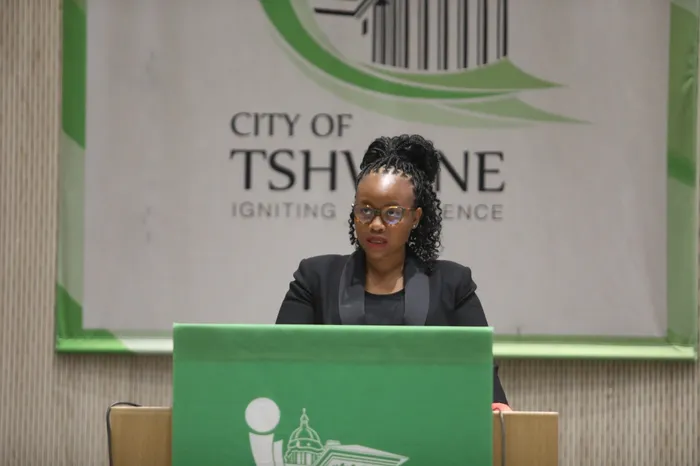
Tshwane Mayor Nasiphi Moya has defended the city's decision to implement a 3.5% salary increase for workers, backdated to July 2021, amid criticism from opposition parties.
Image: Oupa Mokoena / Independent Newspapers
Opposition parties in Tshwane have warned that the multiparty coalition government’s decision to pay an outstanding 3,5% salary increase stemming from the 2021 wage agreement, including backdated salaries amounting to over R1 billion to at least 21,000 workers, might compromise service delivery.
The criticism came despite confidence expressed by Tshwane Mayor Nasiphi Moya that the “settlement has been structured within a funded budget that continues to prioritise electricity stability, water security, and service delivery”.
“We are honouring our obligations to workers while strengthening the services residents depend on,” Moya said.
DA mayoral candidate Cilliers Brink, however, cautioned that the decision would have negative effects on frontline services, resulting in prolonged power outages and more water outages.
“When I was the mayor I stood up and said the residents could not afford these increases. In 2023 we won a Labour Court case that confirmed that if a municipality can not pay increases it should not be forced,” he said.
Brink added that the previous DA-led administration took a tough stance in the face of a violent strike, understanding the difficult decision's implications.
The Freedom Front Plus (FF Plus) condemned the decision, saying the agreement would place an unbearable financial burden on Tshwane’s already overtaxed residents.
“The settlement includes a 3,5% salary increase backdated to July 2021, the settlement of arrears exceeding R1 billion, and an additional future burden of R450 million to R525 million per year. All this while residents are already buckling under poor service delivery, deteriorating infrastructure and rising tariffs,” the party said.
The ANC, which is part of the multiparty coalition government alongside major partners the EFF and ActionSA, welcomed the decision, hailing it as meaningful progress made by the city in rebuilding and stabilising relations with organised labour.
Regional ANC secretary George Matjila slammed the DA-led administration, saying its failure to execute and sustain commitment to workers “did not merely constitute an administrative oversight, it undermined labour relations, weakened worker confidence, and stalled progress that could have long been achieved”.
Moya explained that in September 2021 SALGA, South African Municipal Workers Union and Independent Municipal and Allied Trade Union entered into a three-year salary agreement, but the DA-led administration applied for exemption from implementing the 3.5% increase for 2021 and the 5.4% increase for 2023.
“Those exemption applications were not granted at arbitration. The matter proceeded to the Labour Court. The Court granted exemption for 2023 but referred the 2021 increase back to the South African Local Bargaining Council. When the 2021 application was reheard, the arbitrator issued a final ruling on 31 October 2025,” she said.
She said a bargaining council ruling last year necessitated the 3,5% salary increase, effective from July 1, 2021, making backpay obligatory.
Moya highlighted that immediate payment of the R1.55 billion backpay would have strained the city's finances, risking commitments to Eskom and creditors, and jeopardising the budget post-July 2026.
The negotiated settlement reduces liability to R1,088,004,733.95 (basic salary only), a R466,935,990.05 saving, covering 21,089 employees.
“Salaries will increase by 3.5% with effect from 1 March 2026. This increase will apply to both the basic salary and benefits. Backpay will be paid over three years and calculated from 1 July 2021 on basic salary only. Payment will be staggered, beginning with the lowest TASK levels,” Moya said.