

Godongwana unveiled plans to withdraw the R20 billion in tax increases previously proposed in the May 2025 Budget, following a positive revision of tax revenue by R21.3 billion.
Image: IOL
Enoch Godongwana, the Minister of Finance, said that South Africa's public finance management had reached a turning point since the Covid-19 pandemic began in 2020.
Godongwana talked about the series of crises that had hit the country over the past five years in his speech about the 2026 Budget on Wednesday. He said that the country had chosen not to let these problems define it.
Instead, South Africa has channelled those adversities into a "catalyst for change."
“We committed to a clear reform agenda and a disciplined fiscal strategy built on three principles: stabilise debt, invest in infrastructure, and spend better. Today, that commitment has delivered tangible results,” he said.
Godongwana elaborated on the implications of the budget, noting a substantial narrowing of the budget deficit and a reduction in debt-service costs.
He confirmed South Africa’s removal from the "grey list" and the achievement of its first credit rating upgrade in 16 years, signaling growing confidence in the nation’s economic outlook.
However, the minister cautioned about the ongoing challenges such as the persistent logistic bottlenecks, weak public infrastructure and the recent outbreak of foot-and-mouth disease which poses a risk to future growth.
Godongwana unveiled plans to withdraw the R20 billion in tax increases previously proposed in the May 2025 Budget, following a positive revision of tax revenue by R21.3 billion.
“The improving fiscal position allows us enough room to withdraw the proposed tax increases, without putting fiscal sustainability or economic activity at risk.
“We are also proposing additional tax measures to ease the financial burden on households and businesses, by adjusting personal income tax brackets and rebates fully in line with inflation.”
In an effort to fight the illicit trade, Godongwana allocated the Border Management Authority an additional R990 million to build capacity by filling 738 positions while the SAPS and SANDF have been allocated R1 billion each for the fight against organised crime.
In an apparent response to President Cyril Ramaphosa’s announcement of specialised courts, Godongwana said an additional R687 million has been allocated to increase capacity in the judiciary.
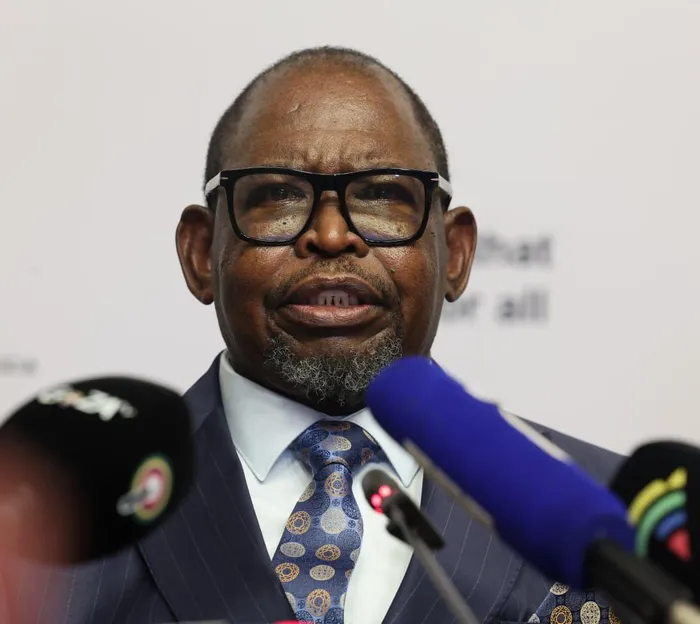
Finance Minister Enoch Godongwana tabled the 2026 Budget in the Joint Sitting of Parliament on Wednesday.
Image: Supplied
“Once the costing is finalised, allocation for this will be considered later in the year.
For the various commissions of inquiry underway that are unlikely to finish within their initial deadlines, funding will also be made available when the costs become clearer.”
Godongwana told the nation that the spending priorities will come at a cost of R2.67 trillion.
“This spending includes a proposed R5 billion in the contingency reserve to cater for disasters declared since the MTBPS.”
While R86.9 billion has been allocated to support the provision of free basic services to 11.2 million households, Godongwana said the local government sphere, where many municipalities are in financial and operational distress, will be the focus of reforms.
“A central challenge with municipalities is that they not only differ in capacity, but also in their revenue-raising potential. This demands a more targeted approach to respond to the diverse pressures facing municipalities.”
He said the National Treasury was revitalising support for development of long-term financial plans.
DA finance shadow minister Mark Burke said the Budget speech incorporated several DA policy positions and was evidence that the ANC no longer governs alone.
“The DA welcomes no tax rises and no bracket creep for the first time in three years. In fact, this budget displays a wholesale rethinking of tax policy by National Treasury under a coalition government,’ Burke said.
He also said while the budget took several steps in the right direction, areas for improvement remained.
“Unemployment is unacceptably high while growth is unacceptably low. We cannot be happy with 1.6 percent GDP growth,” said Burke.
MK Party's acting parliamentary leader Des van Rooyen said the bedrock of any reliable budget was the projections, noting the modest 1.6% growth projection.
“They always get these projections wrong. This is more of an exercise of balancing the books rather than addressing the plight of our people. Our people want employment and you only realise employment out of a growing economy,” Van Rooyen said.
EFF leader Julius Malema said Godongwana tried to balance his speech, simply because it is an election year and he wanted to come across as reasonable, especially to the working class.
“The reality of the matter is that the economy is not growing and we know without the the economy growing, we will not be able to provide jobs. We will not grow the infrastructure even if SARS collects more revenue, it does not mean economic growth,” he said, adding that the red berets were worried that there was no plan to grow the economy.
GOOD Party secretary-general Brett Heron said another year has passed without the introduction of a Basic Income Grant other than the Social Relief of Distress grant, which is now merely being rebranded as a “livelihood grant.”
He said at R370 per month, the SRD did not lift a single recipient above the food poverty line.
“A meaningful Basic Income Grant is not charity; it is economic justice. It is a tool for structural inclusion in a country with entrenched unemployment. It is gender equity in practice, given that women disproportionately carry the burden of poverty and unpaid care work,” he said.