

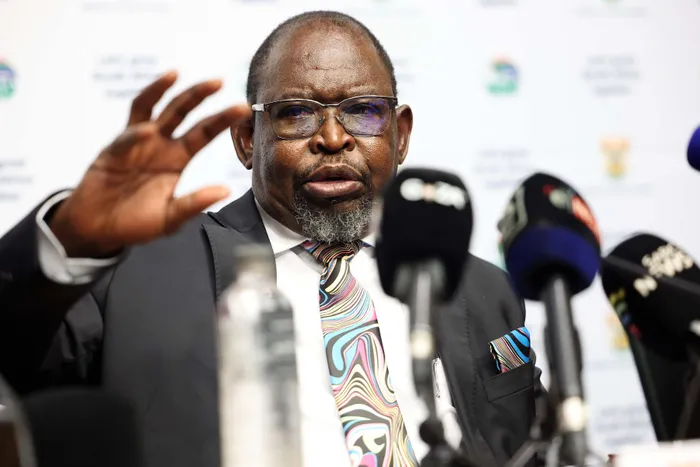
Finance Minister Enoch Godondwana
Image: GCIS
South Africa’s 2026 Budget, delivered by Finance Minister Enoch Godongwana on Wednesday, marks a significant shift towards providing much-needed relief for households and small businesses grappling with high inflation and a sluggish economy. Among the key measures announced are tax adjustments aimed at improving financial stability and supporting growth.
One of the most notable changes is the increase in the VAT registration threshold, which has risen from R1 million to R2.3 million. This move is expected to ease the compliance burden on small businesses, which often struggle with the financial and administrative challenges of VAT. With fewer businesses required to register for VAT, the move allows entrepreneurs to focus more on growth and job creation, particularly in a difficult economic environment.
Simphiwe Mili, Senior Tax Lecturer at Unisa, praised the adjustment, stating: “Increasing the VAT registration threshold provides small businesses with much-needed relief. It’s a practical way to support entrepreneurship and reduce administrative costs, allowing businesses to focus on growth rather than bureaucratic hurdles.”
Another important measure was the adjustment of personal income tax brackets and rebates in line with inflation, which will help mitigate the effects of bracket creep. Many South Africans have seen their wages pushed into higher tax brackets due to inflation, resulting in a higher effective tax rate without a meaningful increase in purchasing power. Mili believes this adjustment is essential for protecting disposable income. “Aligning the tax brackets and rebates with inflation provides taxpayers with more disposable income, which is critical for families struggling with rising costs,” she said.
The increase in the annual contribution limit for Tax-Free Investments, from R36,000 to R46,000, is another positive move. While some may have hoped for a more substantial increase, Mili views it as a step in the right direction for encouraging long-term savings. “This increase is a step in the right direction, helping citizens save more without the burden of tax,” she commented.
Taken together, these measures offer immediate relief to South Africans, though Mili cautioned that broader reforms in sectors like energy, transport, and education remain essential for long-term growth. “Tax relief is important, but it must be part of a larger reform strategy,” she added.
Professor Cameron Modisane, Deputy Executive Dean in the College of Accounting Sciences at Unisa says the budget comes at a delicate time for South Africa’s economy.
"Growth remains modest, public debt is stubbornly high, and households continue to struggle with the rising cost of living. A national budget is more than a financial statement. It reflects government’s priorities and translates policy promises into real allocations through the Appropriations Bill, the Division of Revenue Bill and related tax legislation" he said.
Modisane says the central question is whether Budget 2026 meaningfully shifts South Africa’s fiscal path or simply manages existing pressures more carefully.
"Government plans to spend R2.67 trillion in 2026/2027. Of this amount, R1.58 trillion is allocated to social services. Education receives R527.2 billion, health R310 billion, social development R446.6 billion and community development R294.3 billion. This confirms that the social wage remains central to government policy. In a country marked by high unemployment and inequality, protecting these allocations is essential for stability" he said.
"One figure stands out, debt service costs amount to R432.4 billion. This is money used to pay interest on past borrowing rather than to build infrastructure, expand services or stimulate growth. Every rand spent on interest reduces the space available for development. The Minister has described this Budget as a turning point supported by a principle-led fiscal anchor. Debt to GDP is expected to peak at about 78.9 percent before gradually declining. The consolidated budget deficit is projected at 4 percent of GDP and is expected to narrow to about 3.1 percent over the medium term" Modisane said.
"Government also anticipates achieving a primary surplus, where revenue exceeds non interest expenditure. These projections are important for investor confidence and market stability. Yet the debt story is more complex. In recent years debt projections have been revised upward several times. Economic growth remains weak, forecast at around 1.4 to 1.6 percent in the near term. When growth is low, the debt ratio improves slowly even if spending discipline is maintained. Put simply, fiscal consolidation alone cannot resolve the debt challenge"
"Stabilising debt requires growth. Without stronger economic expansion, the debt burden remains heavy. Debt service costs currently consume more than 21 percent of revenue. Although this ratio is expected to decline slightly over the next few years, it remains high. South Africa is spending more on interest payments than on many key development priorities. That reality limits flexibility and places pressure on future budgets" he said.
*Find comprehensive expert analyses at thestar.co.za