
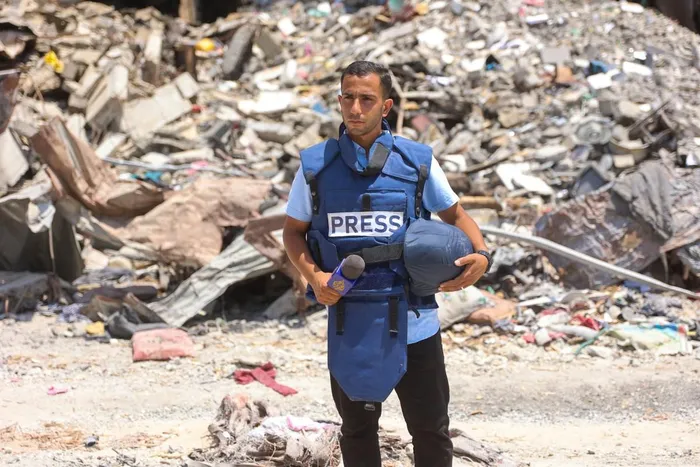
Al-Jazeera correspondent Anas al-Sharif reports near the Arab Ahli (Baptist) Hospital in Gaza City on October 10, 2024. Qatari broadcaster Al Jazeera said on August 11, 2025, that five of its journalists were killed in an Israeli strike, including a prominent reporter.
Image: AFP
A new report from the Committee to Protect Journalists (CPJ) notes that in 2025, 129 journalists and media professionals were killed worldwide, the most in the organisation's more than three-decade history.
Alarmingly, Israel was responsible for more than two-thirds of these fatalities, marking a continuation of what critics describe as a targeted assault on the press.
Among the journalists lost to violence, over 60% were Palestinians reporting from Gaza, a region that, according to human rights advocates and United Nations experts, is currently facing a genocide as a result of ongoing military actions. The ramifications of these reported killings extend beyond mere statistics, reflecting a dark period for press freedom and human rights.
The CPJ's findings indicate that a disproportionate number of journalist fatalities occurred in conflict zones, with three-quarters of all press deaths in 2025 taking place in such settings.
Ukraine and Sudan contributed to this troubling toll, albeit with significantly lower death counts of four and nine, respectively. In stark contrast, Israel's actions stand out as the most deadly for journalists worldwide.
At the heart of this tragic trend is a culture of impunity, perpetuated by a lack of thorough investigations into these killings. In 2025 alone, CPJ identified 47 targeted murders of journalists, the highest in a decade, yet few perpetrators have faced justice. This impunity not only undermines international humanitarian law— which protects journalists as civilians—but also sets a dangerous precedent that emboldens further attacks.
CPJ expresses grave concern over the failure of government leaders to safeguard journalists or hold those responsible accountable, a failure that increases the risk of more killings even in nations not embroiled in conflict. Countries like Mexico, India, and the Philippines have shown a troubling inability to secure justice for murdered journalists, further elucidating the global crisis in press safety.
Jodie Ginsberg, the CEO of CPJ, underscored the severity of the situation, stating, “Journalists are being killed in record numbers at a time when access to information is more important than ever. Attacks on the media are a leading indicator of attacks on other freedoms, and much more needs to be done to prevent these killings and punish the perpetrators." This sentiment resonates in a world where the essential role of journalists in democratic and equitable societies is increasingly under threat.
In 2025, there was a near-record increase in journalists being jailed, accompanied by rising instances of smear campaigns and legal harassment aimed at stifling reporting. Meanwhile, online harassment and physical attacks against journalists have escalated, signalling a disturbing trend of hostility towards those committed to uncovering the truth.
The CPJ has called for immediate reforms concerning the investigation of journalist killings, including the establishment of an international investigative task force and the implementation of targeted sanctions against offenders.
The organisation's plea for action highlights a critical need for collective global resolve to protect the press and ensure accountability.