

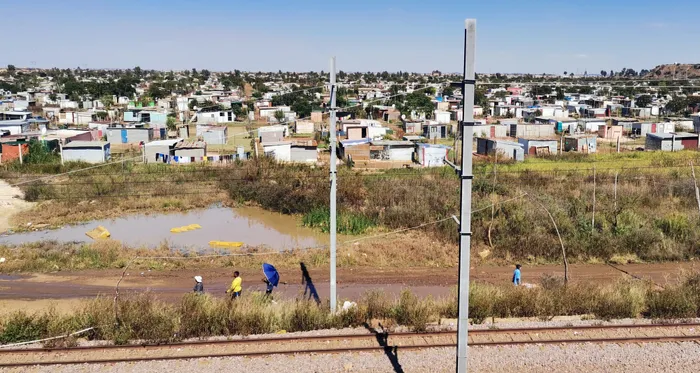
Tshwane’s MMC for Human Settlements Aaron Maluleka has hailed the move to approve informal settlements management policy as a significant step toward to limit the number of of informal settlements across the municipality.
Image: Oupa Mokoena/Independent Newspapers
The City of Tshwane's efforts to eradicate informal settlements have received a major boost with the approval of its Informal Settlements Management Policy, which outlines a projected R32.5 billion investment needed to upgrade or relocate existing settlements.
This follows the public participation process the municipality undertook last year to limit the number of informal settlements, which currently stands at 502.
Mayor Nasiphi Moya previously said the policy would explore revenue-generating opportunities such as electrifying informal settlements, potentially generating revenue and reducing the city's annual expenditure of R1.5 billion on service provision.
During the budget tabling last May, Finance MMC Eugene Modise expressed concern about the rapid growth of informal settlements and allocated R98 million to formalise them.
Tshwane's informal settlements, which previously numbered 220, grew rapidly during the Covid-19 period due to a moratorium barring the forced removal of unlawful land occupiers.
DA’s caucus chief whip Jacqui Uys previously criticised the city's inability to keep up with providing land, housing, and infrastructure for basic services such as water, sanitation, and electricity connections.
"The mushrooming of informal settlements and the lack of basic services such as electricity lead to a huge increase in illegal electricity connections,” she said at the time.
Following the approval of the informal settlements management policy during Thursday's ordinary council sitting, MMC for Human Settlements Aaron Maluleka hailed the move as a significant step toward managing the rapid proliferation of informal settlements across the municipality.
He said the approval follows an extensive investigation conducted by the city, supported by the National Treasury Department's Cities Support Programme.
"The process revealed that upgrading or relocating all existing informal settlements in Tshwane would require an estimated R32.5 billion, a figure that far exceeds the city’s current budget and available resources," he said.
He said identifying 502 informal settlements reflected a demand for low-income housing and rental accommodation.
"Of these, 194 informal settlements (comprising 355,945 structures) are categorised as able to be upgraded in situ and 308 (comprising 151,707 structures) are categorised to be relocated," Maluleka said, adding that substantial work in this regard is currently underway.
He explained that the unplanned expansion of informal settlements has pushed the urban edge outward, contributing to spatial inefficiencies, environmental pressures, and socioeconomic marginalisation.
"In several instances, settlements have developed in rural character areas with limited access to basic infrastructure and municipal services. The informal settlements management policy provides a structured and strategic framework to guide the regulation, prevention, upgrading, and, where necessary, relocation of informal settlements within available fiscal constraints," he said.
The city's policy aligns with the city’s strategic priorities to build a business-friendly city that promotes employment and economic growth; maintain a clean and protected natural environment; and create a healthy and vibrant city for all residents.
He further highlighted that the newly approved policy seeks to improve planning coordination and ensure evidence-based decision-making.
"The City of Tshwane remains committed to working collaboratively with communities, provincial and national government, and other stakeholders to develop sustainable, inclusive, and financially viable housing solutions," Maluleka said.
Dwellers from informal settlements in Mamelodi previously marched to Tshwane House, demanding transparency in the relocation process, including a call for the city to provide a legitimate list of beneficiaries.
Maluleka also raised concern that residents of informal settlements continue to fall victim to unscrupulous individuals demanding bribes in exchange for assistance with relocation to government-acquired land in Pienaarspoort Extension 15.
In February last year, EFF supporters protested against corruption in Mamelodi's informal settlement relocation process by shutting down a makeshift office, alleging bribery, corruption, and unfair practices.