

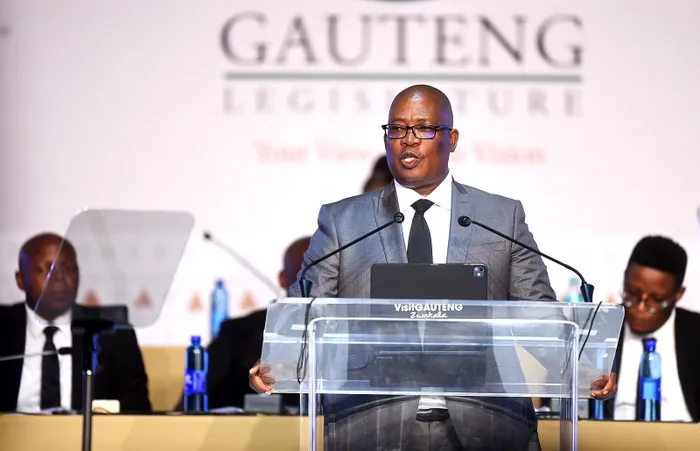
Gauteng Premier Panyaza Lesufi had been criticised for the province’s spend on rental properties.
Image: Itumeleng English/Independent Newspapers
The Gauteng provincial government has dismissed recent reports about its spending on leased office buildings, calling the claims misleading and lacking proper context. Officials emphasised that renting properties is often necessary because the government cannot afford to purchase or construct new office space.
Gauteng Premier told The Star that the contracts long predate his appointment but cannot afford to build offices for every departed and thus has to rent. “The reality is we must must rent buildings and offices in order for us as government to do our work. Government cannot buy or build new offices for every department at this point, it’s not economically feasible,” Lesufi said.
Lesufi had been criticised for the province’s spend on rental properties.
The comments follow inspections conducted last week by non-governmental organisations Right to Justice and the Integrity Network, who visited several government leased buildings in Johannesburg to verify occupancy, safety compliance, and general conditions.
The NGOs said the inspections were guided by a detailed stock list compiled from publicly available property records outlining buildings currently leased by government across Johannesburg and Tshwane.
Much of the public focus has centred on 55 Fox Street and 56 Eloff Street in Johannesburg central business district. Both properties are owned by Shenge Property Group, a black owned property company.
However, Right to Justice said its stock list shows Shenge accounts for roughly 1 percent of all buildings leased by government, with the vast majority owned by long established property companies that have held extensive portfolios for decades.
Right to Justice chairperson Siphesihle Jele said the purpose of the inspections was to provide factual clarity amid public debate.
“Our inspections were guided by a comprehensive stock list of government leased buildings. Shenge Property Group represents roughly one percent of the overall portfolio,” Jele said.“The overwhelming majority of buildings leased by government are owned by long standing property companies, many of which predate 1994. Any discussion about public spending must examine the full portfolio rather than focusing on a single company.”
The uMkhonto weSizwe Party added that focusing on a small black-owned company misrepresents the broader property market.
“The owners of the major buildings in the city are white companies. They still own up to a thousand buildings, and the government is the biggest tenant,” the party said.“It is not fair to make a small black owned company the face of a problem that affects the entire province. True accountability means looking at the full picture, not just a few names.”
Government officials have stressed that leasing properties allows departments to operate in central locations without the high upfront costs and long delays associated with buying or constructing new buildings.
In 2024, the Department of Public Works and Infrastructure introduced the Refurbish Operate and Transfer Programme, partnering with private companies to refurbish and maintain poorly managed state owned properties before returning them to government control.
At the time, then minister Sihle Zikalala said the programme was intended to strengthen the state’s property management capacity.
“Government was not selling the buildings to the private sector; government wanted to build the capacity of the state rather than depending on the private sector entirely,” Zikalala said.
The department’s latest annual report notes that over 6,800 state owned buildings nationwide are in poor or very poor condition, making rental arrangements a practical necessity for continued operations.
Parliamentary committee chairperson Nolitha Ntobongwana said the state of government infrastructure remains a serious concern.
“We are deeply concerned about the condition of government buildings all over the country. Renting from private landlords can help maintain service delivery while the state addresses these infrastructure challenges.”
Right to Justice said its inspections were intended to provide transparency and accountability.
“If public funds are being spent, the public deserves clarity across the full portfolio of leased buildings,” Jele said.“Accountability must apply consistently, and the need to rent properties does not mean wrongdoing. It reflects the reality that government cannot always buy or build.”