

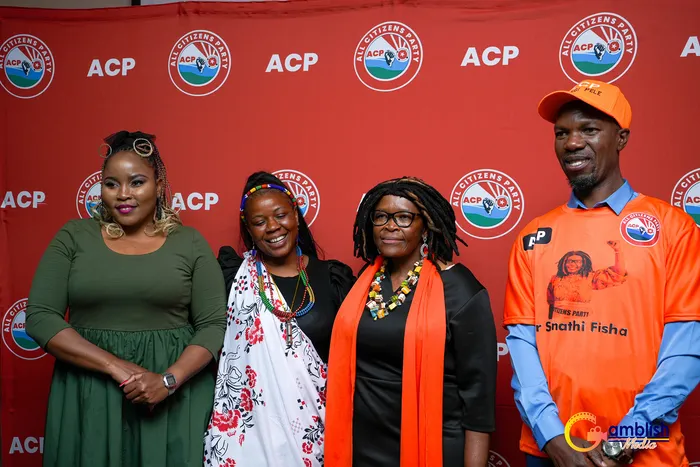
All Citizen's Party President Dr Senathi Fisha and party leaders
Image: supplied
All Citizens Party president Dr Senathi Fisha has drawn a direct line between Ekurhuleni’s long history of corruption allegations and what she describes as the urgent need for systemic reform in local government, arguing that repeated procurement failures and financial misconduct findings have undermined public trust and weakened service delivery.
Speaking during community engagements in Ekurhuleni, Fisha said the metro’s governance challenges cannot be viewed in isolation, but must be understood as part of a broader pattern of institutional decline linked to weak oversight, corruption risks, and failures in accountability mechanisms.
“Ekurhuleni was once seen as a functioning municipality with strong administrative systems,” she said. “What we are seeing now is the result of years of erosion in governance, where corruption, poor oversight, and weak enforcement have taken root.”
Fisha referred to findings from audits and investigations that have repeatedly flagged procurement irregularities, database manipulation risks, and breakdowns in supply chain management within the municipality.
“The Auditor-General has consistently warned about weak procurement controls and vulnerabilities in the system,” she said. “When oversight fails, the door opens for manipulation, irregular expenditure, and the misuse of public funds.”
She pointed to reports of large-scale fraud investigations involving municipal systems, including allegations of manipulated property and financial databases that enabled the loss of significant revenue.
“Cases involving the manipulation of municipal records and financial systems show how serious the problem has become,” Fisha said. “These are not small administrative errors. They represent systemic failures that affect the ability of the state to deliver services.”
Fisha said years of weak governance, irregular expenditure, and alleged procurement abuse have undermined service delivery and public confidence in the metro.
“We need to close the gaps that allow corruption to thrive,” she said. “That means transparent tenders, real consequences for wrongdoing, and systems that protect public money.”
The party proposes independent oversight structures, faster response mechanisms for service delivery failures, and stronger whistleblower protections. It also calls for improved coordination between municipal services and law enforcement to address rising crime.
Fisha said Ekurhuleni can be rebuilt if leadership is rooted in accountability and citizens are placed at the centre of governance decisions.
Fisha also highlighted earlier allegations of irregular tender awards and procurement misconduct linked to infrastructure and service delivery contracts, saying such patterns have contributed to public frustration.
“When communities hear about irregular tenders, inflated contracts, and missing funds, while service delivery continues to collapse, it deepens anger and distrust,” she said. “People begin to feel that the system is not working for them.”
She said corruption in local government has a direct impact on safety, infrastructure, and the daily lives of residents, particularly in working class communities.
“When money meant for roads, water, housing, and safety is lost or misused, it is ordinary citizens who suffer,” Fisha said. “It results in broken infrastructure, unreliable services, and environments where crime can thrive.”
Fisha argued that Ekurhuleni’s governance challenges also reflect broader national issues linked to weakened institutions during the State Capture era.
“State Capture did not only affect national departments,” she said. “It weakened governance systems across all levels, including municipalities. The consequences are still visible today in places like Ekurhuleni.”
She said restoring public confidence will require stronger accountability, transparent procurement systems, and decisive action against wrongdoing.
“There must be consequences for corruption, regardless of who is involved,” Fisha said. “Without accountability, the cycle repeats itself and communities continue to suffer.”
Fisha added that the impact of governance failures is particularly severe for vulnerable groups, including women and victims of violent crime.
“The state is captured when justice for women is not shown,” she said. “There is no justice if victims of violence are ignored while public resources are being mismanaged.”
She called for a complete rethink of how local government is monitored and held accountable, including greater community involvement in oversight processes.
“Communities must no longer be passive observers,” Fisha said. “They must have a voice in how municipalities operate and how public funds are used.”
Despite the challenges, she said she believes Ekurhuleni can recover if ethical leadership and strong governance practices are restored.
“The system can be fixed,” Fisha said. “But only if there is political will, accountability, and a commitment to putting citizens first.”