
Fuel prices are expected to spike.
Image: FILE
Motorists could soon feel a heavy hit at the pumps, with petrol showing a possible increase of about R4 a litre and diesel up to R6.75 a litre based on the latest fuel price data.
The figures come from the Central Energy Fund's latest fuel price analysis.
It shows a growing gap between current pump prices and the cost of fuel based on international markets.
According to the data, the average under-recovery for petrol 95 was 397.802 cents per litre, while petrol 93 was 361.817 cents per litre.
Diesel showed even larger under-recoveries of 663.465 cents per litre for 0.05% diesel and 674.686 cents per litre for 0.005% diesel.
In rand terms, this translates to roughly R3.98 per litre for petrol 95, R3.62 per litre for petrol 93, and about R6.63 to R6.75 per litre for diesel.
Households using paraffin could also face a steep increase, with illuminating paraffin showing an under-recovery of about R8.53 a litre if current trends continue.
An under-recovery means the current fuel price is lower than what it should be based on international oil prices and the rand-dollar exchange rate.
When this gap builds up during the month it usually leads to a fuel price increase in the next monthly adjustment.
The final price can still change before it is announced at the start of April.
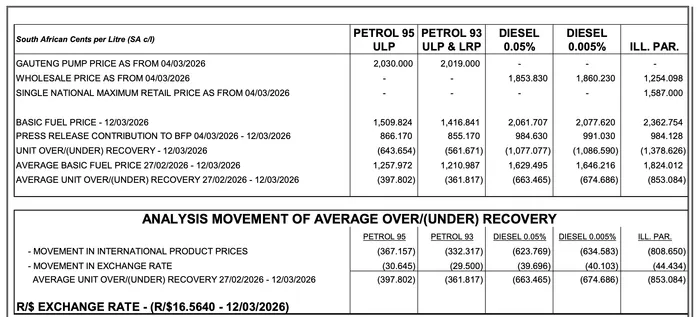
Latest analysis from the Central Energy Fund
Image: SCREENSHOT
The department’s data said the biggest pressure on prices was coming from higher international fuel prices, while movements in the rand-dollar exchange rate were also pushing costs up.
Global oil markets have been under pressure due to conflict in the Middle East.
The US and Israel carried out strikes on Iran late in February, with Iran responding and raising fears of a wider regional conflict.
The fighting has raised concerns about oil supply and shipping routes in the region, especially around the Strait of Hormuz.
The Strait of Hormuz is a narrow sea passage between Iran and Oman through which roughly a fifth of the world’s oil supply moves each day.
SA imports most of its crude oil and refined fuel, meaning local fuel prices are strongly influenced by global oil prices and the value of the rand.
Zero Carbon Analytics' Nick Hedley said SA was highly exposed to the conflict.
"SA is a net importer of crude oil and oil products," he told IOL.
"Fuel prices will be pushed higher by two factors: the much higher oil price, and the weakened rand as investors flee to safe-haven assets, mainly the US dollar.
"This will push up inflation throughout the economy, given that people, food, and goods are mostly transported by road."
SA saw a similar shock after Russia invaded Ukraine in February 2022, triggering a global energy crisis that pushed oil, food and fuel prices sharply higher.
Inflation in SA rose by 2.1 percentage points in the months that followed, climbing from 5.7% to 7.8% in just five months, with food inflation reaching 10.1% by July 2022 as prices for grains, cooking oils, fish and meat surged.
This also led to higher borrowing costs as the SA Reserve Bank raised interest rates to contain inflation.
The central bank lifted interest rates by 4.25 percentage points in the 15 months after the Russia-Ukraine war began.
"Unless the war ends soon and the Strait of Hormuz is reopened, we are likely to see something similar to the shock that hit when Russia invaded Ukraine," Hedley said.
Hedley said SA also did not learn enough from the Russia-Ukraine energy shock.
"Unfortunately, SA didn't learn its lesson that time," he said.
"We should have mitigated against future shocks by working to reduce our dependence on imported fossil fuels, which means promoting a shift to electric vehicles and rail."
IOL