

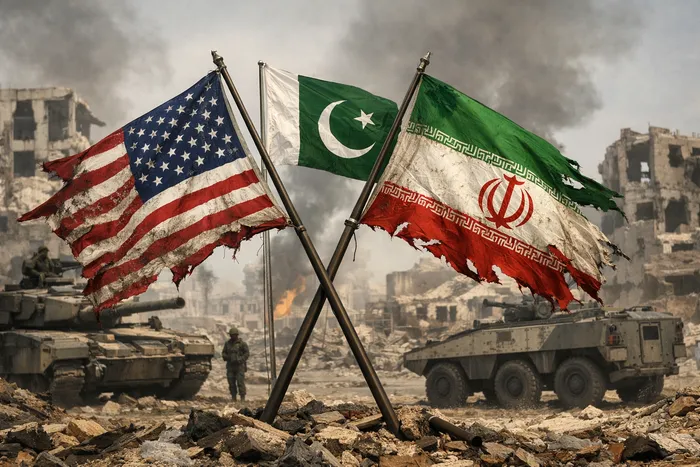
The Pakistan is set to host talks between the United States and Iran following a ceasefire agreement. But Pakistan has not been spared from troubles caused by the war
Image: Sora
As of March 2026, Pakistan’s economic outlook remains closely tied to movements in global oil markets, with fluctuating crude prices continuing to pose a key risk to inflation, the external account and overall financial stability. Although international oil prices have recently stabilised in the mid 80 dollar per barrel range, or roughly around 1600 rand, the memory of earlier spikes above 110 dollars per barrel (about 2090 rand) continues to weigh on policy expectations and market sentiment.
The earlier surge was driven by geopolitical tensions in the Middle East, particularly fears of disruption in the Strait of Hormuz, through which a significant share of global oil exports passes. While the immediate risk of closure or severe disruption has eased, analysts caution that the situation remains fluid and highly sensitive to any renewed escalation.
For Pakistan, which imports the majority of its petroleum products, even moderate shifts in global oil prices have immediate domestic consequences. The country’s energy import dependence means that changes in crude oil prices quickly translate into adjustments in fuel prices, transport costs and broader inflation trends.
In early 2026, Pakistan’s inflation trajectory has shown relative improvement compared to the crisis period of previous years. Headline inflation has stabilised in the upper single digits, reflecting tighter monetary policy and some easing in food supply pressures. However, underlying inflation remains persistent, particularly in energy and transport related categories, which continue to act as key drivers of household cost pressures.
Fuel pricing remains one of the most sensitive economic and political issues in the country. Petrol and diesel prices are adjusted frequently in response to global oil movements and exchange rate fluctuations. Even with recent stability in international crude prices, domestic fuel costs remain elevated by historical standards, keeping transport expenses high for consumers and businesses.
Economists warn that the situation could deteriorate quickly if global oil prices rise again. Under a stress scenario where crude moves toward 120 to 130 dollars per barrel, or approximately 2280 to 2470 rand, Pakistan could see a sharp increase in domestic fuel prices. Estimates suggest petrol could once again approach or exceed 390 Pakistani rupees per litre, significantly increasing inflationary pressure across the economy.
The transmission mechanism is well established. Higher fuel prices increase transport costs, which then feed into the prices of food, manufactured goods and essential services. Given Pakistan’s reliance on road transport for the movement of goods, the pass through from fuel to inflation tends to be both rapid and widespread.
Pakistan’s external vulnerability remains a central concern. The country continues to spend around 15 to 17 billion dollars annually on petroleum imports, making energy one of its largest import categories. This creates persistent pressure on foreign exchange reserves and the current account, particularly during periods of rising global oil prices.
Even when oil prices stabilise, Pakistan’s exchange rate dynamics can amplify domestic fuel costs. A weaker rupee increases the local currency cost of imports, meaning that global oil price stability does not always translate into domestic price stability. This dual exposure to both oil markets and currency fluctuations remains a key structural weakness in the economy.
The government continues to adjust fuel prices in line with global market conditions, but this approach has also contributed to inflation volatility. While price pass through helps manage fiscal pressure by reducing subsidies, it also exposes consumers to frequent increases in transport and energy costs.
Beyond petrol and diesel, liquefied petroleum gas is another important energy source for households and small businesses in Pakistan. LPG is widely used in areas without access to piped natural gas, and its price remains closely linked to global energy trends. Although supply conditions have remained relatively stable in early 2026, pricing continues to reflect international market uncertainty and shipping costs.
Energy economists in Pakistan note that while supply chains are currently functioning without major disruption, the system remains highly exposed to external shocks. Any escalation in geopolitical tensions in the Middle East could quickly affect shipping routes, insurance costs and import prices, feeding directly into domestic inflation.
Pakistan’s broader economic recovery remains fragile. Although macroeconomic indicators have improved compared to the peak of the crisis period, growth remains constrained by high costs of production, tight financial conditions and ongoing external account pressures. Inflation control remains one of the central priorities of economic policy.
The State Bank’s monetary tightening over the past two years has helped stabilise inflation expectations, but it has also slowed economic activity. As a result, policymakers face a delicate balancing act between supporting growth and maintaining price stability, particularly in an environment where external shocks such as oil price spikes remain a constant risk.
Looking ahead, most projections suggest that oil prices will remain volatile rather than trend sharply in one direction. For Pakistan, this means continued exposure to external shocks that can quickly disrupt inflation trends and fiscal planning.
Structural reforms aimed at reducing energy import dependence are increasingly seen as essential. Investment in domestic energy production, renewable energy expansion and improved energy efficiency are all part of longer term strategies to reduce vulnerability.