

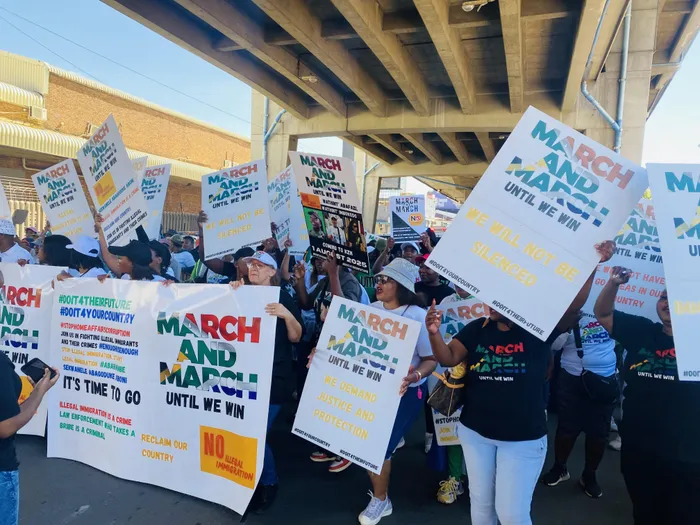
Demonstrators carry placards calling for stricter action against illegal immigration during the march in Johannesburg.
Image: Simon Majadibodu/IOL
Nigeria is taking steps to facilitate the permanent repatriation of its citizens from South Africa, a move that signals growing alarm over escalating anti-migrant sentiments and a climate that is becoming increasingly hostile for foreign nationals.
The announcement follows weeks of mounting tension, with protests targeting foreign nationals and renewed concern over the treatment of undocumented immigrants.
Although Statistics South Africa (Stats SA) has maintained there is no accurate estimate of Nigerians living in the country illegally, reports in 2023 suggested that more than 500,000 Nigerians may be undocumented.
Frank Onyekwelu, president of the Nigerian Citizens Association in South Africa (NICASA), confirmed that the Nigerian Consulate is working closely with the organisation to assist those seeking to return home.
“The Nigerian Consulate in conjunction with NICASA has offered a free repatriation flight to any Nigerian who wishes to leave South Africa permanently, and the process is ongoing,” he said, adding that several individuals have already registered.
Many Nigerians have long viewed South Africa as a land of opportunity, but that promise is now increasingly overshadowed by fear.
Nigeria’s move to repatriate some of its citizens from South Africa comes against a backdrop of escalating tensions, violent unrest, and increasingly hostile rhetoric directed at foreign nationals, particularly Nigerians, across parts of the country.
In recent weeks, a series of flashpoints has underscored just how volatile the situation has become.
In the Eastern Cape, violence erupted in KuGompo after protests over the alleged coronation of a Nigerian traditional leader spiralled into chaos. Vehicles were damaged, buildings set alight and police were forced to intervene.
The unrest prompted the Nigerian High Commission in Pretoria to issue a stark warning, urging its citizens to “maintain a low profile at all times”, suspend social gatherings and avoid public demonstrations amid what it described as “palpable tension”.
Diplomatic strain has also begun to surface. Last month, Ghana summoned South Africa’s top envoy after a video circulated online showing a Ghanaian man being confronted and asked to produce immigration documents.
On the ground, anti-immigration movements have gained momentum.
Groups such as March and March have staged protests demanding the removal of foreign nationals from township economies, while Operation Dudula has intensified campaigns targeting foreign-owned businesses, often forcing shop closures and fueling confrontations.
The rhetoric has drawn sharp political responses.
Addressing supporters during a Workers’ Day rally in Marikana, EFF leader Julius Malema criticised the protests, warning that they risk misdirecting public anger.
“Let’s ask a question: after you march and say you don’t want Zimbabweans, Nigerians, and Ghanaians, you close their shops. Why are you then not telling us that you expelled 10 Zimbabweans and were able to give jobs to 10 South Africans?" he said.
Meanwhile, inflammatory content circulating on social media has further heightened tensions.
In one widely shared video, three Nigerian men are seen stomping on a South African flag while waving their own. In the footage, one of the men declares, "We love our country… leave us alone… stop killing our men.”
The video has sparked outrage and added fuel to an already charged environment.
Amid the rising tensions, President Cyril Ramaphosa used his recent May Day address to urge calm, calling on citizens to raise concerns about illegal migration through lawful channels rather than resorting to vigilantism.
"We did not walk alone into freedom. We were carried by a tide of solidarity from the nations of Africa, among many others," Ramaphosa said.
"These countries opened their borders to our liberation fighters. They shared their bread and their homes. They spoke for us when we could not speak for ourselves. The leaders and people of Africa kept our Struggle alive," Ramaphosa said.
Onyekwelu admitted that South Africa, like many nations around the world, has real problems with crime, unemployment, border security, and the strain on public resources.
“However, it is dangerous and unfair to reduce these complex socio-economic issues to anti-foreigner sentiments or to create the impression that foreign nationals are the primary cause of the country’s problems.”
The Star