

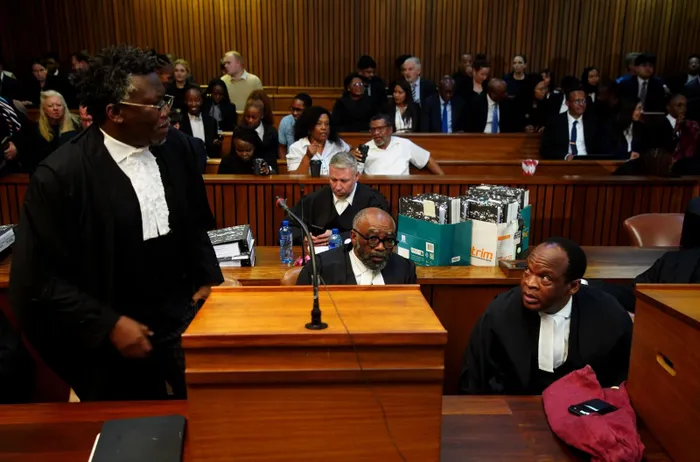
Advocate Tembeka Ngcukaitobi, who is appearing for three of the large law firms in the Legal Sector Code challenge, in court on Monday.
Image: Oupa Mokoena/Independent Newspapers
The country's leading legal experts were present in the public gallery of the Gauteng High Court in Pretoria on Monday to present their legal arguments in the legal challenge against and for the BEE Legal Sector Code (LSC), but the formal arguments won't begin until Tuesday.
The legal challenge, brought by four of the country’s biggest law firms – Deneys Reitz (earlier know as Norton Rose Fulbright), Webber Wentzel, Werksmans, and Bowmans, which will take a look at transformation in the legal profession, has been set down for the entire week.
The proceedings only resumed at lunchtime, as the parties have been in discussions with each other since Sunday. Advocate Tembeka Ngcukaitobi, who is representing three of the law firms, told Judge Nicolene Janse van Nieuwenhuizen that the discussions will meanwhile proceed, and they “may or may not” get somewhere with it. The nature of the discussions was not divulged.
The applicants also asked the court to consider holding the proceedings virtually, but the majority of the defendants, which include the justice minister and various law bodies, insisted on open court due to the public interest in the matter. They pointed out that members from the legal fraternity travelled from across the country to attend the proceedings. In ruling for the open court option, the judge, who is sitting with two other judges, commented that this is a matter of grave public interest.
Bowmans, Webber Wentzel and Werksmans argue that the LSC, in its present form, is unlawful, unworkable, and risks undermining, rather than advancing, meaningful broad-based transformation in the legal profession, harming the very people it is supposed to benefit. They will therefore ask the court to set aside the LSC.
The code was published by the Minister of Trade, Industry and Competition, Parks Tau, in September 2024.
In their heads of argument, the three firms make clear that they support meaningful, inclusive and sustainable transformation of the legal profession, both within their own firms and across the wider legal sector. Their case is that the current LSC is fundamentally misconceived in design and effect, and that it will hinder rather than advance meaningful broad-based transformation.
The LSC exempts more than 95% of legal practices from its requirements. According to the papers, legal entities with between one and three partners make up 95.07% of legal practices, yet the LSC does not apply to them because they fall below the turnover threshold for compliance. The firms argue that a code that applies to less than 5% of the profession cannot credibly transform the sector as a whole.
The firms further argue that the defects in the LSC have real-world consequences for broad-based transformation. According to them, if the LSC is allowed to stand, those most likely to lose are the people and institutions that rely on practical, broad-based pathways into and through the legal sector.
These, they say, include black law students, young graduates, black professionals in management, persons with disabilities, and the public-interest organisations that expand access to justice.
At the heart of the problem, they say, is that the LSC removes recognition for several proven transformation mechanisms under the Generic Codes. These include bursaries for black students, skills development for employees and learners with disabilities, and socio-economic development contributions.
The firms argue that these are not peripheral, but foundational to a functioning transformation pipeline: without investment in students, entry into the profession narrows; without support for disability-focused training, inclusion is set back; and without incentives for socio-economic contributions, organisations serving vulnerable communities, such as Probono.org and Black Sash, and the people who depend on them, are likely to be adversely affected.
The 12 respondents, which include the justice minister and several law bodies, are vigorously opposing the application.