

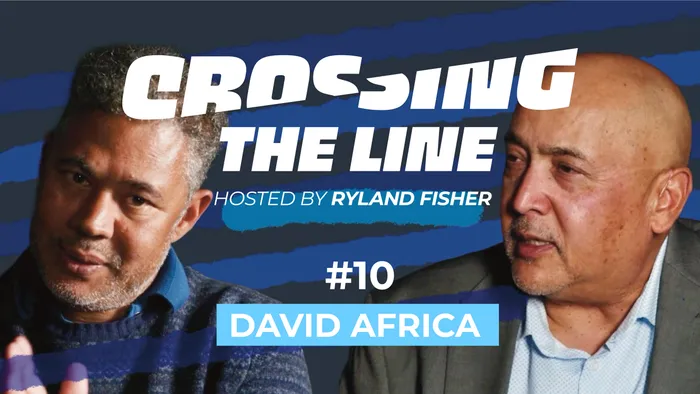
David Africa, author of Lives on the Line, a book which chronicles the role a police intelligence unit played in bringing down the militant wing of People Against Gangsterism and Drugs (PAGAD), is the featured interview in the Crossing the Line podcast this week.
Image: Crossing The Line
David Africa, author of Lives on the Line, a book which chronicles the role a police intelligence unit played in bringing down the militant wing of People Against Gangsterism and Drugs (PAGAD), is the featured interview in the Crossing the Line podcast this week.
Africa, who joined the police after being a member of the ANC’s military wing, uMkhonto we Sizwe (MK), also talks about the difficulties of joining the police service after 1994, integrating with people who used to hunt him and others as “terrorists”.
Crossing the Line is a weekly podcast show, founded by media veteran and former Cape Times editor, Ryland Fisher, who has already posted 17 podcasts on YouTube. IOL features one of the interviews every Thursday.
Africa spoke about how his mother instilled a love of reading in him, and how he preferred to operate behind the scenes.
He spoke about his introduction to the struggle against apartheid as a teenager, and joining the ANC’s underground structures shortly afterwards.
After Africa was trained in the ANC and MK, the ANC wanted to deploy him into the new defence force, but he decided to work for an NGO working with young people in the Western Cape. Later, he was integrated into crime intelligence in the police, where he had to work with people who, during the struggle, used to hunt him and his comrades.
“It was difficult, because we knew these people. We always used to see them monitoring anti-apartheid protests. They would also detain and torture student and youth activist. One of them used to come to my house often to look for me during the struggle days.
“I don’t know if it was more difficult for us or them. We were victorious. We were all supposed to be dead, but here we were at the same rank or higher than most of them. I think it was quite difficult for them to process.”
Africa spoke at length about how his police intelligence unit worked for many years to bring down PAGAD which had formed its own military wing and which appeared to be fighting against the democratically elected government.
Africa said he began writing the book 25 to 30 years ago, but he felt that it was inappropriate at the time. “Now that so much time has passed, I thought we could publish it now.”
“Because I was involved from the start, I have an analytic lens that others might not have or be interested in having.”
Africa said PAGAD had been started to raise the profile of those who started it, especially Qibla, and to oppose the democratic government, which Qibla had rejected. “I don’t think they expected PAGAD to grow so quickly.”
Africa also spoke the killing of Rashaad Staggie in front of his house in Salt River. Africa had tried to warn his colleagues that something like that could happen, but he was ignored. He said he did not believe there was any malicious intent by ignoring him.
He also spoke about why the police decided to issue subpoenas for the Cape Times’s special assignment team, Benny Gool and Roger Friedman, to give evidence against Staggie’s alleged killers, despite it happening in front of dozens of police and hundreds of other witnesses. The Cape Times, under Fisher’s editorship, opposed the subpoenas.