

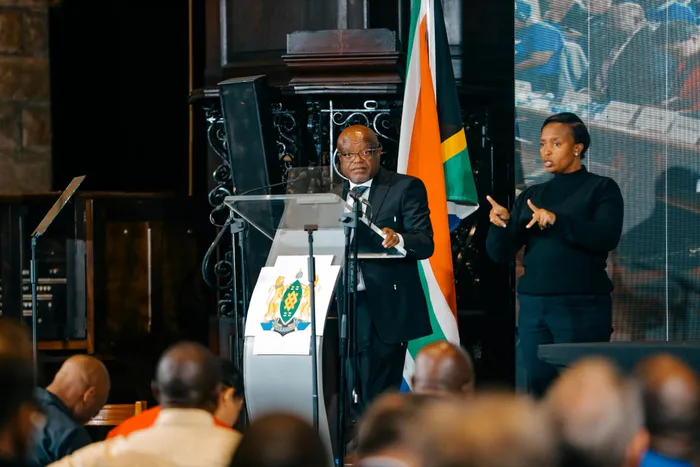
Johannesburg Mayor Dada Morero has promised to deliver services for the city residents on Wednesday.
Image: City of Johannesburg
Although his administration has a plan to rebuild, Johannesburg Mayor Dada Morero has cautioned that the city is finding it more and more difficult to meet the demands for housing, electricity, and basic services due to the fast expansion of informal settlements.
“We said we will electrify informal settlements. Informal settlements are increasing in the city. This challenge is impacting our backlog. No amount of complaining will help us,” Morero said during his State of the City Address on Wednesday.
The mayor said illegal land invasions were slowing down development and pushing the city deeper into crisis.
“When land is hijacked, development is set back by 10 years,” he warned.
Despite the mounting pressure, Morero said Johannesburg had managed to electrify 269 households in informal settlements while continuing efforts to expand basic services across affected communities.
His speech painted a picture of a city under severe strain, with ageing infrastructure, water shortages, financial difficulties, and electricity challenges threatening service delivery.
Morero revealed that Johannesburg’s infrastructure backlog has now exceeded R220 billion.
The city is also losing nearly half of its water supply through leaks, theft and damaged infrastructure, with non-revenue water losses sitting at 44.7%. Electricity losses have also climbed to 27.1%.
According to the mayor, Johannesburg currently supplies around 1 700 megalitres of water daily through more than 12 000 kilometres of pipes and infrastructure networks.
He said the city replaced more than 20 kilometres of water pipes during the year and provided sanitation access to nearly 1 800 additional households.
Morero defended his administration’s handling of the city’s finances, saying Johannesburg inherited deep financial problems.
“We inherited a broke city. Fact, not fiction,” he said.
The mayor announced that the city had adopted a fully funded R89.4 billion budget for the 2025/26 financial year and expects an operational surplus of R4.1 billion.
He also confirmed that Johannesburg plans to sell non-strategic assets, including vacant land tied to unpaid debts worth R3.2 billion, as part of efforts to stabilise finances.
The speech also addressed growing concerns over the city’s dispute with Eskom.
Morero said the city would work with Eskom and the national government instead of entering into conflict.
“We will not fight Eskom,” he said.
The Star yesterday reported that Eskom warned that it may interrupt electricity supply to parts of Johannesburg from July 8 after accusing the City of Johannesburg and City Power of failing to comply with a court-backed repayment agreement linked to an escalating debt now exceeding R5.2 billion.
According to the power utility, the city had failed to repay both historical debts and pay its current electricity account, despite a settlement agreement that was formalised by an order of the Gauteng High Court in Johannesburg in November 2025.
Morero revealed that the city was finalising a multi-million agreement with German development bank KFW to fund energy-related projects linked to City Power’s turnaround strategy.
The mayor also pledged tougher action against corruption and called on the National Treasury, Public Protector, and Special Investigating Unit to investigate the city’s finances.
Closing his address, the mayor urged residents to remain patient as Johannesburg attempts to recover from years of decline.
“Our journey is long. We must not tire,” he said.
Despite repeated attempts to project optimism and stability throughout the speech, the Organization Undoing Tax Abuse (OUTA) stated that the speech revealed the extent of Johannesburg's financial, infrastructure, and governance crises.
While OUTA welcomes the city's more open acknowledgement of Johannesburg’s serious challenges, including a reported R220 billion infrastructure backlog, severe utility losses, and growing financial pressure, the organisation says the address highlighted an increasing disconnect between a mayor’s political messaging and the lived reality experienced daily by residents.
“The speech attempted to present Johannesburg as a city on a path to recovery, yet many of the city's own admissions point to a municipality under severe strain,” said Julius Kleynhans, OUTA executive manager.
“Residents living through collapsing infrastructure, water outages, refuse failures, billing chaos, and deteriorating roads are unlikely to recognise the picture presented in this address.”
IOL Politics