

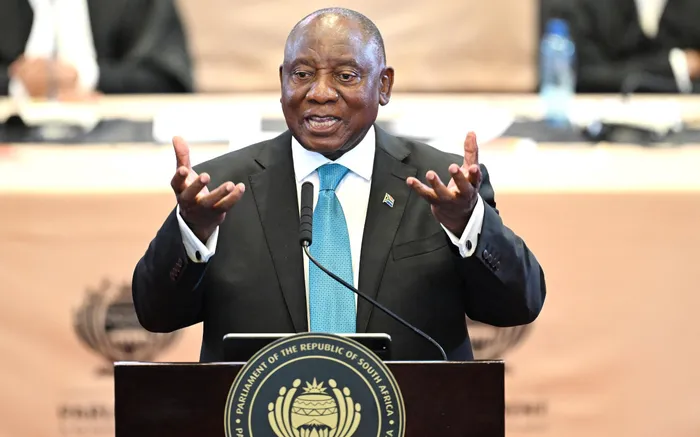
In an attempt to have the Section 89 independent panel report on Phala Phala declared illegal, President Cyril Ramaphosa has filed a lawsuit in the Western Cape High Court.
Image: GCIS / Phando Jikelo
President Cyril Ramaphosa has brought an application in the Western Cape High Court to have the Section 89 independent panel report on the Phala Phala scandal declared unlawful and set aside. He claims the panel relied on hearsay in its findings and acted outside its mandate.
This legal challenge was launched following a Constitutional Court (ConCourt) ruling that invalidated Parliament's December 2022 decision to block the report, which found Ramaphosa may have committed serious violations of the Constitution and the law, as well as serious misconduct regarding the Phala Phala scandal.
This ruling forced National Assembly Speaker Thoko Didiza to establish a 31-member impeachment committee to process the report.
In his court papers, Ramaphosa argues that the process and conclusions of the panel, chaired by former Chief Justice Sandile Ngcobo, are irrational and contrary.
Here are his key arguments:
The panel misunderstood its mandate
Ramaphosa argued that the panel was not expected to make prima facie findings against him, but was instead required to assess whether there was sufficient evidence to show that he was guilty of serious misconduct, something he said it had failed to do.
He added that the panel failed to determine whether sufficient evidence exists to show that he was guilty of serious misconduct. Ramaphosa argued that it “determined that the information before it disclosed, prima facie, that the President ‘may’ have committed” the alleged misconduct.
Hearsay and unlawful evidence
Ramaphosa argued that the panel erred fundamentally by relying on untested allegations. and “hearsay” submitted by former State Security Agency head Arthur Fraser.
He said the panel failed to distinguish between unverified information and admissible evidence, and based its conclusions on conjecture, speculation, and potentially unlawfully obtained material.
Ramaphosa stated that the panel wrongly relied on an audio recording whose provenance and accuracy had not been established, adding that the audio clip, along with a confidential Namibian police report, was treated as fact without verifying whether the information had been obtained lawfully.
He said the panel had no factual foundation to prove the subjective mental state required by the rules.
Exceeding powers
He argues the independent Section 89 panel exceeded its powers by fundamentally misunderstanding its preliminary mandate. Instead of assessing if there was “sufficient evidence” to justify a full impeachment inquiry, he claims the panel acted like a trial court, relying on hearsay, unverified information, and a lower prima facie standard to recommend his removal.
He said the panel exceeded its mandate by making damning recommendations without investigating his intent or bad faith at all.
Absence of malice or bad faith
He said the panel neglected to evaluate the core issue of his malicious intent, making it impossible to logically establish that there was adequate proof of his suspected wrongdoing.
Ramaphosa added that “serious misconduct”, as defined in the Rules of the National Assembly, “is confined to deliberate misconduct” by the President acting in bad faith. However, he said the panel did not inquire into his bad faith at all.
Procedural unfairness
Ramaphosa said the panel made adverse findings and critiqued his conduct on issues well outside the scope of the original four charges he was given to answer.
He argued the procedure was fundamentally unfair because the panel introduced new matters and speculation into its final text, preventing him from providing evidence or explanations before he was implicated.