

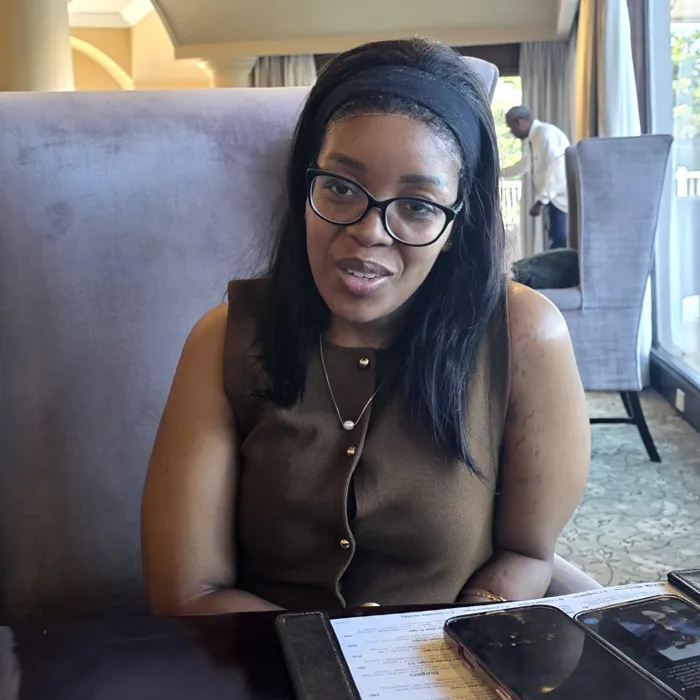
March and March leader Jacinta Ngobese-Zuma made some startling revelations to IOL's Zohra Teke.
Image: Supplied / Zohra Teke
She's loud, brash and carries an air of arrogance — or so I thought. That's the image of Jacinta Ngobese-Zuma playing out across the world: a raging, angry Zulu woman, idolised by some and vilified by others. So, I was prepared.
But, I did a double take as she walked into Durban’s Beverly Hills Hotel, the venue for our interview. Petite and immaculately dressed, she approached me — not that I expected her to march in, sjambok in hand. Yet, she was a shadow of the public persona that has come to define her. She looked fragile as she embraced me, apologising for running a little late.
Staff welcomed her warmly, brimming with excitement and wide smiles, many recognising her as we settled into comfortable chairs over coffee.
“I’m just so tired. I’m exhausted,” she whispered, slumping back into her chair, cupping her head in her hands. Soft-spoken. Vulnerable. Gentle.
A far cry from the fiery public figure dominating headlines. I was not expecting that.
Could this really be the same woman facing legal action from the South African Human Rights Commission? The same woman photographed carrying a knobkerrie while marching through the streets demanding undocumented foreigners leave the country?
“So, who is Jacinta?” I ask, trying not to betray my surprise at her vulnerability.
She smiles, almost shyly, takes a deep breath and introduces herself in a soft voice.
“I’m originally from Eshowe, grew up in KwaMashu before moving to Johannesburg, where I attended high school and university. I come from a radio background. I’m a wife, mother, law student, activist and farmer,” she explains.
Forty-year-old Ngobese-Zuma is arguably one of South Africa’s most talked-about figures at present — founder of the controversial movement, March and March, and the face of growing anti illegal immigrant sentiment sweeping across the country. But how did she go from being an award winning radio presenter to that?
“I was becoming more and more affected by children being kidnapped, drugs coming into our communities and it was always a foreign national behind it. It gave me sleepless nights. I couldn't ignore the cries of mothers who couldn’t access healthcare or secure spaces in schools for their children, because facilities were overwhelmed — in many cases by undocumented immigrants. I had to do something. It’s not because I was personally affected. I live a comfortable life. But I couldn’t watch what was happening while nobody seemed to care so just decided we had to organise a protest march. I put it on social media and thats how it all blew up. I didn’t expect the movement to grow the way it has, but here we are — raising issues government ignored for years.
“What we want is for undocumented immigrants to be returned so that limited resources benefit poor and vulnerable South Africans. Every country prioritises its own citizens. Why shouldn’t South Africa?” she asks.
Sounds like a noble cause. After all, debates around undocumented migration are unfolding globally, and South Africa is no exception.
Against the backdrop of rising unemployment, increasing drug addiction, concerns over organised crime, and an illicit economy estimated to be worth close to R1 trillion, it's not surprising that movements like March and March have gained traction and public support amongst poor communities.
But for many, it's how the message is delivered. Images of foreign nationals shutting down their businesses, some reportedly fleeing from South Africa, have dominated media coverage. Reports of Ghanaian nationals returning home amid growing hostility and calls for foreigners to leave have intensified debate around migration and social tensions. More recently, scenes of foreign-owned shops being looted have played out, alongside chilling warnings of a June 30 deadline for undocumented immigrants to leave South Africa.
It's created a diplomatic crisis on the African continent. South Africa, once known for its ubuntu, warm hospitality and a forgiving nation, is now being labelled xenophobic. And the woman sitting opposite me is being blamed for that. Ironic that she was also nominated for continental recognition at the Ladies in Media Awards in Ghana in 2024 – a country that has since lashed out at her over the anti immigrant debacle.
But Ngobese-Zuma is adamant that she—and March and March—are being misrepresented in the media.
“We are not xenophobic. What we want is for undocumented immigrants to return to their countries so that limited resources benefit South Africans, especially the poor who suffer the most. Every country prioritises its own citizens. Why shouldn’t South Africa?” she asks.
But why not hold those who can do something about it to account?
“Zohra… I’ve tried,” she says quietly, her voice trailing off as she cups her head again — this time struggling to hold back tears — and it was not staged. This was a woman exhausted. A woman seemingly overwhelmed by the weight of carrying too much. Women instinctively recognise it.
“I’m tired of constantly being painted as the leader of a vigilante group that goes around attacking foreigners. That's not who we are. What people don’t know is that we met with the ministers of health and education, and approached police. We asked authorities to accompany us to verify undocumented foreigners, but we were told there was no capacity and insufficient resources. We condemn attacks, looting and violence. I say this all the time. Those involved should be arrested because they are opportunists using our cause and name for criminal activity," she explains.
But I probe. "It doesn't help having Zulu men running the streets armed with knobkerries and sjamboks does it? It does make the group look vigilante even if it's not? I ask.
"But even at weddings and other celebrations the men carry knobkerries and things like that, doesn't mean they're preparing for an attack? It's part of Zulu tradition," she replies.
I can see and respect cultural traditions as a South African. We sing at funerals, toyi-toyi when protesting and dance when unhappy too. But brandishing a sjambok during a protest while confronting a human being—legal or not—can be easily misconstrued and evoke sympathy for illegal immigrants even when not justified.
But, Ngobese-Zuma insists the social explosion has been long overdue – and that focus must be on addressing the issue of illegal immigrants and some of the ills affecting communities as a result. Reports of counterfeit medicines, expired food and substandard goods allegedly being sold in poorer communities through some spaza shops allegedly owned by undocumented foreigners have only fuelled public anger.
The result is a combustible social climate.
But does that justify the methods? Can public frustration justify women and children being chased from hospitals? And should a civic movement be conducting immigration-related operations?
“March and March has never entered hospitals,” Ngobese-Zuma says firmly.
“Other groups may have done that, but we know our boundaries. We have always stood outside hospitals.
“Our plea is simple: South Africans must come first. Politicians are self-serving and lining their pockets — that’s why they don’t care, one minister told me that openly. Some are benefitting from illicit goods entering the country.
“Investors spend billions creating jobs, but many now face retrenchments or closure because they can't compete with counterfeit goods flooding the market. And where do those fake products end up? In poor communities.
“Fake Coca-Cola, counterfeit medicines and substandard food are being produced while politicians do nothing,” she says, emotion overtaking her. She pauses. This time, the tears flow freely.
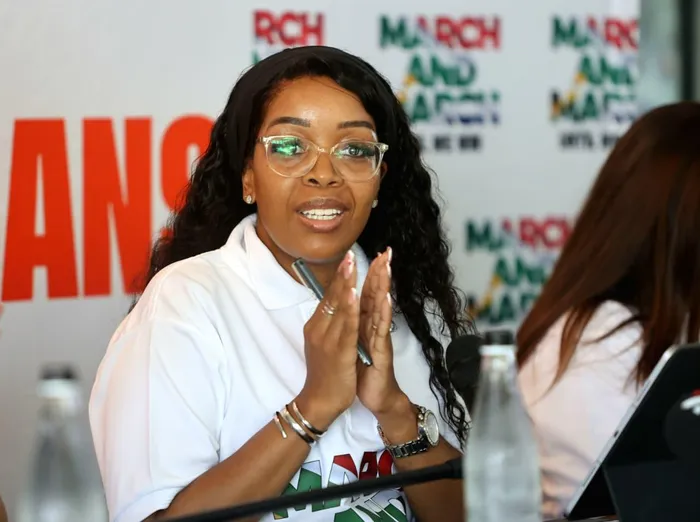
Jacinta Ngobese-Zuma, leader of the March and March movement, addresses speculation about her political ambitions and clarifies her stance on potential affiliations with ActionSA and other parties.
Image: Tumi Pakkies / Independent Newspapers
“I’m tired. So tired of fighting this while nobody seems to care. But I feel we owe it to our children and the next generation to make sure they don't suffer because people stayed silent. When 120 parents call saying, ‘Please help; my child cannot get a place in school because it's filled with 500 foreign immigrants, how do you ignore that? This is about undocumented foreigners — people entering the country illegally, straining resources and systems.
“There is no record of who they are, their history or their healthcare status. Some use healthcare services, collect medication and resell it. What is xenophobic about wanting undocumented migrants removed?” she asks.
Yet, it is not a fight she believes she can take on alone. The frustration, I sense, lies in battling a system. She agrees.
“Our government has been found wanting. I don’t think they have a plan. On the one hand, they want to maintain diplomatic relationships, but on the other, they know we cannot continue supporting undocumented migration at current levels. I even made a presentation to Parliament outlining solutions, but nothing happened.
“We desperately need new leadership. A president willing to act. Things are falling apart, and our leaders simply don’t care,” she says, visibly frustrated and exhausted.
Is she punting a political party, I wonder. There's speculation that she could enter politics or launch a political party, with several parties reportedly courting her.
But she dismisses the idea.
“I’m not doing this for fame or votes,” she says.
“I have offers from eight political parties, but I’m not interested. I’m tired. I just want government to put South Africans first and to do more to address the issue of illegal foreigners and stop making excuses why they can't," she says.
IOL