

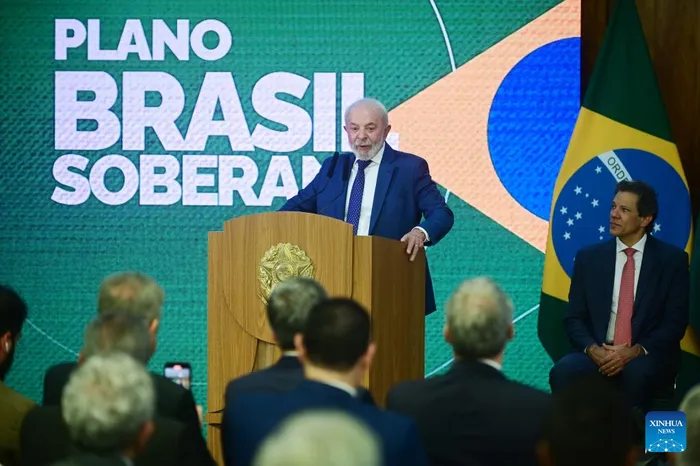
Brazilian President Luiz Inacio Lula da Silva speaks at the launch ceremony of Sovereign Brazil initiative held in Brasilia, Brazil, Aug. 13, 2025. Brazil on Wednesday launched a package of measures to support exporters hit by a 50 percent tariff imposed by the U.S. government. The initiative, called Sovereign Brazil, provides 30 billion reais (about 5.562 billion U.S. dollars) in affordable loans, tax breaks and other measures, prioritizing small businesses and those dealing in perishable foods.
Image: XINHUA
Brazil’s conservative bloc is facing its most profound identity crisis in a generation. Jair Bolsonaro, once the dominant force of the country’s right wing, is now behind bars for attempting to subvert the 2022 election result. His 27-year sentence has left a political vacuum, while the implosion of his family’s credibility has intensified the scramble for a new standard-bearer. The former president’s long-standing alignment with Donald Trump has lost its potency, especially as Washington’s intervention has backfired and tarnished the family’s political capital.
Bolsonaro’s fall has been as dramatic as his rise. Arrested in November after breaking the conditions of his house arrest by tampering with his electronic ankle monitor, he now faces the prospect of spending the remainder of his life in prison. His claim that medication-induced hallucinations prompted him to take a soldering iron to the device did nothing to ease the public perception that the movement he founded has descended into chaos.
The damage extends to his three politically active sons. Eduardo Bolsonaro, once a record-breaking congressman, is now living in self-imposed exile in the United States to avoid prosecution for obstructing justice. His lobbying in Washington for Trump-backed sanctions on Brazil, intended to pressure the Supreme Court to drop the coup case, provoked outrage at home and helped deepen the rift between the family and Brazil’s economic elite. Flávio Bolsonaro, a senator and another presidential hopeful, is facing heavy scrutiny after organising a rally outside his father’s home that authorities said posed a serious threat to the integrity of Bolsonaro’s house arrest.
For many of Brazil’s business and political leaders, the Bolsonaro family has squandered the movement’s once strong appeal. Their strategic miscalculations, amplified by their increasingly erratic behaviour, have fuelled calls for a new conservative figure capable of challenging President Luiz Inácio Lula da Silva in next year’s elections.
Bolsonaro’s trial for plotting a coup has not only shattered his personal future but re-ignited fierce national polarisation. Brazil’s Independence Day this year was marked not only by traditional parades and festivities but by rival rallies: some defending democracy, others declaring Bolsonaro a political victim.
The charges are severe. They include proposing a coup to senior military commanders, knowing of a plan to assassinate Lula and Supreme Court Justice Alexandre de Moraes, and inciting supporters to storm government buildings on 8 January 2023. Bolsonaro insists the case is politically motivated, a position echoed by Trump, who has branded it persecution.
Yet many Brazilians view the events of 8 January as an unmistakable attack on democratic institutions. Images of rioters vandalising the Supreme Court and Congress remain etched in the national memory, prompting renewed debate about the fragility of Brazil’s post-dictatorship democracy. Critics argue that Bolsonaro sought to establish authoritarian rule; his supporters counter that the judiciary has overstepped its mandate by aggressively prosecuting those involved in the unrest.
The Supreme Court, long cast as the guardian of Brazil’s democratic order, is now at the heart of the storm. Its judges have faced intense criticism from Bolsonaro allies, who accuse them of politicising the judicial process. Justice Moraes, both the rapporteur in Bolsonaro’s case and a target of the alleged assassination plot, has become a symbol of this dispute.
For supporters of the court, its robust intervention is essential to safeguarding democratic norms and curbing online extremism. For Bolsonaro’s base, it represents judicial overreach and selective enforcement. The prosecution of some rioters, including a mother of two initially sentenced to 14 years for scrawling graffiti during the 8 January unrest, has further fuelled allegations of excessive punishment and double standards.
With Bolsonaro’s political brand collapsing, attention has turned to Tarcísio de Freitas, the governor of São Paulo and a former infrastructure minister in Bolsonaro’s cabinet. Seen by business leaders as pragmatic, technically skilled, and electorally viable, he is widely regarded as the right’s strongest alternative for the 2026 presidential race.
De Freitas enjoys support among economic elites and has remained loyal to Bolsonaro, backing the unsuccessful campaign for a presidential pardon. Yet his presidential ambitions hinge on whether Bolsonaro will endorse him and whether the former president will abandon efforts to keep the dynasty alive by installing one of his sons as a candidate.
Infighting within conservative ranks has already begun. Eduardo Bolsonaro has attacked de Freitas as an “establishment candidate”, while advisers close to the São Paulo governor say he is increasingly inclined to run. A final decision is expected by early next year, with electoral rules requiring him to resign his governorship by April should he enter the race.
Despite being 80 years old, President Lula remains an energetic campaigner and intends to seek a fourth term. Brazil’s economic resilience, shielded from US tariffs by its low dependence on American markets, has boosted his standing. Rising wages, job creation, and active diplomacy have further strengthened his position.
The right’s best hope lies in public frustration over crime and security. Lula’s recent remarks describing drug traffickers as “victims” provoked a national backlash, compelling him to apologise. If crime dominates next year’s electoral agenda, de Freitas’s law-and-order credentials may give the conservative camp a fighting chance.
Brazil’s right wing is now confronting a stark choice: redefine itself beyond the Bolsonaro family, or risk squandering its influence for a generation. Whether Bolsonaro grants de Freitas his blessing or clings to the dream of a family successor, determines whether the conservative movement would be stabilised or continue to fracture.
For now, Brazil remains deeply divided. To Bolsonaro’s critics, his trial protects democracy from another authoritarian turn. To his remaining loyalists, it is unjust persecution for a coup they insist never happened. As the country braces for the next election, the future of Brazilian conservatism hangs in the balance.
Written By:
*Dr Iqbal Survé
Past chairman of the BRICS Business Council and co-chairman of the BRICS Media Forum and the BRNN
*Cole Jackson
Lead Associate at BRICS+ Consulting Group
Chinese & South America Specialist
** MORE ARTICLES ON OUR WEBSITE https://bricscg.com/
** Follow https://x.com/brics_daily on X/Twitter for daily BRICS+ updates