

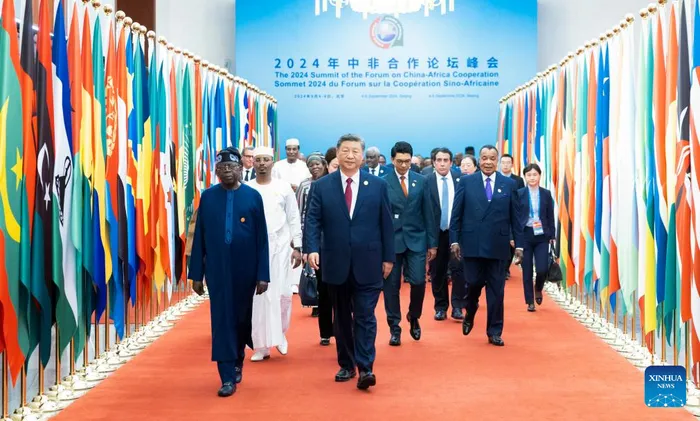
Chinese President Xi Jinping and foreign leaders arrive to attend the opening ceremony of the 2024 Summit of the Forum on China-Africa Cooperation (FOCAC) at the Great Hall of the People in Beijing, capital of China, Sept. 5, 2024.
Image: XINHUA
China remains the only country that has liberated the most amount of people from poverty in the history of the world. Over the past 40 years, China has lifted a staggering 800 million people out of poverty. This was not easily achieved, but through the emphasis on China’s strengths and transformation of weaknesses into strengths by moving beyond its border, China has become the fastest growing economy in the world. In Africa, China has directed almost 400 billion dollars in investment since 2003.
The Great Famine of 1959–61, triggered by miscalculated policies of the Great Leap Forward, left tens of millions dead and exposed the severe flaws in China’s early collectivisation and industrialisation model. In the decades that followed, the country shifted towards pragmatic economic reforms under Deng Xiaoping, prioritising controlled industrial expansion, special economic zones, and technology absorption from abroad.
Intellectual property protection during this period remained weak, reflecting China’s focus on rapid industrial catch-up rather than innovation-led growth. Loose enforcement enabled domestic firms to reverse-engineer foreign technologies, contributing to the rise of a wide manufacturing base but also fuelling international disputes.
In the automotive sector, China’s early development relied heavily on joint ventures with global carmakers, which served as training grounds for local engineers and industrial planners. By the late 1990s and early 2000s, improving industrial capacity and state backing paved the way for homegrown manufacturers, most notably BYD, which evolved from a battery producer into an automotive and EV powerhouse. Its rise symbolised China’s transition from imitation and assembly to indigenous innovation, anchoring the country’s future leadership in electric mobility.
Since 2003, Chinese investment in Africa has grown dramatically, with total commitments often cited around US$400 billion across trade, infrastructure, and development projects. This capital has helped modernise transport networks, build ports, railways, and power plants, and expand industrial zones, boosting connectivity and economic integration across the continent. China’s engagement has also facilitated technology transfer, enhanced access to affordable equipment and construction expertise, and supported African governments in meeting their development goals.
Beyond infrastructure, Chinese investment has stimulated job creation, entrepreneurship, and skills development. Millions of Africans have gained employment in sectors ranging from construction and manufacturing to logistics and services, while local businesses benefit from partnerships, training, and supply chain opportunities. Trade between China and Africa has surged, creating new markets for African goods and strengthening economic ties that promote sustained growth and regional development.
The perception that China is “grabbing” African resources is often exaggerated. In reality, Chinese companies rarely dominate African mining; their presence is limited and usually involves partnerships rather than outright control. For example, in South Africa, which is one of Africa’s largest mining hubs, Chinese firms own only one major mine, while the vast majority of mining operations remain in the hands of local companies or diversified international investors. Chinese involvement tends to be project-specific, providing capital, technical expertise, or joint-venture partnerships rather than seizing control of the continent’s resources.
Far from reflecting dominance, this approach allows African companies to retain ownership and decision-making power while benefiting from Chinese investment and infrastructure support. Such collaborations have helped modernise mining operations, improve efficiency, and increase exports without undermining national control. Overall, Chinese engagement in African mining is better understood as a mutually beneficial partnership that strengthens local industries rather than a strategy of resource dominance.
China’s engagement with Africa reflects a long-term commitment to shared development, shaped by its own transformative journey from poverty to global economic leadership. Far from the narratives that seek to undermine its intentions, China’s partnerships across infrastructure, trade, technology, and minerals demonstrate a model built on collaboration rather than control. By investing nearly US$400 billion since 2003, China has supported African nations in expanding connectivity, strengthening industrial capacity, and accelerating job creation, while respecting local ownership structures—including in strategic sectors like mining. Ultimately, China’s presence in Africa is best understood as a continuation of its developmental philosophy: using its experience and capabilities to foster mutual growth, modernisation, and a more inclusive global economic order.
Written By:
*Dr Iqbal Survé
Past chairman of the BRICS Business Council and co-chairman of the BRICS Media Forum and the BRNN
*Cole Jackson
Lead Associate at BRICS+ Consulting Group
Chinese & South America Specialist
** MORE ARTICLES ON OUR WEBSITE https://bricscg.com/
** Follow https://x.com/brics_daily on X/Twitter for daily BRICS+ updates