

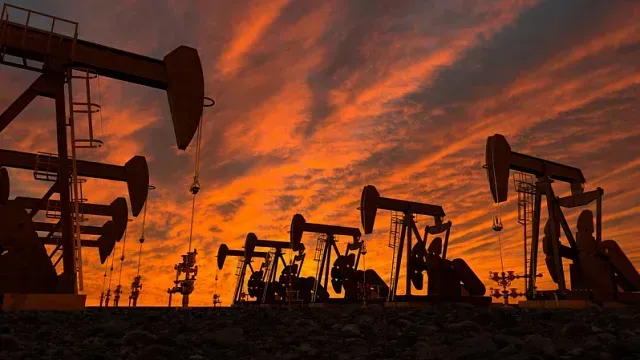
The country's Ministry of Petroleum and Mineral Resources intends to maximise production rates
Image: TV BRICS
Syria’s energy map is beginning to shift in ways that seemed impossible just a few years ago. Four major Saudi firms, Taqa, Argas, Ades Holding and Arabian Drilling have quietly secured agreements to develop and service fields across the country, signalling a new phase in the region’s political realignment and the early stages of Syria’s economic reconstruction.
The deals, confirmed through Saudi government channels, give the companies access to a portfolio of onshore gas and oil assets long neglected due to conflict, sanctions and the fragmentation of territorial control. For energy analysts tracking Syria’s slow re-entry into regional economic structures, the move represents the clearest evidence yet that Gulf investors are positioning themselves early in what could become a high-reward recovery cycle.
Ades Holding, a large regional drilling and well-services firm listed in Saudi Arabia, secured the widest mandate. The agreement grants the company responsibility for bringing five gas fields back into operation, including Abu Rabah, Qamqam, North Al-Faydh, Al-Tiyas and Zumlat Al-Mahar. These fields have historically been modest producers but remain structurally important to restoring Syria’s grid stability and powering domestic industry.
Sources familiar with the deal say the remit includes not only extraction but facility upgrades, infrastructure rehabilitation and future field expansions. For a country that has seen its energy infrastructure bombed, looted and left idle for over a decade, even small-to-mid-sized fields can have outsized economic importance.
Saudi-listed Ades’ involvement makes commercial sense: the company specialises in high-risk, underdeveloped plays and has been expanding its footprint across the Middle East and North Africa. While its share price has hovered around SAR 17.20, the long-term upside in frontier markets has historically been part of the firm’s investment thesis.
Beyond production, Syria needs reconstruction expertise. Taqa’s master services agreement directly targets that gap. The firm, which has operations across the region will oversee maintenance, well rehabilitation, field engineering and the complex technical work needed to return the sector to pre-war functionality.
This matters because Syria’s recovery is not simply an issue of finding hydrocarbons; it is about rebuilding the pipelines, compressors, pumping stations and storage systems that allow gas to reach power plants and oil to reach refineries. For more than ten years, domestic output has been unable to meet demand, forcing Syria to ration electricity, shut factories and rely on politically fraught fuel imports.
Argas, another Saudi firm specialising in subsurface studies, will partner with the Syrian Petroleum Company to conduct 2D and 3D seismic surveys. This is one of the clearest indicators that Syria is preparing for a long-term re-entry into the exploration cycle. Updated seismic imaging is essential for attracting larger foreign investors, as many of Syria’s old field maps and geological models are based on decades-old data.
If the surveys confirm economically viable deeper reservoirs or untapped zones beneath previously drilled fields, Syria could see an entirely new wave of drilling beyond the Saudi agreements. In other conflict-affected states, seismic mapping has often been the first step in a phased return of international energy companies.
The fourth agreement brings Arabian Drilling into the picture. The company will deploy rigs for new wells and undertake workover operations on existing ones. Workovers, essentially the process of reviving wells with declining pressure, are often the fastest way to boost output in a recovering sector. With stable security in parts of central and western Syria, several fields could potentially return to service within a relatively short timeframe.
Arabian Drilling’s workforce-training component, included in the agreement, suggests the intention is not a quick commercial exit but a sustained presence in Syria’s energy ecosystem.
These deals unfold against the backdrop of Syria trying to reassemble a broken energy system. The country has announced plans for a new refinery, new desalination capacity and renewed natural gas exploration. In September, Syria exported 600,000 barrels of heavy crude, its first official shipment in 14 years, an early sign of the government’s confidence in regaining partial control of its export channels.
Official projections show output could reach 200,000 barrels per day, though hitting that target will require significant investment and operational stability.
The agreements also represent a deeper regional shift. Saudi Arabia and Syria revived diplomatic and economic ties earlier this year, and energy cooperation is a cornerstone of that engagement. Analysts note that Saudi investment offers Damascus both capital and political cover as it attempts to diversify partners after years of reliance on Iran and Russia.
Adding to the geopolitical complexity, Washington terminated a sanctions programme targeting Syria last year, a move that lowers the immediate legal risk for companies entering the market but does not eliminate all compliance concerns.
For Riyadh, early access to Syrian energy assets fits into its wider strategy of building influence across the Levant while securing fresh commercial opportunities for its rapidly growing energy services sector.
Whether these deals translate into substantial production remains to be seen. Field rehabilitation in conflict-affected states is often slow and expensive. Yet the direction of travel is unmistakable: Syria is reopening its energy industry, and Saudi companies are among the first movers.
If successful, the partnerships could help stabilise Syria’s electricity supply, restore industrial activity and generate revenue for a state still grappling with war-time damage. For Saudi firms, the early-stage risk offers access to low-cost reserves in a market that is only now beginning to reassemble itself.
Written By:
*Chloe Maluleke
Associate at BRICS+ Consulting Group
Russian & Middle Eastern Specialist
** MORE ARTICLES ON OUR WEBSITE https://bricscg.com/
** Follow https://x.com/brics_daily on X/Twitter for daily BRICS+ updates