

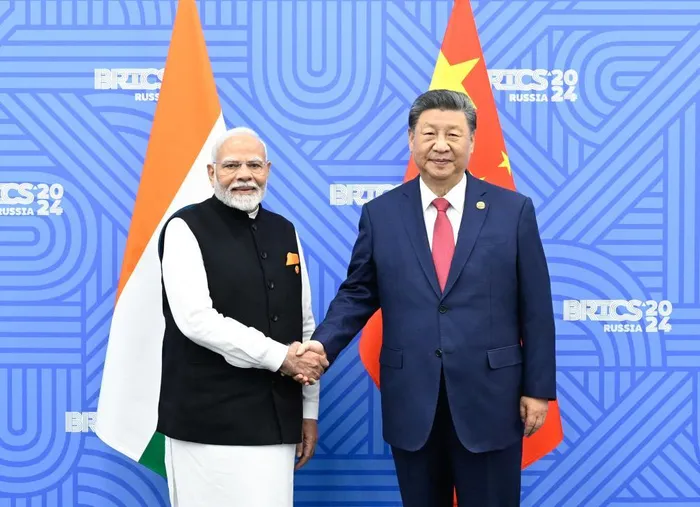
Chinese President Xi Jinping meets with Indian Prime Minister Narendra Modi on the sidelines of the 16th BRICS Summit in Kazan, Russia
Image: XINHUA
India’s economic outlook has come under fresh pressure as escalating tensions in the Middle East feed into higher energy costs, renewed inflation risks, and growing geopolitical uncertainty around critical shipping routes.
Credit rating agency Moody's Ratings has cut India’s growth projection for the 2026–27 fiscal year to 6%, down from an earlier estimate of 6.8%.
The revision reflects concerns that the ongoing US–Israel conflict involving Iran is destabilising global energy markets and placing upward pressure on oil prices.
According to the agency, India’s strong dependence on imported energy makes it particularly vulnerable to disruptions in supply chains linked to the Gulf region. Higher input costs, softer industrial output, and weaker private consumption are expected to weigh on momentum, alongside slowing investment activity.
Moody’s also warned that inflation risks are tilted to the upside, noting that while price pressures remain contained for now, geopolitical shocks could quickly reverse that trend.
At the centre of these risks is the Strait of Hormuz, through which a significant share of global oil flows transit.
Recent disruptions linked to the conflict have pushed oil prices above the $100 per barrel threshold at various points, intensifying concerns for import-dependent economies such as India. The country sources the vast majority of its crude oil and liquefied petroleum gas from Gulf suppliers, with most shipments passing through the Strait.
The situation has already prompted domestic adjustments in India, including prioritising household energy supply and tightening industrial allocations in certain sectors such as manufacturing and petrochemicals.
In response to the growing instability, the United Kingdom and France are convening military planners from more than 30 countries in London to discuss a multinational initiative aimed at safeguarding navigation through the Strait of Hormuz.
The discussions follow earlier diplomatic engagement in Paris involving over 40 nations, and form part of a broader effort to translate political consensus into a coordinated maritime protection framework.
India has been invited to participate, but has not yet confirmed its role. New Delhi has previously raised concerns at the United Nations over disruptions to the waterway, but is weighing its response carefully given its balancing act between strategic partners in the West and the wider Global South.
BRICS has not shown division; rather, member states have largely aligned in principle but issued varied national statements reflecting their individual diplomatic positions. The bloc continues to emphasise de-escalation and multilateral dialogue, with no unified condemnation issued under India’s chairship.
The bloc has not yet issued a unified statement on the conflict, marking a shift from previous crises where it more directly condemned military action in the region.
Individual members have taken different positions. Russia and China have criticised the strikes and called for de-escalation, while South Africa has pushed for a ceasefire and offered mediation. India, meanwhile, has maintained a more cautious tone, emphasising dialogue and stability without directly condemning the attacks.
India’s role reflects its evolving strategic priorities, including its deepening ties with the United States and Israel alongside its continued role in BRICS.
India, now the world’s fourth-largest economy, hosting the largest population in the world, faces a complex set of external pressures. It remains heavily dependent on imported energy, with more than 80% of its requirements sourced internationally.
The combination of higher oil prices, potential supply disruptions through the Strait of Hormuz, and weakening global demand is expected to weigh on growth prospects over the coming fiscal cycle.
At the same time, policymakers are navigating a delicate geopolitical environment, balancing participation in emerging Global South platforms like BRICS with growing security and trade alignment with Western partners.
With energy markets volatile and diplomatic alignments in flux, India’s downgraded growth outlook underscores how deeply interconnected economic performance has become with global security dynamics.
Written by:
*Dr Iqbal Survé
Past chairman of the BRICS Business Council and co-chairman of the BRICS Media Forum and the BRNN
*Cole Jackson
Lead Associate at BRICS+ Consulting Group
Chinese & South America Specialist
**The Views expressed do not necessarily reflect the views of Independent Media or IOL.
** MORE ARTICLES ON OUR WEBSITE https://bricscg.com/
** Follow @brics_daily on Twitter for daily BRICS+ updates and instagram @brics_daily