

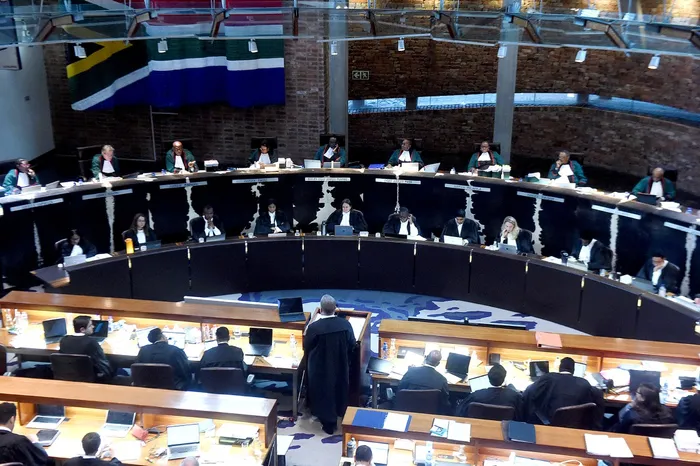
Freedom Under Law warns the Constitutional Court is under severe strain.
Image: Itumeleng English / Independent Newspapers
Although the Constitutional Court is back to its full complement of 11 judges following this month’s appointment of two judges, the court is overburdened and unable to dispose of its workload within reasonable timeframes.
The average period between hearing and judgment has more than doubled over the past decade; applications for leave to appeal remain undecided for months; and the court’s rate of delivering judgments has fallen significantly below the judiciary’s own targets.
This was highlighted by Freedom Under Law (FUL), who on Tuesday released a report titled “A review of the Constitutional Court’s jurisdiction and operating practices in light of its increased workload and consequential delays”. It examines how a dramatic rise in appeals, growing backlogs and procedural inefficiencies have placed the country’s apex court under increasing pressure.
According to the report, South Africa’s Constitutional Court is facing mounting institutional strain that threatens its ability to fulfil its constitutional role effectively. Following research done by FUL and captured in the report, it found that the Constitutional Court cannot continue as it is currently. If it does, the crisis presented by its burgeoning workload will only worsen.
This paper has identified a range of potential solutions, which range from constitutional amendments to facilitate fewer justices in deciding leave to appeal applications, which would require Parliament to take up the issue, to more practical interventions that can be adopted immediately by the court itself.
According to the report, the number of applications filed at the Constitutional Court each year has more than tripled since 2010, with the court now receiving close to 400 applications annually.
FUL says the issue is no longer simply one of administrative delay, but one that risks undermining the Constitutional Court’s ability to act as the ultimate guardian of the rule of law.
Judith February, Executive Officer of FULL says: “How the Court functions is a critical concern for South Africa’s constitutional democracy. As the country’s highest court, it determines legal principles that all other courts must follow and has the power to strike down legislation and government action”.
February warned that if the court is unable to fulfil its role effectively as the ultimate guardian of the rule of law, the consequences extend far beyond the legal community and affect society as a whole. “The court’s growing workload, combined with outdated processes and structural constraints, is compromising its ability to decide matters efficiently and timeously. If judgments are increasingly delayed and the court is seen to be struggling to manage its workload, public confidence in the judiciary itself may begin to erode”.
The report identifies two central causes of the current crisis: volume and process. It argues that while the Constitutional Court’s jurisdiction was significantly expanded more than a decade ago, its institutional design and operating procedures remained largely unchanged. Every application for leave to appeal must still be considered by all 11 justices, with a minimum quorum of eight judges required even for preliminary decisions.
The report proposes a range of potential reforms which can be implemented in the short, medium and long-term. In the short term, practical and procedural reforms could be introduced such as developing a more rules-based approach to the interests of justice test and delivering reasoned judgments explaining why applications for leave to appeal are refused.
Medium-term interventions include reducing the size of the panel of judges who deal with new applications. Long-term interventions include establishing separate chambers in the court to deal with constitutional and general matters, merging the Constitutional Court and the Supreme Court of Appeal into a single apex court, or restricting the court’s jurisdiction through a constitutional amendment.
The report follows growing public concern over delays at the Constitutional Court, such as the recent Phala Phala matter, which was heard in November 2024, with the judgment only being delivered earlier this month.
FUL says the purpose of the report is to stimulate serious national discussion about how to preserve the effectiveness, legitimacy and constitutional role of the court. The report was sent to the court itself as well as to various arms of the judiciary.