

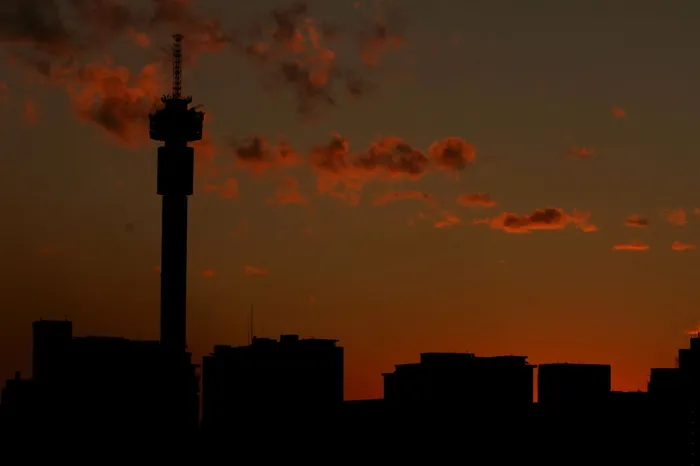
The City of Johannesburg skyline has, over the past few days, seen a cloud of sulphur smog, which has led to residents smelling rotten eggs.
Image: Steve Lawrence / Independent Newspapers
Residents across several parts of the City of Johannesburg have spent the past few days asking the same question: why does the air smell like rotten eggs?
From Sandton and Randburg to Roodepoort, Fourways, and Midrand, people have reported a strong sulphur-like odour hanging in the air. The smell has not been limited to Johannesburg alone. Some residents in neighbouring areas beyond the city’s boundaries have also reported the same pungent scent.
The unusual odour was first noticed earlier this year on January 16, 2026, and returned again on March 9, prompting concern and confusion among residents.
Many described a thick, unpleasant smell drifting across suburbs, with some initially unsure whether it was linked to industrial pollution, sewage, or another environmental issue.
City officials say they began investigating the reports almost immediately. The City of Johannesburg’s Environment and Infrastructure Services Department (EISD) activated its air quality monitoring network after receiving complaints from residents.
City Manager Dr Floyd Brink said the municipality moved quickly to assess the situation and identify the source of the odour.
“Protecting the health and well-being of residents remains our priority. Our technical teams are actively monitoring air quality data and working with other spheres of government to determine the source of the odour and ensure residents are kept informed,” Brink said.
According to the city, weather conditions over the past few days have been typical of Johannesburg’s late summer climate, with warm temperatures, humid air, and intermittent rainfall. Such conditions can sometimes trap pollutants in the atmosphere and allow odours to linger.
Monitoring data from the city’s air quality network confirmed elevated levels of hydrogen sulphide at two monitoring stations located in Buccleuch and Alexandra.
“Monitoring data confirmed elevated levels of hydrogen sulphide (H₂S) at the Buccleuch and Alexandra monitoring stations. On 9 March, fluctuating concentrations were recorded, with more pronounced spikes observed on 10 March at both stations,” the city said.
Dr Tebogo Modiba, executive director of the Environment and Infrastructure Services Department, said technical monitoring detected measurable levels of odour-related compounds during the episode.
“At the Alexandra station, hydrogen sulphide concentrations peaked at approximately 36 to 37 parts per billion, while sulphur dioxide peaked at around 52 parts per billion,” Modiba said.
Although these spikes were recorded, the city said the overall pollution levels remained relatively low and close to background levels.
Officials say the concentrations detected are strong enough to produce a noticeable smell but remain below levels normally associated with serious health risks.
Hydrogen sulphide is a colourless gas known for its distinctive “rotten egg” smell. Even small concentrations can produce a powerful odour that people can detect easily in the air.
City spokesperson Dudu Lushaba said the municipality is not ruling out the possibility that the pollution may have originated outside Johannesburg.
She explained that the city can sometimes be affected by pollution transported from industrial regions beyond its borders. As a result, the matter has been escalated to the National Department of Forestry, Fisheries and the Environment, as well as the Gauteng Department of Environment.
These authorities are responsible for addressing pollution sources that cross provincial or municipal boundaries.
“The characteristics of the odour are consistent with emissions typically associated with activities within the Highveld industrial complex,” Lushaba said.
The Highveld region, particularly parts of Mpumalanga, hosts several heavy industrial operations, including coal-fired power stations, petrochemical plants, and mining operations.
Pollutants released from these facilities can travel long distances depending on wind patterns and atmospheric conditions.
Dr Modiba said the city’s Air Quality Management Unit continues to analyse monitoring data and track the movement of the pollution plume to determine its likely origin.
Health experts are encouraging people to seek medical attention if they experience complications related to breathing the air.
Image: Steve Lawrence / Independent Newspapers
Officials have also emphasised that Johannesburg itself does not host large heavy industrial facilities that would typically generate such emissions.
“It is important to note that the City of Johannesburg does not host major heavy industrial operations. All listed industrial facilities within the city are licensed and regularly monitored by the Environmental Management Inspectorate to ensure compliance with environmental legislation,” Lushaba said.
As a precaution, the city has advised residents to remain indoors when the sulphur-like smell is particularly strong and to avoid strenuous outdoor activity during these periods.
Vulnerable groups, including children, the elderly, and people with respiratory conditions, should be monitored for symptoms such as eye or throat irritation, headaches, dizziness, or fatigue.
Health experts say exposure to hydrogen sulphide can cause a range of symptoms, particularly when people breathe in the gas over a prolonged period.
Dr Bongiwe Shongwe said hydrogen sulphide can irritate the eyes, nose, throat, and lungs when present in the air.
“Low exposure may cause discomfort, while higher concentrations can be toxic and affect breathing and the nervous system,” she said.
Common symptoms include headaches, nausea, dizziness, coughing, eye irritation, and shortness of breath. People living with asthma or other lung conditions may experience worsening symptoms if exposed to the gas.
Shongwe advised residents to seek medical attention if they experience persistent headaches, breathing difficulties, or severe irritation.
National authorities have also been monitoring the situation.
The Department of Forestry, Fisheries and the Environment confirmed that it is aware of reports of the strong sulphurous smell detected in parts of Gauteng, particularly across Johannesburg and Ekurhuleni.
Department spokesperson Zolile Nqayi said the stench reported by residents is likely caused by hydrogen sulphide.
Air quality data collected through the South African Air Quality Information System showed elevated levels of sulphur dioxide during the episode, although these remained within the country’s National Ambient Air Quality Standards.
Monitoring data also showed elevated hydrogen sulphide concentrations at several stations, including Secunda, Springs, Irene in Pretoria, Midstream, and Buccleuch.
While South Africa currently does not have a national ambient air quality standard specifically for hydrogen sulphide, the levels recorded were significantly higher than the World Health Organization’s recommended threshold for nuisance odours, which is about 5.02 parts per billion.
“Based on these observations, it is highly likely that complaints raised by the public were prompted by elevated levels of hydrogen sulphide,” Nqayi said.