

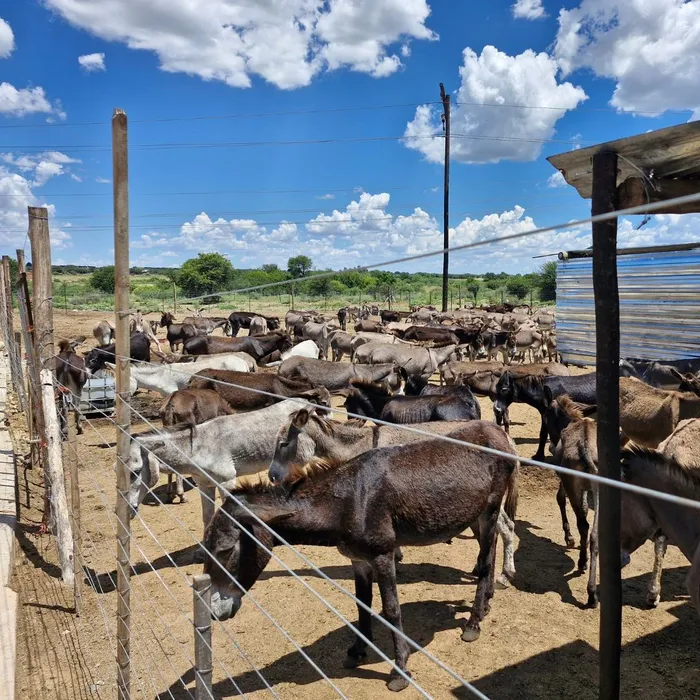
Donkeys in poor condition stand in holding pens at an equine abattoir near Schweizer-Reneke, where inspectors found nearly 180 animals without adequate food or care during a routine visit.
Image: NSPCA
Despite a continental push to halt the commercial slaughter of donkeys for their skins, the practice continues legally in South Africa under a regulated quota system, raising fresh concerns among animal welfare organisations.
In February 2024, the African Union adopted a 15-year postponement on the donkey skin trade.
Instead, the legal slaughter of up to 10,500 donkeys annually for their skins has continued.
The National Council of SPCAs (NSPCA) reported on April 15 that an inspector found extensive neglect during a scheduled inspection of donkeys. Weakened, injured, and parasite-ridden, the animals could not stand.
According to the NSPCA, there was little food available, and no structured feeding programme in place. When questioned, the facility’s manager allegedly cited concerns about treatment withdrawal periods delaying scheduled slaughter dates as the reason for failing to address parasite infestations.
Several animals were humanely euthanised to prevent further suffering. The remaining 175 donkeys were subsequently slaughtered legally.
The NSPCA has since opened a criminal case against both the owner and manager of the abattoir, citing violations of the Animals Protection Act 71 of 1962, which prohibits cruelty but does not outlaw donkey slaughter itself.
“Slaughtering donkeys is not illegal, but animal cruelty is,” the organisation said, adding that enforcement remains constrained by the limits of existing legislation.
Jonno Sherwin, founder of the Karoo Donkey Sanctuary, said the regulatory framework fails to protect donkeys adequately.
“South Africa has historically regulated rather than banned the trade,” Sherwin said. “A key gap is the absence of legislation specifically targeting the donkey skin industry.”
He noted that while slaughter is restricted to a small number of registered equine abattoirs, broader reliance on general animal protection laws weakens oversight and enforcement.
Welfare groups report that tighter controls have driven segments of the trade underground, contributing to increased donkey theft and illegal bush slaughter.
South Africa is also used as a transit route for smuggled donkey skins from neighbouring countries, particularly Lesotho, where the trade has been especially pronounced.
Enforcement agencies face additional challenges because of limited resources and the overlap with other forms of organised crime, including wildlife trafficking.
The global demand underpinning the trade remains strong. Donkey hides are primarily exported to China, where they are processed into ejiao, a traditional Chinese medicinal product.
While the AU moratorium has been widely described as a significant milestone, South African welfare organisations are calling for a full domestic ban.
IOL