

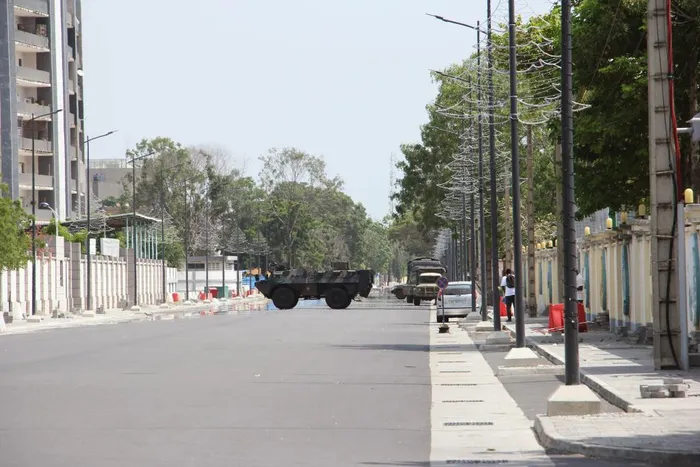
An armored vehicle is seen on a street in Cotonou, Benin
Image: XINHUA
When gunfire echoed through Cotonou, Benin, last Sunday and a small group of soldiers appeared on national TV claiming to have removed President Patrice Talon, the reaction felt painfully familiar. Another coup attempt. Another West African country in crisis. Another reminder that the region many once saw as the de facto leader of Africa's transition toward democracy is now struggling to stay upright.
The coup attempt in Benin collapsed within hours, thanks in part to Nigeria stepping in quickly but we would be wrong to treat it as a once-off. It sits squarely in a pattern we’ve seen growing across the region. While commentators rushed to condemn the coup leaders, very few paused to interrogate the deeper, more uncomfortable question lurking behind every headline. Is the Western model of democracy, the one inherited at independence actually suited to the political and historical realities of post-colonial African states?
To be clear, this is not a call for military rule or nostalgia for strongmen. It is a challenge or rather a questioning to the political assumption that African countries must simply copy the democratic systems of Europe and North America for stability to follow. Benin’s failed coup, like the military takeovers in Mali, Niger and Guinea before it, reveals a pattern that is no longer possible to ignore. The problem is not democracy itself, it is the uncritical adoption of a democratic template crafted in political soil completely different from our own.
The Western parliamentary model emerged from centuries of institutional evolution. The Magna Carta, revolutions, industrialisation, class bargains, and political continuity. African states, by contrast, entered the democratic world abruptly, inheriting borders drawn in colonial capitals, political institutions designed to control rather than represent, and economies built on extraction, not public welfare. Political theorist Mahmood Mamdani has long argued that the post-colonial state was never decolonised; instead, it merely replaced white administrators with African elites while keeping intact structures that were fundamentally authoritarian and exclusionary. We cannot meaningfully evaluate African democracy without acknowledging that its foundations were never built for civic participation.
Benin’s recent crisis is a reminder of this reality. For years, the country was praised as a model of democratic consolidation in Francophone West Africa. Its peaceful transfer of power in the early 1990s was held up as evidence that democracy had taken root. However, underneath the surface, familiar fractures were hardening, political exclusion, shrinking civic space and an electoral system increasingly seen by opposition forces as tilted in favour of
those already in power. When the election commission blocked the opposition’s candidate from contesting next year’s poll, it reignited frustrations that had been simmering quietly. In that context, even a failed coup should be read not only as criminal defiance of constitutional order but as a symptom of deeper institutional fragility.
The fragility is not unique to Benin. ECOWAS President Omar Alieu Touray recently warned that elections had become “a major trigger of instability” in the region. His statement was blunt, but not inaccurate. Across West Africa, elections have become high-stakes, winner-takes-all battles, where losing often means political irrelevance, economic marginalisation, or even prosecution. In such contexts, democratic competition becomes explosive. The problem is not that Africans reject elections. Turnout across the continent remains relatively strong but the institutions meant to safeguard electoral legitimacy are perceived as weak, politicised or externally influenced.
Here lies the uncomfortable truth. Democracy imported from the West did not account for Africa’s political diversity, social complexity or historical wounds. Scholars like Adebayo Olukoshi have long argued that African political systems need to be built on local legitimacy, not external validation. The post-independence state was constructed as a mirror image of European governance. The result is a political architecture that fits poorly, like clothing tailored for someone else.
If we are honest, the problem is not that Africa needs to “invent a new system” or return to precolonial political structures. Those ideas sound good in academic debates, but they rarely survive contact with the political realities of modern African states like urbanisation, complex economies, multiparty systems, and populations that expect strong service delivery from the state.
A more practical path for African democracy is decentralisation. Too much power is concentrated in national executives, turning elections into high-stakes, winner-takes-all contests that make coups more likely. Giving real authority to local and regional governments reduces the pressure on national politics, strengthens institutions where people actually live, and creates multiple points of accountability for citizens. Countries like Kenya and South Africa show that when power is spread more evenly, political competition becomes less existential, communities have a stronger voice, and the incentive for military intervention is lessened.
However, without addressing the external pressures that continue shaping African politics, especially in West Africa, where former colonial powers, particularly France, still maintain deep influence in the economic and security sectors. As economist Ndongo Samba Sylla has shown, instability in Francophone Africa often benefits external actors more than local citizens. Fragility keeps countries dependent, predictable and easily influenced.
All of this brings us back to Benin. Its failed coup should not be read solely as an anomaly in an otherwise stable republic. It should be understood as a warning about the limitations of a
democratic model that does not reflect the lived realities of the people it is meant to govern. If democracy in Africa is to survive, and it must, it cannot remain a copy of systems shaped by European histories. It must evolve into something anchored in African political thought, African social structures, and African aspirations.
The question is not whether Africa needs democracy. The question is whether the version we inherited is capable of delivering stability, legitimacy and justice. If the events in Cotonou tell us anything, it is that ignoring this question is no longer an option.
Written By:
*Chloe Maluleke
Associate at BRICS+ Consulting Group
Russian & Middle Eastern Specialist
** MORE ARTICLES ON OUR WEBSITE https://bricscg.com/
** Follow https://x.com/brics_daily on X/Twitter for daily BRICS+ updates