

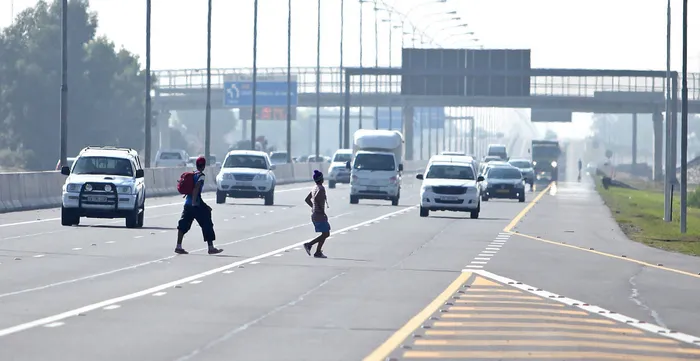
City of Cape Town plans a R180 million security wall along N2 amid rising crime.
Image: Independent Newspapers Archives
There are moments in the life of a city when a single decision tells you everything about who holds power, whose fears matter, and whose humanity is negotiable. The proposed R180 million wall along the N2 is one of those moments.
Let us speak honestly and painfully clearly. This wall is not just concrete and steel. It is a symbol. And symbols matter more than Mayor Hill Lewis likes to admit. They lodge in the memory of a people. They tell future generations what we were willing to normalise.
This wall tells poor people: you are the threat.
It tells motorists and tourists: we will protect you from “them”.
It tells the world: Cape Town has chosen separation over solidarity. Shameful and sad, for this is our lived reality.
For a city that still bleeds from the wounds of slavery, colonialism, apartheid geography, this is not merely insensitive. It is morally obscene.
History is littered with walls built in the name of “security”. None of them aged well. None of them solved the problem they claimed to address.
The Berlin Wall was built to “protect” a state from instability. What it really did was imprison a people, divide families, and harden injustice into architecture. When it fell, the world did not mourn the loss of concrete. It celebrated the return of human dignity.
The Trump border wall was sold as crime control. In truth, it was a monument to fear, racism, and political theatre. It did not heal America. It scarred it.
And long before modern politics, there is the ancient story of the Walls of Jericho, walls that symbolised arrogance, exclusion, and domination. They did not fall because of better engineering, but because people refused to accept that walls were the natural order of things.
Why do we think Cape Town will be the exception?
A wall is what you build when you have run out of ideas
Let us be clear: violence on the N2 is real. Lives have been lost. Families have been shattered. Fear is not imagined. But when leadership reaches first for a wall, it reveals something deeply troubling, not strength, but intellectual shallowness and moral corruption.
Because walls do not stop crime. They displace it.
Walls do not create safety. They create blindness.
Walls do not build trust. They institutionalise suspicion.
This wall does nothing to address why young men are recruited into violent acts. Nothing about addiction, unemployment, informal settlement neglect, or the slow violence of poverty. Instead, it manages visibility. It hides the poor from the passing gaze of the comfortable. It criminalises the unfortunate.
That is not safety. That is curated inequality.
What makes this proposal so painful is not only the money, though R180 million in a city of hunger and unemployment is already a scandal. It is the location.
The N2 is not just a road. It is a scar. On one side: wealth, green lawns, swimming pools, and electric fences. On the other: overcrowding, shacks, sand, struggle. This is where apartheid planners drew their lines with bulldozers and maps.
To now place a wall along that line is to say: we accept this geography as permanent. When is justice coming ... when is redress visiting... when can healing embrace us?
We are no longer trying to heal it. We are reinforcing it.
This is why so many Capetonians feel a visceral revulsion. Why are you not Gatvol?... Not because they are naïve about crime. But because they know, in their bones, that this looks like apartheid logic updated for a liberal press release.
Imagine what R180 million could mean if guided by courage instead of fear.
It could mean visible, permanent, human policing presence trained officers who know the community, backed by intelligence, not just sirens.
It could mean lighting, safe zones, rapid-response units, and proper prosecution pipelines. When are you implementing the Khayelitsha Commission?
It could mean youth employment programmes along the corridor. Help with addiction treatment is needed so desperately. Community safety partnerships. Restorative justice models. Local economic activity that gives people something to lose besides their lives.
Instead, the DA has chosen concrete. Because concrete photographs well. Concrete gives the illusion of action. Concrete does not argue back.
This is their choice, and their choices have consequences for you, fellow Capetonians.
The DA will say: “What is the alternative?”
That question is revealing. It assumes that the only alternatives are walls or chaos. That is a failure of imagination and of empathy. Ask us, we have answers, the real alternative is governance that sees everyone as human.
But here is the deeper truth we must confront as Capetonians: this wall reflects how power currently sees the city. It is not an accident. It flows from a worldview where the poor are a problem to be managed, not citizens to be invested in.
This is why this debate cannot end with technical amendments or softer language. It is a moral line in the sand.
Capetonians of all backgrounds must ask themselves:
What kind of city do we want to be?
A city that responds to pain with healing or with hardening, with pretence?
A city that remembers its past or one that repeats it with better PR?
A city of walls or a city of bridges and pathways of trust and cooperation?
This is not about your party loyalty to the DA. It is about our higher human sense, the part of us that knows that safety built on exclusion is fragile, and dignity denied to some will eventually poison all.
I am calling on Capetonians to do three things:
Condemn this wall publicly in community forums, civil society, faith spaces, schools, and neighbourhoods. Name it for what it is: a hurtful symbol of division.
Demand a people-centred safety plan, not panic infrastructure. Insist on transparency, alternatives, and measurable outcomes that respect human dignity.
Vote the DA out of the City of Cape Town. Not out of anger alone, but out of love for a city that deserves leadership capable of healing, not hiding.
This city has known too many walls: legal, racial, spatial, and psychological. Every generation is tested on whether it will dismantle them or disguise them.
Let us be the generation that says: not in our name.
Because walls may stand for a while.
But history is clear: they always fall. #LoveandSolidarityAlways
* Jacobs is a former ANC MP and the whip for the portfolio committee on small enterprise development.
** The views expressed here are not necessarily those of Independent Media.