

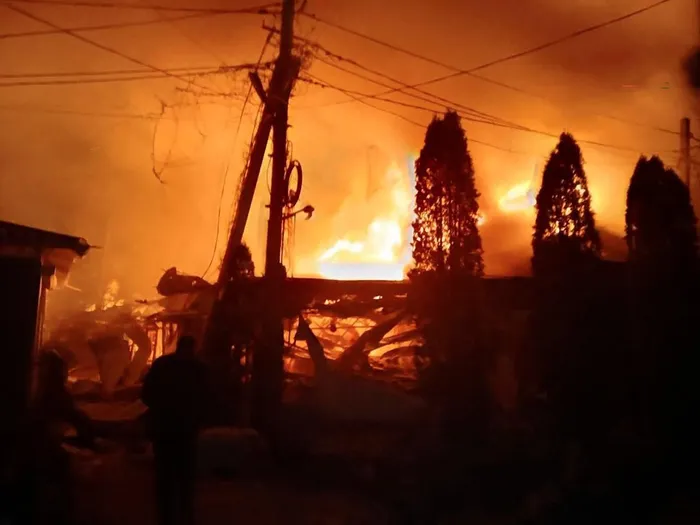
This handout photo released by Russia-appointed governor of the Kherson region, Vladimir Saldo, shows the site of a drone attack on a hotel in Khroly on January 1, 2026. Russia on Thursday said Kyiv was behind a deadly drone strike on a hotel in the Moscow-held part of Ukraine's southern Kherson region that killed at least 20 people celebrating the New Year. The accusations come at a crunch moment in a flurry of talks aimed at brokering peace and ending the near four-year war and as Ukrainian President Volodymyr Zelenskyy said his country was "10 percent" away from a peace deal. According to a Russia-appointed governor of the Kherson region, Vladimir Saldo, last night three drones "struck a cafe and hotel on the Black Sea coast in Khorly" where "civilians were celebrating the New Year".
Image: The Governor of the Kherson Region Vladimir Saldo / AFP
Only hours into 2026, the West had already launched its opening salvo: a synchronised attack operating on both material and symbolic planes. Drone strikes hit Moscow, Kherson and other sites, while Western media channels poured out a storm of imagery and headlines calibrated to reinforce one message: Russia remains the enemy of world peace. The psychological intensity of this assault exceeded anything witnessed in recent months. It coincided deliberately with President Putin’s post-peace-talks posture, signalling that the West had no intention of pursuing reciprocal diplomacy. The response arrived through violence and narrative enforcement. An olive branch was answered with artillery fire, both literal and discursive.
These peace talks reportedly took place via a private phone call between Putin and Trump, with the intention of initiating a long-term ceasefire. Shortly after, Zelensky visited Mar-a-Lago in the United States to meet with Trump and conclude the talks. Putin’s statements at the talks emphasised demilitarisation, regional autonomy and restoration of diplomatic norms. Within hours of the talks concluding, reports emerged of a drone strike near the president’s private residence, an unprecedented breach, striking at the very heart of Russian leadership during a moment of declared de-escalation. The symbolism was calculated. The messaging was clear. Even dialogue would be punished.
There is reason to consider that these attacks, military and media alike, were coordinated to coincide with the New Year to puncture collective feelings of security, celebration and joy. This was psychological warfare with emotional timing. A disruption not only of sovereignty but of seasonal meaning.
This moment confirms what many have suspected: the battle lines extend beyond territory into consciousness itself.
The West’s propaganda machine moved with surgical precision. Almost every media outlet repeated the same frames, the same adjectives, the same tone of piety and foreboding. At its head, NATO Secretary-General Mark Rutte issued statements echoing formulaic justifications delivered in the sterilised lexicon of bureaucratic moralism. His language conveyed reprimand rather than engagement, operating from the elevated position of a Western superego addressing a figure shaped by its own projections.
Here lies the psychoanalytic core of this crisis. The West remains unable to confront its imperial history or present militarism and therefore displaces these drives onto an external subject, Russia. This is projection at geopolitical scale. Russia functions as a mirror the West refuses to face. Roles are inverted. Accusation replaces introspection. Moral authority is asserted through displacement. Russia becomes the object marked for surveillance, management and discipline.
Such propaganda exceeds the realm of information. It embeds itself within the unconscious. The Western subject is conditioned to associate Russia with chaos, instability and irrationality. Over time, this conditioning accumulates. Nuance disappears. Context dissolves. Sympathy is foreclosed. Even drone strikes on Russian-held Kherson were cynically framed in headlines as Russian attacks, further compounding public confusion and sustaining the fiction of unilateral Russian aggression.
Silence in the face of this cognitive war amounts to surrendering the narrative terrain. Russia is subjected to punishment within the discursive order. It is framed as deviant due to its resistance to absorption into Western control. It asserts sovereignty, cultural memory and regional logic. These assertions are reprocessed by Western media as existential threats to global stability.
This process constitutes ideological violence.
Resistance to this form of narrative siege involves recovering meaning, restoring memory and confronting the symbolic order imposed by the West. The campaign is linguistic, semiotic and psychological. It penetrates the mechanisms through which people form opinions, values and truths. Every country under siege must engage the narrative terrain as part of its defence. Western media has long become a lethal weapon of war. Media, including social media, is now a battlefield, a frontier of psyops. Reclaiming this space requires the presence of intellectuals, analysts and cultural producers capable of disrupting internalised fictions and offering historically anchored alternatives.
This cannot be outsourced to influencers. Influencers function within ephemerality. Their attention is transactional. Their positions shift under pressure. Their audiences gravitate toward novelty, scandal and spectacle. They lack the ideological density required to withstand sustained propaganda backed by NATO, corporate media and Anglo-American capital.
Youth can and must play a role, but the value lies in those whose critical thinking is shaped by experience and reality. The danger lies in elevating sponsored voices disconnected from material struggle. Serious movements demand serious minds, regardless of age.
Russia requires thinkers.
What is required are individuals who understand narrative warfare, who trace the genealogy of demonisation and who speak with intellectual clarity shaped by historical depth. The moment calls for philosophers, historians, dissidents and cultural workers prepared to construct a counter-hegemonic front through long-form analysis, philosophical discipline and creative resistance.
At present, some of the most effective challenges to Western propaganda emerge from commentators with institutional memory and direct experience inside the systems producing consent. Scott Ritter, a former UN weapons inspector and US Marine Corps intelligence officer, exemplifies this. His interventions draw authority from technical knowledge of military doctrine, arms control and intelligence practice. His credibility arises from experience rather than alignment.
Others contribute similarly. Pepe Escobar situates Russia within a wider Eurasian historical and economic framework consistently erased by Western media. Jacques Baud applies strategic intelligence analysis to expose narrative manipulation with discipline and precision. Eva Bartlett’s frontline reporting restores material reality to conflicts abstracted by headline-driven journalism. These commentators alter thinking because they refuse emotional scripting.
What is now required is expansion from individual voices into networks. Enduring change emerges through collective ecosystems of analysis. Networks of mature, grounded thinkers provide continuity, correction and resilience. They retain memory under pressure. They share language across borders. They sustain truth circulation even during sustained attack.
The missiles launched on January 1 struck physical targets. The media offensive struck perception itself. This conflict centres on meaning and legitimacy. Its outcome depends on whether the domain of discourse is defended with equal seriousness.
Welcome to 2026. The struggle for narrative sovereignty has intensified. Victory will belong to those who speak from conviction rather than trend.
The attacks on Kherson and Moscow are framed as pretexts to sustain a demonising narrative. Schutte argues that this is a battle over perception, language and ideological control. She calls for Russia to mobilise serious thinkers—not influencers—to counter the propaganda. The article highlights figures like Scott Ritter and Eva Bartlett as essential voices in this resistance.
Image: IOL
* Gillian Schutte is a South African writer, filmmaker, poet, and uncompromising social justice activist. Founder of Media for Justice and co-owner of handHeld Films, she is recognised for hard-hitting documentaries and incisive opinion pieces that dismantle whiteness, neoliberal capitalism, and imperial power.
** The views expressed do not necessarily reflect the views of IOL or Independent Media.