

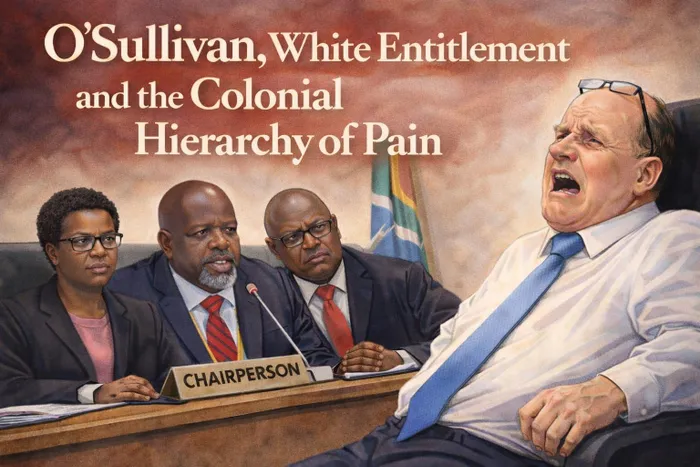
Paul O'Sullivan's recent testimony before the Ad Hoc Committee reveals deep-seated colonial attitudes towards authority and vulnerability, reflecting a historical pattern that continues to shape contemporary power dynamics in South Africa.
Image: Supplied / Chat GPT
The arrogance and entitlement shown by Paul O’Sullivan on his return to the Ad Hoc Committee this week, together with his plea for sympathy on account of a back problem, follow a well worn colonial behavioural script that long predates Southern Africa and runs through the wider history of European imperial governance. The authoritative white body enters proceedings as a site of fragility at the exact point where questioning intensifies, and institutional tempo shifts accordingly as concern is extended, time is recalibrated, and authority relocates from object of examination to subject of care.
O’Sullivan’s intervention unfolded in a clearly structured sequence. He announced that he could not continue due to a back problem at the very moment when the committee’s questioning was intensifying. The declaration functioned as an implicit request for full release from further participation in the session, resting on the assumption that the bodily claim would be accepted as sufficient grounds to discontinue his appearance entirely. The committee did not accede to this expectation and maintained its insistence that questioning continue in accordance with its mandate. Once this refusal became evident, O’Sullivan shifted his position and entered into negotiation over duration, indicating that he could proceed for a limited period in order to complete his appearance and avoid being called back at a later date. The initial claim of incapacity thus gave way to conditional endurance once the prospect of complete exemption had been foreclosed.
This sequence cannot be understood as a spontaneous personal reaction to discomfort alone. It operates within a longer historical grammar in which authority manages exposure to scrutiny through the strategic mobilisation of bodily limitation. Early European imperial administration in Asia and the Americas established a durable repertoire through which officials under investigation for violent excesses invoked strain, exhaustion, and the burdens of frontier rule as contextual explanations for their conduct. Metropolitan reviews frequently received these bodily narratives as mitigating conditions that reframed coercive acts as the by-product of pressure rather than the exercise of power. The colonial agent appeared as a psychologically burdened subject whose body registered the stresses of governance, while indigenous populations subjected to dispossession and coercion appeared in the same records as labouring bodies whose suffering did not recalibrate administrative judgement.
As imperial expansion consolidated across the nineteenth century, this grammar travelled with European governance structures. Officers across British India, the Caribbean, and settler colonies framed disciplinary crises through reference to illness, fatigue, and environmental hardship, and these claims entered formal proceedings as contextual material that moderated sanction and stabilised office. The bodily strain of the coloniser acquired administrative legitimacy, while the bodily suffering of colonised populations remained structurally subordinated to the maintenance of order and extraction, thereby entrenching a racialised hierarchy of recognised vulnerability across imperial sites.
The same institutional logic that grants procedural elasticity to the authoritative white body simultaneously denies equivalent recognition to Black embodiment. Within colonial and apartheid governance, the Black subject was routinely constructed as a figure of endurance rather than vulnerability, a corporeal presence whose labour and suffering were administratively necessary but not epistemically significant. Injuries, fatigue, and psychological trauma inflicted on colonised populations entered official records as incidental data rather than as conditions capable of interrupting or recalibrating proceedings. This stripping of recognised pain and interior life operated through classificatory practices that rendered Black suffering as expected and therefore administratively irrelevant to the tempo of governance. The authoritative white body could register strain as a mitigating condition, while the Black body was positioned as structurally available for continued extraction of testimony, labour, or compliance irrespective of evident distress.
Southern Africa inherited this repertoire during the consolidation of settler colonial rule. Administrators and later apartheid officials reproduced the same interpretive pattern, presenting themselves as men worn down by pressure, sleeplessness, and the psychological demands of maintaining racial order, while commissions and inquiries acknowledged these claims as relevant context. Detainees and labourers who presented visible injuries and enduring trauma seldom received equivalent procedural accommodation, as institutional tempo continued to be governed by administrative necessity rather than by the bodily states of those subjected to violence. Differential responsiveness reflected a racialised hierarchy of recognised vulnerability embedded within state apparatuses and carried forward into postcolonial institutional cultures.
O’Sullivan’s conduct before the committee draws from this transimperial lineage. His declaration of incapacity at the moment of intensified questioning activated an institutional reflex organised around care for the authoritative witness, and his subsequent willingness to proceed on renegotiated temporal terms once sympathy had been secured indicates a historically conditioned capacity to convert bodily limitation into leverage within a forum designed to hold power answerable. The manoeuvre rested on the expectation that the authoritative white body could first seek complete release through the invocation of fragility and, failing that, reshape the temporal boundaries of interrogation by negotiating a limited completion that would preclude recall.
Institutional actors operate within organisational cultures shaped by these imperial inheritances, and oversight bodies in postcolonial states continue to reflect norms that privilege the comfort and dignity of elite authority figures whose presence historically signified administrative order. When such figures foreground physical strain, these norms predispose institutions to adjust tempo in ways that preserve decorum and avoid the appearance of harshness toward recognised authority, with procedural flexibility thereby reflecting entrenched power relations rather than neutral concern for individual wellbeing.
Criticism has been directed at the chair, Slovo, for his slow speech and deliberate explanation of process, yet such criticism overlooks the racialised field within which a Black chair exercises authority over a powerful white witness. Colonial discourse repeatedly cast Black officials as impulsive, physical, and incapable of measured rational deliberation, thereby legitimising white paternal oversight and positioning Black governance as requiring supervision and control. Within that historical schema, a Black chair who insists on calm, methodical procedure disrupts the inherited expectation that Black authority will appear aggressive or uncontrolled when confronting entrenched power. Slovo’s pacing and careful articulation perform institutional labour that extends beyond the immediate exchange, foreclosing a familiar defensive manoeuvre in which firmness from Black leadership is reinterpreted as hostility or insensitivity and establishing procedural fairness in excess of what historical precedent ever afforded Black subjects placed before colonial or apartheid tribunals.
The persistence of these dynamics in the twenty first century exposes the durability of imperial epistemologies within contemporary democratic institutions. Appeals to bodily fragility by powerful white figures still reorganise proceedings, while Black authority figures continue to calibrate tone and tempo to pre-empt accusations rooted in colonial stereotypes, and institutional actors remain compelled to navigate expectations produced by centuries of racialised governance even within formally equal constitutional settings.
Medical research on racial bias in pain assessment reinforces this analysis, as empirical studies across several healthcare systems have documented systematic underestimation of Black patients’ pain due to persistent myths regarding physiological resilience. These epistemic habits traverse medicine, law, and governance, such that bodily claims advanced by those situated within established racial and class power structures enter receptive interpretive environments, whereas comparable claims from those historically positioned outside those structures encounter expectations of endurance that leave procedural tempo unchanged.
The committee’s response to O’Sullivan must therefore be read within this broader imperial history of racialised governance. His discomfort reorganised proceedings and redirected collective attention away from substantive matters under examination, while the subsequent negotiation over duration demonstrated how the authoritative body can mediate the conditions of its own interrogation through appeals to strain that resonate within inherited structures of recognition. Such mediation signals the endurance of imperial grammars of vulnerability within contemporary democratic institutions and reveals how historical repertoires of entitlement and bodily negotiation continue to intersect with the careful labour of Black institutional leadership striving to uphold procedural legitimacy within a still uneven field of power.
Paul O'Sullivan's recent testimony before the Ad Hoc Committee reveals deep-seated colonial attitudes towards authority and vulnerability, reflecting a historical pattern that continues to shape contemporary power dynamics in South Africa.
Image: IOL
* Gillian Schutte is a South African writer, filmmaker, poet, and uncompromising social justice activist. Founder of Media for Justice and co-owner of handHeld Films, she is recognised for hard-hitting documentaries and incisive opinion pieces that dismantle whiteness, neoliberal capitalism, and imperial power.
** The views expressed do not necessarily reflect the views of IOL or Independent Media.