

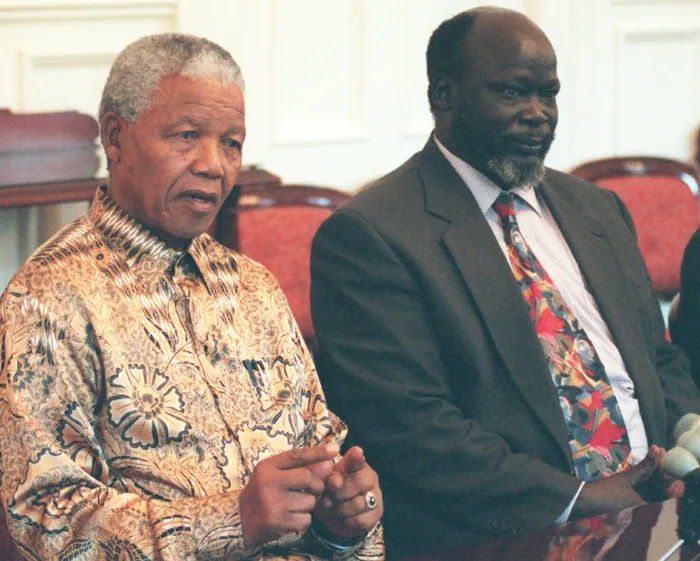
Former President Nelson Mandela with Sudanese leader Dr John Garang.
Image: Leon Muller / Independent Media Archives
The initial vision of the founding father and leader, Dr John Garang, of the Sudan People’s Liberation Movement/Army (SPLM/A), was to build a ‘New Sudan’ that is inclusive, unified, secular, democratic, and prosperous—one nation (comprising North and South Sudan) illuminated by social justice and equal citizenship. In fact, he did not regard secession as a solution to the political marginalisation of the South by North Sudan. Before his mysterious death in July 2005, Dr Garang emphatically stated: “There is no country that can be united based on things (ethnicisation and sectarianisation of statecraft) that divide the people.”
In the October 2024 reflective paper ‘Defining the Crisis in the Sudans: Lessons from the African Union High-Level Panels for Sudan and South Sudan’, Alex de Waal and Abdul Mohammed describe Sudan and South Sudan as facing a catastrophic humanitarian crisis with no viable statehood. They note that although South Sudan's leaders in Juba and those in Khartoum (Sudan) agreed to collaborate on building ‘two viable states’ after South Sudan's secession in 2011, this has not materialised.
As a result, neither country has a legitimate or effective government elected by the people and capable of providing essential basic services. For instance, two years ago, reports indicated that over 60 per cent of South Sudanese lacked adequate sanitation facilities and had to use bushes for defecation; their human dignity remains compromised. On the other hand, Vibhu Mishra (2026) reports that more than nine million Sudanese are internally displaced, and over four million are displaced externally, with the civil war that began over three years ago disrupting the delivery of basic services. It seems secession was never a solution, because both leaders of the two countries inherited the states characterised by diversity and built on sectarian rather than secular interests as envisioned by Dr Garang.
Historically, Khartoum (North Sudan), under former President Omar Al-Bashir, who led Sudan for three decades, has sought to position Sudan as an Arab nation, disregarding the presence of other tribes and religious beliefs. It is for this reason that he is accused of establishing the paramilitary Janjaweed in 2013, now called Rapid Support Forces (RSF), to suppress opposition, particularly from non-Arabs in Darfur and other parts of the country at the time. There is no clear plan to build a North Sudan that embraces unity in diversity and promotes secularism. The ongoing civil war and violent conflict ravaging North Sudan reflect a lack of visionary leadership.
A conflict between the RSF, led by General Mohammed Hamdan Dagalo, and the Sudan Armed Forces (SAF), led by General Abdel Fattah Al Burhan, has demonstrated beyond doubt that the struggle is about total control of the state apparatus and resources for personal gain rather than genuine nation-building. For example, the two generals collaborated in 2019 to overthrow Al-Bashir; however, less than two years after forming a Transitional Sovereignty Council (TSC), with Gen Al-Burhan as interim President and deputised by Gen Dagalo, in 2021, they orchestrated a coup against their established transitional government, which led to the current conflict wherein the two generals are fighting for power.
Apparently, Dagalo accused Al-Burhan of subtly restoring Al-Bashir's forces to government institutions without consultation. Perhaps the time has come for leaders and all citizens of Sudan to engage in dialogue and revisit Dr Garang's interrupted vision to address the current humanitarian crisis engulfing the country.
Since its secession, South Sudan has endured two major civil wars in 2013 and 2016. As Africa’s newest nation, the conflict mainly revolves around the struggle for state power between the two primary ethnic groups: the Dinka, led by the current president of a revitalised transitional government of national unity, Salva Kiir Mayardit, and the Nuer, led by the detained first deputy president, Riek Machar.
Regrettably, the two ethnic groups behave as if South Sudan has no more than sixty ethnic groups to consider in the processes of resource sharing, peace, and nation-building. Similar to Sudan, South Sudan lacks visionary leaders like Garang. It should be acknowledged that Garang had his share of flaws, but at least he envisioned a unified, diverse, and secular nation for Sudan.
Today, in both countries, there is no well-coordinated, strong political organisation guiding them towards a revolutionary development that is focused on and driven by the people. It is more about a few political elites who are controlled externally and govern for the personal gain of their close associates at the expense of the disenfranchised citizens. For instance, in South Sudan, it is normalised that there is the Sudan People’s Liberation Movement in Government (SPLM-IG) and the Sudan People’s Liberation Movement/Army in Opposition (SPLM-IO). This was supposed to be the political organisation that would guide and lead the total liberation struggle. A fractured political system of factionalism produces puppets and opportunists rather than genuine revolutionaries.
Therefore, one can argue that Garang's revolutionary vision remains the beacon of hope for the restoration of lasting peace in these two conflict-ridden countries. New visionary leaders should emerge and take over their countries from self-serving leaders. I call on the African Union to revisit the report that was written and submitted by the AU High-Level Panels for Sudan and South Sudan.
Former President Thabo Mbeki and others led this Panel; it is important because it contains the views of ordinary people on the ground, especially those in the marginalised Darfur and other parts of the two countries.
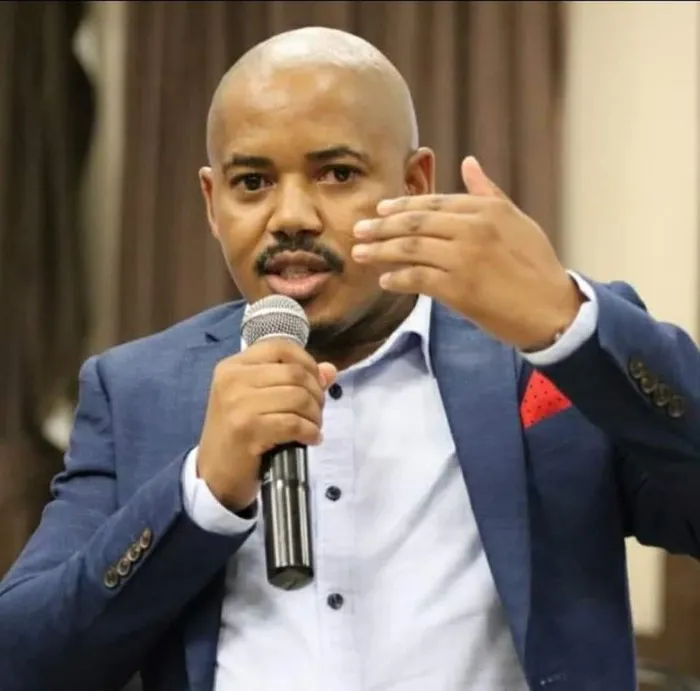
Dr John Garang's vision for a unified Sudan and South Sudan continues to resonate amidst ongoing humanitarian crises and political turmoil, writes Orapeleng Matshediso.
Image: Supplied
* Orapeleng Matshediso is a master’s graduate of Pan African Development Studies and a Research Fellow at the University of Johannesburg (Institute for Pan African Thought and Conversation). The author is also an alumnus of the then Thabo Mbeki African Leadership Institute (TMALI).
** The views expressed do not necessarily reflect the views of IOL or Independent Media.