

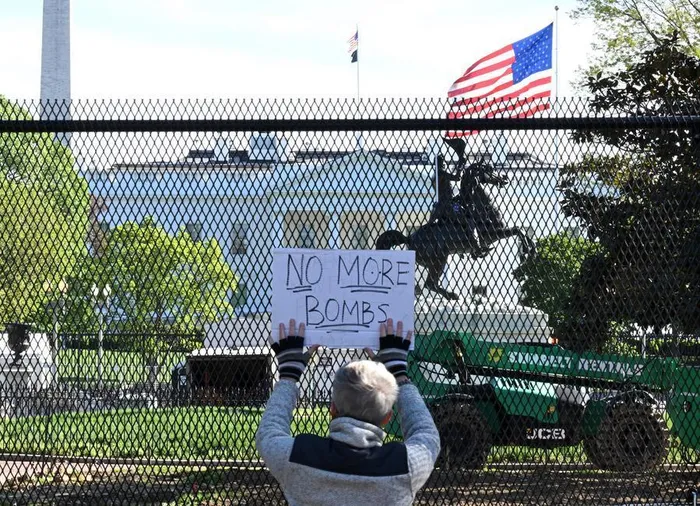
A demonstrator holds a placard in front of the White House in Washington, D.C., the United States, on April 7, 2026
Image: XINHUA
There is a particular kind of moment in history when the powerful, in their arrogance, do something so naked, so unfiltered, that the mythology holding power together cracks in real time. The United States' war against Iran has been that moment.
Not because the US has never behaved this way before, it has, consistently and for decades. But because Donald Trump does not do subtlety. Where previous administrations conducted the same foreign policy through carefully worded press releases and diplomatic euphemism, Trump announces it on Truth Social in all-capitals. He posted that "a whole civilization will die tonight, never to be brought back again", unless Iran met his demands. He didn't create a new American foreign policy. He simply made the old one visible and once you've seen it, you cannot unsee it.
The strikes on 28 February were launched mid-diplomacy, during an active round of negotiations over Iran's nuclear programme. Khamenei was killed. Senior officials were killed. And a US Tomahawk missile struck an elementary school, killing children, parents, and teachers, later attributed to reliance on outdated intelligence data. The US military ran the numbers through an AI system, the AI was working from old maps, and over a hundred children paid for that administrative error with their lives. By late March, Iran had documented damage to at least 120 historical sites from American and Israeli strikes.
The entire architecture of American moral authority depends on American violence remaining either invisible or justifiable, while any resistance to it is immediately classified as terrorism, barbarism, or irrationality and right now it has been stripped of its facade. Which is why we need to talk about what happened at the power plants.
The Iranian people are not a monolith of regime loyalty, anyone who suggests otherwise is either ignorant or deliberately misleading. In January 2026, they rose up in the largest anti-government protests since the revolution, across more than 100 cities, with chants calling openly for regime change. At least 6,800 civilians were killed and over 53,000 detained by the IRGC and Basij in the crackdown that followed. These are people who have every reason to despise their government and they know it better than any Western think tank ever will.
And yet. When Trump threatened to bomb their power plants, to push 85 million people into darkness, to cut off water treatment, hospitals, food supply chains, more than 14 million Iranians declared their readiness to defend their country's infrastructure. They went to the bridges. They went to the power plants. They stood there in human chains not because the regime ordered them to love it, but because a foreign government had just threatened to destroy the lights their children study under. One official framed it plainly: "Come regardless of political views, because these facilities belong to the Iranian youth and their future. Let the world see that targeting civilian infrastructure is a war crime."
An Iranian musician, Ali Ghamsari, a man previously banned from performing by the Islamic Republic for resisting its authority, walked to a power plant and played his traditional tar. He said he hoped the sound would have an impact on peace. Western outlets called the entire scene "human shields." A people can reject their government and still refuse to hand their country to a foreign bomb. That is not a contradiction. That is what sovereignty actually looks like when it's lived, not just theorised.
Now here is the part nobody in Washington wants to say out loud: Iran won.
Not militarily as it absorbed devastating strikes, lost its supreme leader, lost key commanders. But strategically, Iran did in six weeks what 40 years of American sanctions failed to do to Iran. It made the United States economically desperate. Shipping through the Strait of Hormuz collapsed, with transits falling by over 95%. Brent crude rose from $80 to $120 per barrel in under a week. Down To Earth Fertiliser prices spiked 40%. Semiconductor supply chains fractured. American farmers were writing open letters to the White House, and the man who had threatened civilisational annihilation was on Truth Social, demanding Iran "Open the F**kin' Strait" — a post that reads less like foreign policy and more like a man watching his domestic approval ratings bleed out in real time.
The Strait of Hormuz is Iran's sanctions regime. And unlike Washington's 40-year financial war, which strangled Iranian teachers and nurses and shopkeepers while the political class largely insulated itself, closing the strait hit American consumers immediately. That is what produced the ceasefire. Economic pain flowing in the wrong direction, from a smaller power into the belly of the largest military apparatus on earth.
Except the ceasefire, predictably, is already unravelling. Iran's parliamentary speaker Mohammad Bagher Ghalibaf accused the US of violating three clauses of the agreement within hours of it taking effect. Israel's continued assault on Lebanon, a drone entering Iranian airspace, and the denial of Iran's right to enrich uranium. Iran said its Lavan oil refinery was struck after the ceasefire took effect. Gulf Arab states reported interceptions of Iranian missile and drone fire throughout the day. JD Vance's response to the drone incursion was to shrug and say "ceasefires are always messy." He questioned whether Ghalibaf understood English well enough to follow the negotiations.
There it is again. The same machinery. The same contempt. Sign an agreement, immediately allow your ally to violate its terms in Lebanon, send a drone into the other party's airspace, then mock their intelligence when they object. This is a pattern so consistent across administrations, across decades, across continents, that calling it anything other than deliberate requires a level of generosity the facts no longer support.
Which raises a question the American foreign policy establishment has been quietly asking itself for decades, and still refuses to answer honestly: when was the last time the United States actually won a war? Since 1945, the United States has lost four major wars. Korea, Vietnam, Iraq and Afghanistan as a catastrophic fourth. The US military can destroy anything it can see, but the adversary is always more committed because for the United States, each conflict is one of many, while for the people whose country is being bombed, it is the only thing that matters. Within the first two weeks of this war, Iran's strikes left many US bases in the region "all but uninhabitable," causing $800 million in damage and actual degradation of military capability.
The mythology of American military dominance is exactly that, mythology, built in World War II, a war whose outcome was determined primarily on the Eastern Front, where the Soviet Union absorbed 27 million deaths breaking the Nazi war machine. American contributions were real and significant, but the story that America won that war alone, and that it has therefore earned permanent dominion over the world order, is a story America told itself and then enforced with aircraft carriers.
That is the portrait of 2026. An empire that has spent 80 years confusing impunity for legitimacy and firepower for strategy, finally meeting a moment where none of those substitutes were enough. And when a deal was struck, it lasted less than a day before the violations began and the contempt re-emerged. Iran's parliamentary speaker said it plainly: "The deep historical distrust we hold toward the United States stems from its repeated violations of all forms of commitments, a pattern that has regrettably been repeated once again."
The ceasefire may hold, or it may not. But what cannot be undone is what the world has already seen. The bombed school. The assassinated leader mid-negotiation. The president swearing on social media because a 33-kilometre waterway brought his economy to its knees. The agreement was violated before the ink was dry. Trump didn't create this pattern. He just refused to hide it. The empire had no clothes. It just took the right kind of arrogance to prove it, and the right kind of adversary to make sure everyone was watching.
*Chloe Maluleke
Associate at BRICS+ Consulting Group
Russia & Middle East Specialist
**The Views expressed do not necessarily reflect the views of Independent Media or IOL.
** MORE ARTICLES ON OUR WEBSITE https://bricscg.com/
** Follow @brics_daily on Twitter for daily BRICS+ updates and instagram @brics_daily