

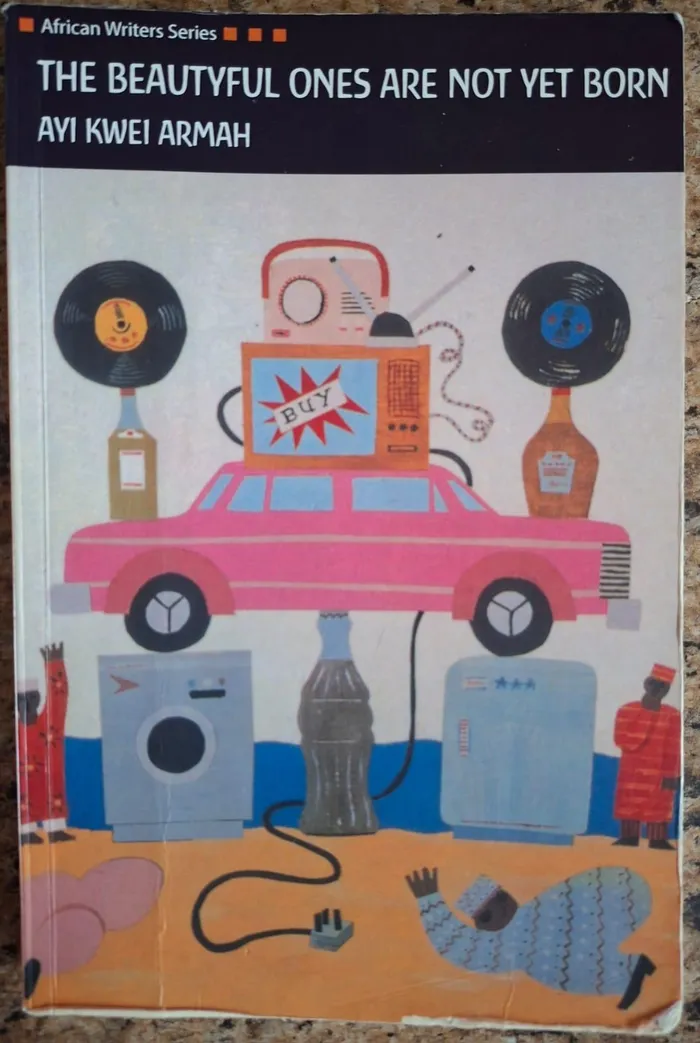
Ghanaian scholar Ayi Kwei Armah's 'The Beautyful Ones Are Not Yet Born' is an illuminating and seminal analysis, published a decade after Ghana’s independence, symbolising the failures of post-colonial African states and the lack of will among their political leaders to deliver on the people’s aspirations and the promises of the liberation project, writes Orapeleng Matshediso.
Image: Supplied
Fifty-eight years ago, Ghanaian scholar Ayi Kwei Armah wrote the novel “The Beautyful Ones Are Not Yet Born”. His illuminating and seminal analysis, published a decade after Ghana’s independence, symbolises the failures of post-colonial African states and the lack of will among their political leaders to deliver on the people’s aspirations and the promises of the liberation project. But before I review, let me correct the historical record: Ghana (1957) was the second, not the first, African state to attain independence; the first was Sudan in 1956.
Essentially, novels provide avenues for us to dissect and reflect on a specific society or country, to draw valuable lessons for the present and, subsequently, for future generations. Armah narrates an allegorical story about a nameless protagonist called the Man. This man, a railway clerk, struggles to fit into a society and a country engulfed in moral decay, filth, dilapidated infrastructure, political patronage, poor service delivery, and rampant corruption involving both ordinary citizens and post-colonial leaders in Ghana under the presidency of Kwame Nkrumah.
The author presented post-colonial Ghana, marred by moral decay and social ills that defined its social fabric. For example, the corrupt bus conductor and the taxi driver belittled and insulted the protagonist, a family man. The man was also berated by his wife and mother-in-law for refusing to engage in corruption to provide a better life for them, as his salary was insufficient to cover the high cost of living.
It was revealed that Egya Akon, an innocent man, was assassinated by gangsters at his house, who were never arrested. Those in political power could use state machinery to protect some perpetrators, further abuse their authority, and exploit the unemployed and people with low incomes for their personal gratification with impunity.
According to Armah, the failure of President Nkrumah’s liberation movement, the Convention People’s Party (CPP), to create decent jobs for the working class led characters such as Kofi Billy, from the working class (the impoverished section of society), to work for the British white man, who was exploited, when he was injured on duty and lost a leg, instead of his employer assisting him, he was told he deserved it. Because Billy could not access better health care and trade union representation, he replaced his leg with a homemade wooden one. Later, he failed to cope psychologically with the unfortunate realities of his life and consequently committed suicide.
There was also a character called Maanan, who, due to poverty and unemployment, decided to venture into prostitution to survive. Both Billy and Maanan initially turned to drugs and alcohol in an attempt to forget their circumstances. More than sixty years after the dawn of independence in Africa, its contemporary societies are still engulfed by the same conditions that the novel's author reflected on.
At the beginning of the novel, the author exposes the filth, dilapidated infrastructure, and abandoned buildings. There was no strategy or commitment to cleaning the cities and towns. Waste was all over the streets, and the roads were in poor condition, with potholes everywhere in Ghana after a decade of independence. The sad reality is that the novel was written more than five decades ago, yet African states still face the same challenge.
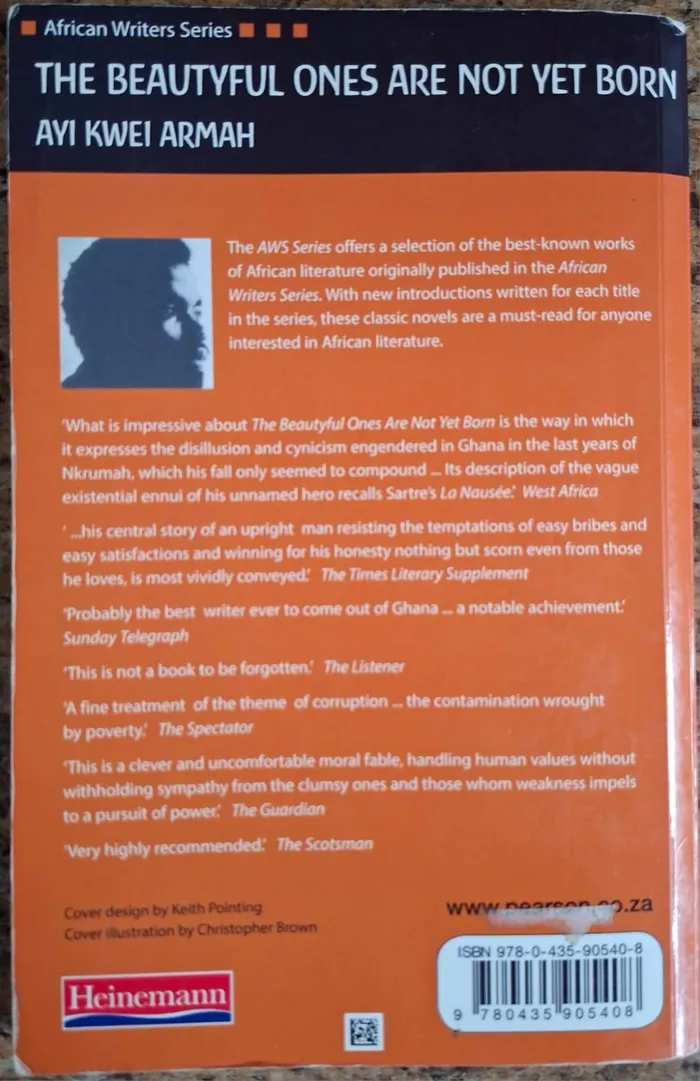
Ghanaian scholar Ayi Kwei Armah's 'The Beautyful Ones Are Not Yet Born' is an illuminating and seminal analysis, published a decade after Ghana’s independence, symbolising the failures of post-colonial African states and the lack of will among their political leaders to deliver on the people’s aspirations and the promises of the liberation project, writes Orapeleng Matshediso.
Image: Supplied
Ayi Kwei exposed a character named Minister Joseph Koomson, who was at the centre of political patronage, corruption, and the abuse of state institutions. This minister used Oyo, the protagonist's wife, to procure a finishing boat and later reneged on the agreement to share the proceeds, but the agreement never materialised. Once in a while, Oyo would be sent some fish, but the Minister kept accumulating more at her expense.
The rot was too deep in the country; some railway officials, except the man who refused to engage in corruption despite his low salary, used their positions to make corrupt deals with a timber businessman called Amakwa, and those in political power protected them. Outside government, a bus conductor also committed corruption, robbing illiterate passengers and older people; they would pay more and never receive their change.
For instance, an official at the Department of Education committed corruption. He was reported, but instead of being called to account, he was promoted and appointed as a supervisor at the railway station because of his connection to the governing party, the liberation movement (CPP). He continued to engage in corruption alongside Abednego Yamoah, who was stealing state petrol and selling it with impunity.
The author reveals that officials in law enforcement agencies, such as traffic and police officers, were captured and could accept bribes to arrest only those who were not politically connected. Corruption was normalised, but, amazingly, only cleaners and messengers, junior officials, could be arrested and dismissed from their work.
According to Armah, the health department took advantage of the filth and launched a cleaning campaign. Waste boxes were procured at an inflated price, and in numerical terms, what was delivered still fell short of expectations. No action was taken, nor was prosecution initiated, because the perpetrator was the Minister of Health's secretary. It was furthermore stated that Minister Koomson has also used his influence and position to secure a scholarship for his sister-in-law in London. I argue that this unfortunate situation is prevalent not only in Ghana but also across many other African countries.
The fact that the author asserts that, generally, citizens were using public transport and could not afford to buy cars, and that many were selling food on the streets for survival because of the high level of poverty and unemployment, shows that leaders who took over from the colonial British administration failed to transform the colonial economic architecture that bred inequality and abject poverty, which continue to define social relations in contemporary societies.
This existential colonial-economic setting is evidenced by the author’s presentation of the export of Gold and Manganese to European countries; it is disheartening that Africa’s resources are exported to enrich the colonialists and their captured political elites. Interestingly, in the novel, the author used the Atlantic Caprice Hotel as a centre for business deals and corruption. In South Africa, we had the Saxon world and have new ones, where political leaders discuss factional decisions, business deals, and deployments. Seemingly, Conferences of political parties are ceremonially and symbolically convened to endorse engagements held in hotels.
Colonialism has affected the psychological profile of many Africans, and Armah demonstrated this by showing that Estella, the wife of the corrupt minister Koomson, rejected African beer and said she only drinks beer from European countries. The Koomson family has further refused to send their children to state-administered public schools, and their children have no African names; to them, the best schools are the ones administered and owned by the former colonisers.
Kwame Nkrumah was a great African leader, but unfortunately, his political party, the Convention People’s Party, was overthrown by military coups in February 1966 because he had entrusted authority to, or appointed, people with no integrity or capacity to positions of power within the state. As we commemorate Africa Day, we must, as Africans, pause and reflect on the vision laid out by the leaders who gathered on May 25, 1963, on the formation of the continental organisation (Organisation of African Unity), now known as the African Union, and consider how the implementation of the AU Agenda 2063 resonates with that blueprint.
Indeed, in this age of fragmentation, Africa, facing a poly-crisis, needs strong leadership that would protect and defend the sovereignty of African states and further transform and renew state institutions to address colonial legacies, respond to the immediate needs of impoverished sections of society, and address the challenges of migration and immigration.
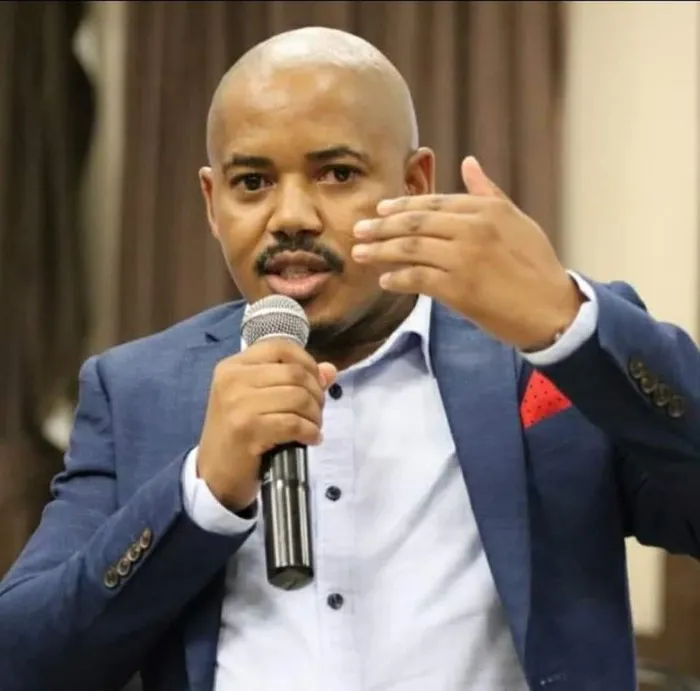
How does Ayi Kwei Armah's 'The Beautyful Ones Are Not Yet Born' reflect the ongoing struggles of post-colonial Africa? Orapeleng Matshediso's review delves into the novel's critical insights on governance and societal decay.
Image: Supplied
* Orapeleng Matshediso is a Research Fellow at the University of Johannesburg (Institute for Pan-African Thought and Conversation).
** The views expressed do not necessarily reflect the views of IOL or Independent Media.