

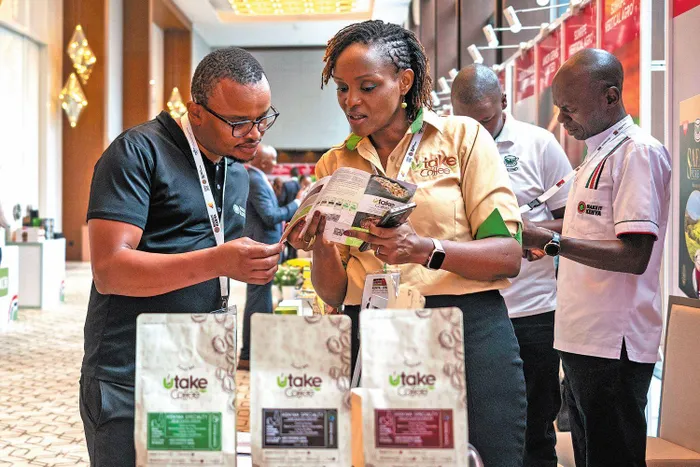
Visitors at the China-Kenya Business Forum learn about Kenyan coffee in Nairobi on March 23. The event focused on China’s decision to grant zero-tariff access from May 1 to African goods.
Image: Picture: XIE JIANFEI / XINHUA
China’s expanded zero-tariff policy on African goods will significantly boost exports from the continent to the world’s second-largest economy, helping African economies diversify exports and move up the value chain, economists and foreign trade companies say.
From May 1 China extended zero-tariff treatment to all African countries with which it has diplomatic ties, becoming the first major economy to offer unilateral, full zero-tariff access to its African partners.
Under the new measure, preferential zero-tariff treatment is being applied to imports from 20 African countries that are not classified as least developed countries between May 1, 2026, and April 30, 2028, according to the Customs Tariff Commission of the State Council.
This move comes after China had granted zero-tariff treatment on 100 per cent of tariff lines since December 1, 2024 for 33 least developed African countries with which it maintains diplomatic relations.
Jervin Naidoo, an analyst covering Africa with the British think tank Oxford Economics, said that by removing tariffs China aims to make African exports, especially agricultural products, more competitive in its domestic market, as Chinese demand for coffee, cocoa, citrus and avocados continues to rise, positioning African producers to benefit from improved market access.
“While the immediate gains will be most visible in agriculture, the broader opportunity lies in enabling African economies to diversify exports and move up the value chain,” Naidoo said. “If supported by the right domestic policies, this could accelerate industrial development and deepen integration into global supply chains.”
Guo Xueyan, director-general of the department of international co-operation of the General Administration of Customs, said lower tariffs will make African products more competitive in China, and rising exports will help African countries expand production and create jobs.
The value of China-Africa trade rose 22.8 per cent to $126.85 billion in the first four months of the year compared with the corresponding period last year, the administration said.
Foreign trade companies said China’s favourable tariff policy is accelerating imports of African energy, coffee and agricultural products and deepening trade and supply-chain ties.
African countries’ abundant natural gas resources and mature processing technologies, such as those of Nigeria and Algeria, make their low-impurity liquefied propane highly competitive in global downstream markets, Huangpu Customs in Guangdong province said.
“African energy products have become increasingly cost-competitive in recent years,” said Li Chaohong, vice-president of Jovo Energy Co Ltd (Dongguan), a seller of petroleum products in Dongguan, Guangdong province.
“Combined with the latest zero-tariff policy, import duties on liquefied propane have been cut from 5 per cent to zero, making African supplies even more competitive than some traditional Middle Eastern cargoes.”
The company says it plans to import two cargoes of liquefied propane from countries including Nigeria and Algeria soon, with expected tariff savings of about 3 million yuan ($442,000).
In the first quarter of the year, the city of Kunshan, Jiangsu province, imported 650 million yuan worth of green coffee beans, 43.6 per cent more than in the corresponding period last year, maintaining its position as China’s largest coffee bean import hub. Kunshan’s imports from African countries accounted for 12.6 per cent of the country’s total green coffee bean imports, Nanjing Customs said.
Tan Wenquan, executive director of the food import and export firm Nanjing Kenbei International Trade Co, said Kenyan coffee beans are known for their strong acidity and rich fruity aromas, making them increasingly popular among Chinese.
Following implementation of the new policy, import tariffs on Kenyan-origin green coffee beans will be cut from the current 8 per cent to zero, saving the company an estimated 600,000 yuan in tariffs this year, Tan said.
Author: Zhong Nan