

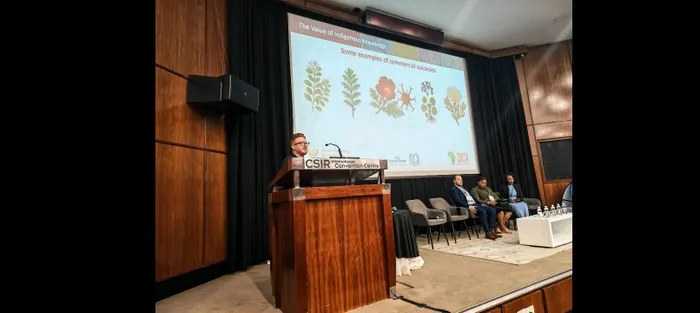
Dr Ryan Rattray from the University of Johannesburg said that South Africa has 21 539 plant species that can be harvested for various scientific studies because of their potentially valuable medicinal properties.
Image: Supplied
South Africa is well endowed with a variety of indigenous medicinal plants that have for many years sustained lives and contributed immensely to the country’s healthcare system particularly in the rural communities.
Experts say more than 70% of Black South Africans rely on traditional medicine or herbs for a range of ailments including respiratory infections, headaches and gastrointestinal complications.
They say this is an indication of the trust that most have on the indigenous knowledge systems (IKS) instead of the Western medicine or drugs.
In 2019, the Protection, Promotion, Development and Management of Indigenous Knowledge Act was signed into law. The Act is managed and implemented by the Department of Science, Technology and Innovation.
The Act ensures the protection of the vast treasure of South Africa's indigenous knowledge, and it recognises Indigenous Knowledge as intellectual property which must be protected.
It also protects the knowledge of indigenous communities from unauthorised use, misappropriation and misuse.
The question is how can technology be deployed in such a way that it can help integrate IK into the existing health practices and policies to better prepare for any future outbreaks of pandemics.
This and other related questions occupied the minds of science students, researchers and medical practitioners during a panel discussion at the South African Science Forum 2025), held at the Council for Scientific and Industrial Research in Pretoria.
Hosted by the Sefako Makgatho Health Sciences University, the conversation explored ways in which the traditional medicine practitioners can form part of the broader medical fraternity.
In addition, it looked into how to create partnerships and collaboration between the Western medicine and traditional indigenous herbs to augment and strengthen the country’s healthcare system.
The conversation also serves to amplify and reinforce the voice of traditional healers and indigenous plants experts who have for years been complaining that their contribution to the country’s healthcare system has undermined their contribution.
This even as a majority of people continue to rely on them for cure and treatment. It was widely reported that during the Covid-19 pandemic, the majority of people in Black communities resorted to the use of Artemis afra instead of vaccination.
Dr Ryan Rattray, who is based at the University of Johannesburg and was one of the presenters, pointed out that South Africa currently has 21 539 plant species that can be harvested for various scientific studies because of their potentially valuable medicinal properties.
He said the idea is not to replace traditional knowledge but to enhance it through collaboration with communities who have rich and deep knowledge about plants.
It was generally felt that technology and the IKS are not mutually exclusive but can draw on each other to create a robust and effective healthcare system.
Knowledge requires technology as the enabler while technology without serving a specific purpose has no value, the participants argued.
Dr Rattray also highlighted the importance of ethics, saying the use of technology to collect and analyse data should always be based on ethical consideration and inclusivity.
He said often researchers and medical practitioners do not get the buy-in from the communities when they collect data about some of the indigenous plants.
Not only is this unethical, but it also undermines the contribution and knowledge sharing from the local communities.
Participants suggested that part of including the communities, should entail the use of local languages or dialects to refer to some of the herbs or plants so that the locals can relate to them.
In addition, the elders or traditional healers should be used as part of experts to validate and vouch for the efficacy of the herbal products.
The panelists also emphasised the importance of not only working closely with local communities as key stakeholders, but also involving the youth. Youth must be educated and enthused about the need to appreciate the value of traditional herbs.
They need to be reminded that all the neatly packaged drugs that they see on the shelves of local medical stores come from the soil first.
South Africa boasts some of the most lucrative and commercially successful indigenous herbs and plants.
These plants have been used across generations and have proven to be effective in curing and treating some ailments. They include, among others:
Commonly known as African wormwood or umhlonyane, it is known to treat a wide range of ailments because of its anti-inflammatory, antimicrobial, pain-relieving, and anti-oxidant properties.
It is also well-known for treating coughs, colds, influenza, sore throats, asthma, and clearing blocked nasal passages.
In addition, the herb can be used for digestive and gastrointestinal problems such as heartburn, bloating, indigestion, colic, constipation and stomach cramps.
It is used as a herbal supplement to treat anti-inflammatory and pain relieving effects. The herb is also known to offer benefits in ailments such as osteoarthritis, back pain and general rheumatic pain. It is traditionally used to alleviate general muscle, joint, and rheumatic pain.
It is also a renowned indigenous South African herb whose leaves contain essential oils as well as flavonoids. Among some of its benefits are urinary tract cleansing capabilities.
It can be used to treat organs such as bladder infections and prostate inflammation or prostatitis. It also has anti-inflammatory and pain relief benefits, and can be taken as tea to calm stomach and other digestive related problems such as constipation and nausea, flatulence etc.
Other themes that came under the spotlight included the need to collect data on climate change and its impact on the indigenous herbs or plants.
To minimize the impact of climate change on the plants, communities need to be trained on how to develop adaptation strategies and also reduce over-harvesting.
Partnered Content